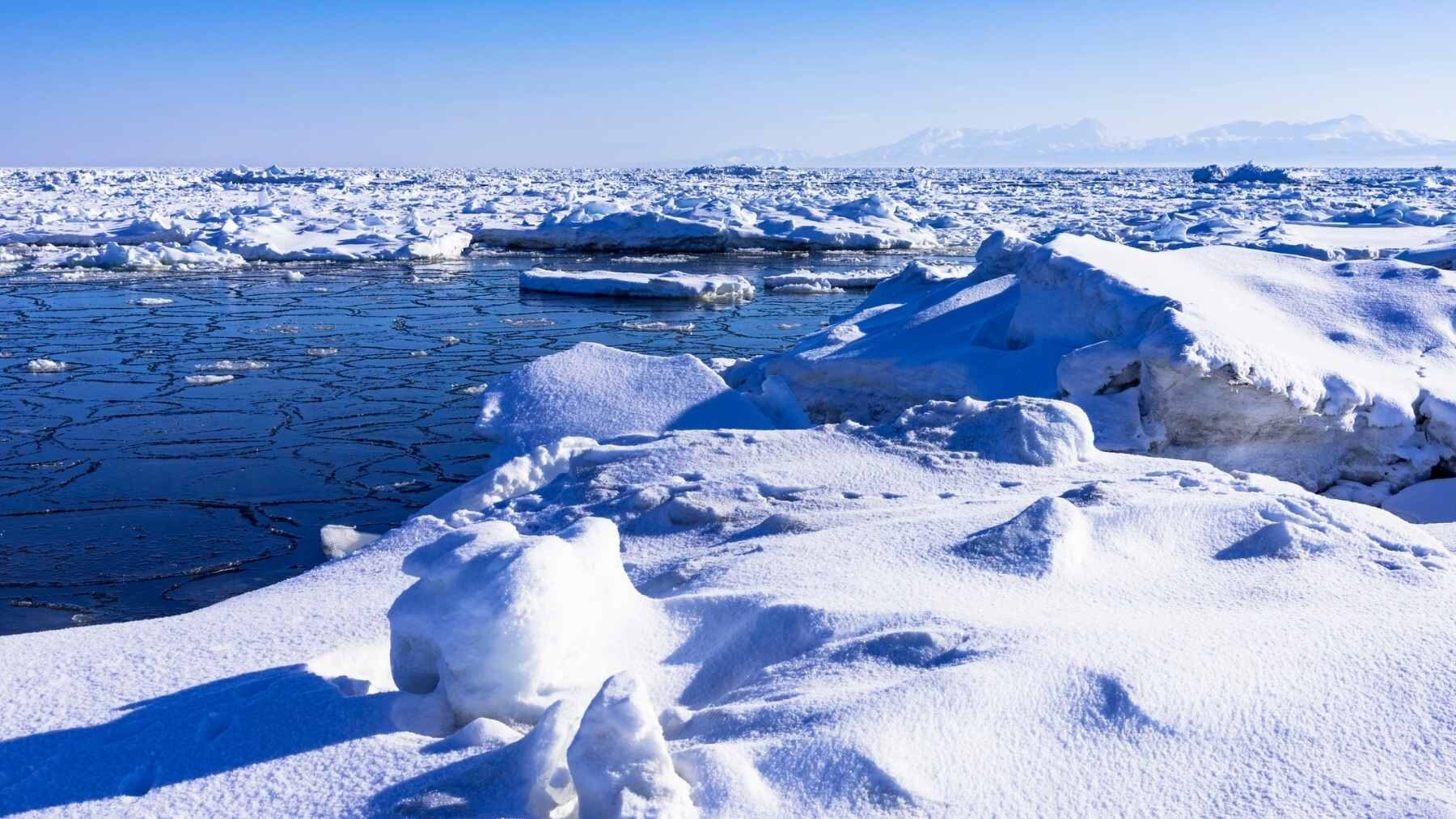
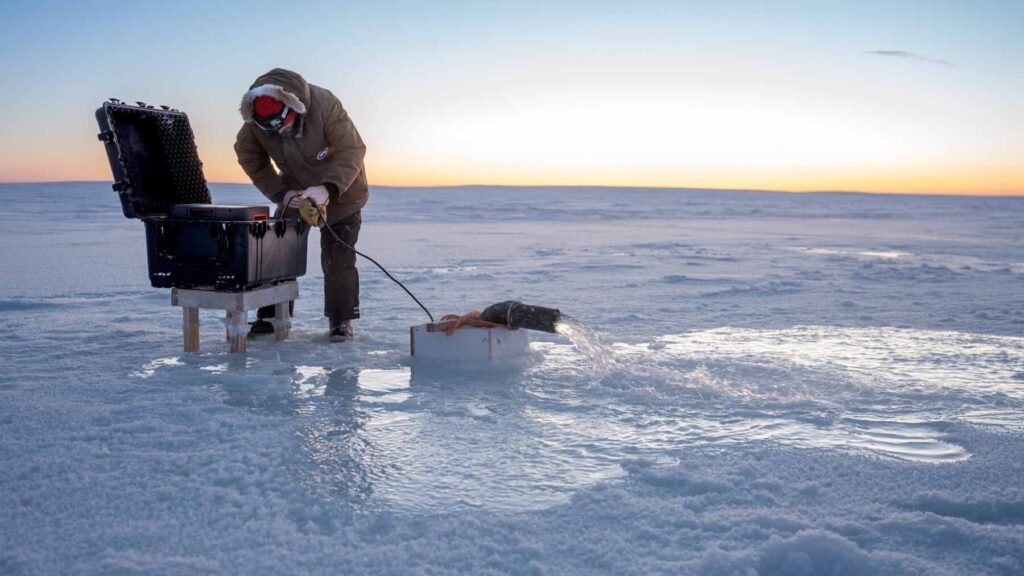
Scientists have completed the first full-season field test of a remarkably simple Arctic intervention. By pumping seawater onto existing winter ice in Cambridge Bay, Nunavut, they made treated areas up to 12.6 in. thicker, brighter, and slower to melt than untouched ice.
That is the encouraging part. The harder conclusion is that a method that works across a small research site may be extraordinarily difficult to deploy across an ocean, leaving its strongest near-term value in local adaptation rather than as a substitute for cutting greenhouse gas emissions.
A simple idea on real sea ice
The 2024 to 2025 campaign took place within a site measuring roughly 0.62 miles by 0.62 miles. Researchers established eight test areas and three control areas, then flooded the test ice once or twice with up to about 8 inches of seawater while leaving the controls alone.
It sounds almost too basic, rather like resurfacing an outdoor ice rink. The water soaked into the snow and froze into a new layer, while the wetter, thinner snow cover stopped acting like such a heavy blanket and allowed cold air to promote additional ice growth from below.
More than a foot of extra ice
By mid-May, the flooded areas were up to 12.6 inches thicker than the controls. Areas flooded twice generally gained more ice than those treated once, and the largest increase was similar to roughly 50 years of local thinning recorded near Cambridge Bay.
Could that difference survive the spring sun? For the most part, yes. The treated ice appeared brighter during the melt season, melted more slowly, and remained thicker than the untreated areas, while a separate test showed that drilling small holes could drain a melt pond and brighten the surface within about a week.
Brighter ice buys more time
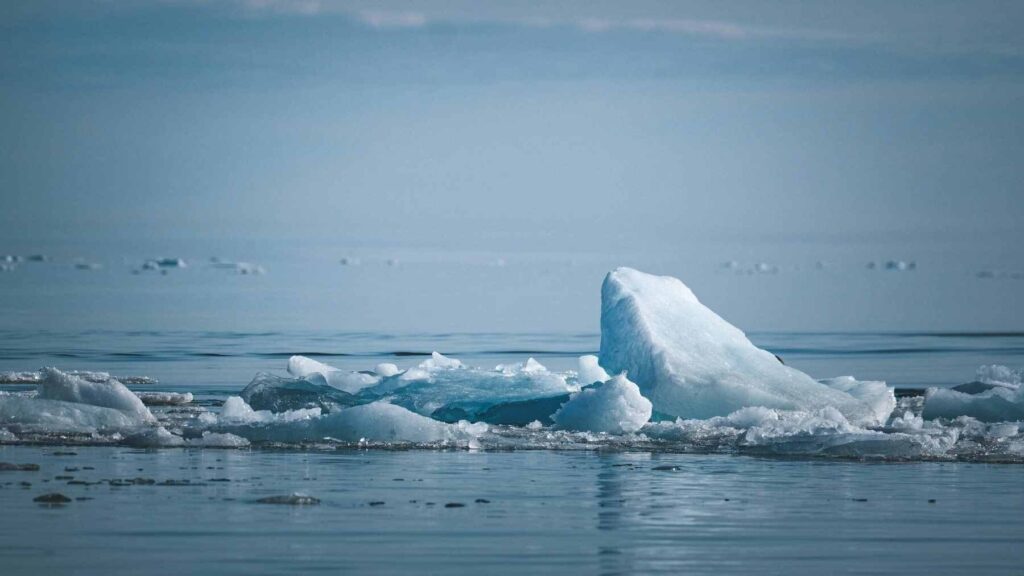
Brightness matters because pale ice reflects more incoming sunlight, while dark ocean water absorbs it. This is the Arctic albedo effect, and it helps explain why losing sea ice can reinforce regional warming once summer melt exposes more open water.
The experiment did not prove that flooding ice can cool the wider Arctic. It showed something narrower yet important: The physical mechanism works at field scale and can lengthen the life of treated ice. That distinction matters when a promising result starts sounding like a planetary fix.
The wider backdrop is sobering. Arctic sea ice has declined in every season since satellite monitoring began in 1979, and end-of-summer cover fell by about 12.1 percent per decade from 1979 through 2024 relative to the 1981 to 2010 average.
The pump problem is enormous
So why not repeat the Cambridge Bay experiment everywhere? An earlier engineering study estimated that treating only 10 percent of the Arctic Ocean could require about 10 million wind-powered pumps. Even before considering energy systems, spare parts, transportation, or crews, that number shows how quickly a neat field experiment turns into a vast industrial project.
The Arctic is also not an empty laboratory. Any large deployment would have to account for national jurisdictions, wildlife habitat, hunting areas, and travel routes used by Indigenous communities, while equipment would need to withstand shifting ice, storms, salt, and months of darkness. As the researchers acknowledged, “Deployment on anything but local scales would be challenging.”
Local protection may be more realistic
That does not make the technique useless. Sea ice thickening has long been used in northern regions to reinforce ice roads and working platforms, and a targeted version could potentially support safer travel, reduce erosion near vulnerable settlements, or help maintain specific routes used by people and animals.
A community might care less about changing the temperature of the entire Arctic than keeping one crossing usable for a few extra weeks. That is where this approach may have its clearest case, though only when local residents help decide where, whether, and how it is tested. The study itself stresses that “close collaboration with Arctic communities will be essential.”
What researchers still need to know
The first trial leaves major questions unanswered. Scientists still need to examine effects on salt movement, marine organisms, wildlife behavior, water circulation, noise, and the safety of operating equipment on unstable ice. Costs and maintenance demands also need real-world testing rather than optimistic assumptions.
There is another risk too. Arctic engineering can become a distraction if it is presented as an alternative to reducing carbon dioxide emissions, even though it cannot stop global warming on its own. At best, sea ice thickening may buy time in selected places while governments and industries tackle the source of the problem.
For now, the result is both hopeful and humbling. Researchers have shown that seawater can build thicker, brighter ice through an Arctic winter, but they have not shown that humanity can do it safely, affordably, or widely enough to protect the whole region.
The study was published in Earth’s Future.