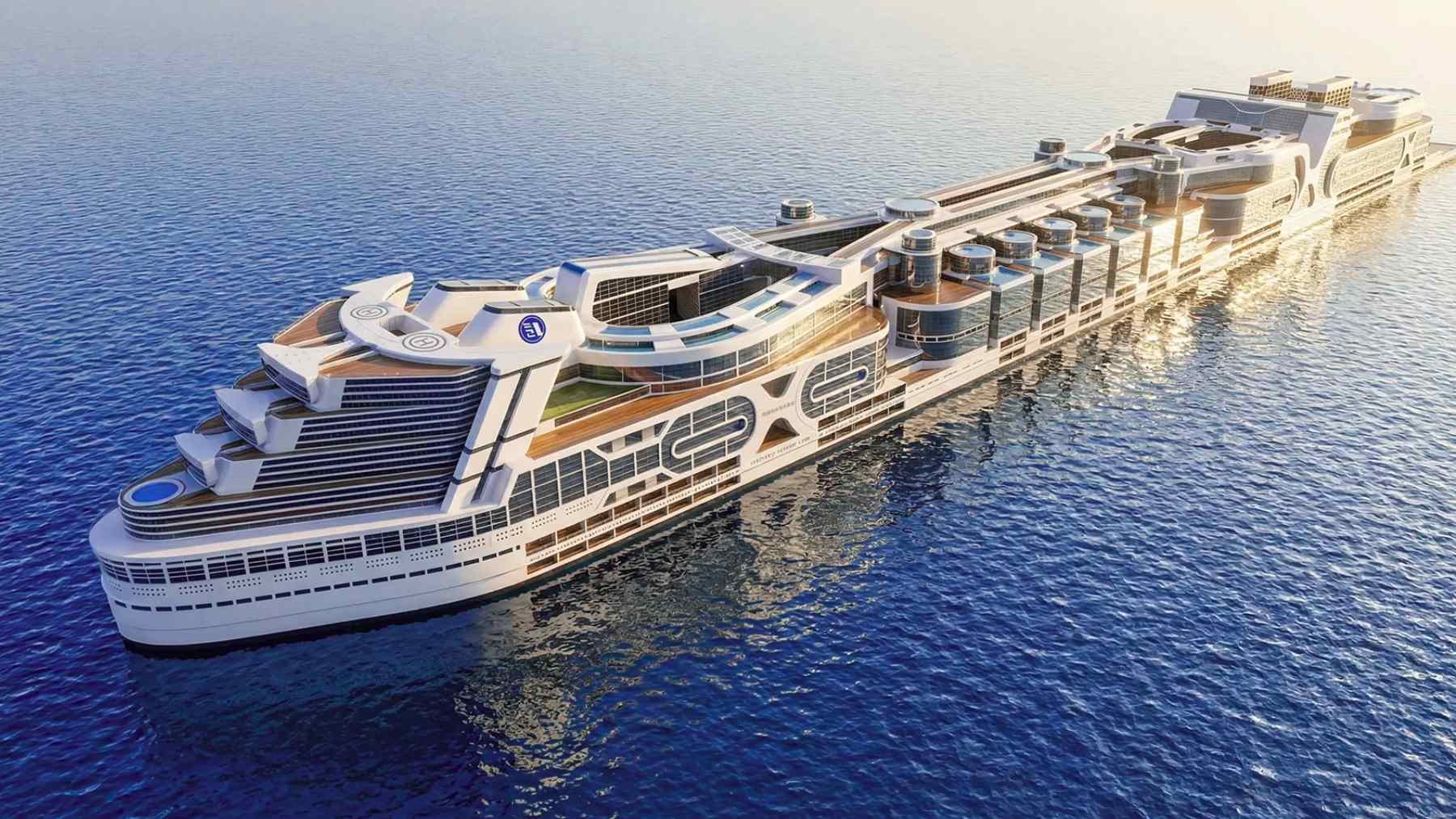
It sounds like something pulled from a science fiction movie. A vessel about one mile long, 800 feet wide, and 30 decks tall could one day carry up to 80,000 people across the world, with homes, schools, a hospital, shops, parks, and entertainment spaces all packed into one floating city.
The concept is called Freedom Ship, and its backers are again presenting it as a new model for life at sea. But for all the excitement, one question sits right at the center of the story. Can a floating city this huge really be called sustainable, or is it simply a bigger version of the cruise industry’s environmental challenge?
A city designed to move
Freedom Ship is not being described as a traditional cruise ship. The project’s official vision presents it as a “permanently mobile city at sea” built for long-term residence, with homes, workplaces, schools, health care, commerce, and public spaces integrated into one moving platform.
According to the official project statement, the vessel would exceed 2 million gross tons and would be roughly one mile long, 800 feet wide, and 30 stories tall. The earlier cost estimate of 12 billion British pounds works out to about $16.1 billion at current exchange rates.
What life onboard could look like
The proposal imagines daily life as if a small city had been lifted from land and placed on the ocean. Plans include hotels, restaurants, stores, banks, museums, a concert hall, a water park, a convention center, a nightclub, an aquarium, and a 15,000-seat sports stadium.
Children would be able to study from primary school through college-level programs, while medical services and research facilities would also be part of the design. In practical terms, that means residents would not just be vacationing at sea. They would be working, learning, shopping, and living there.
Because of its size, Freedom Ship would not operate like a normal cruise ship pulling into every port. The proposal describes supplies, visitors, and passengers moving by ferries, visiting vessels, and aircraft, while the ship travels at around 7 knots, or just over 8 mph, and circles the globe roughly every two years.
The environmental test
Supporters say the project could reduce pressure on crowded ports and rely on cleaner systems. The official statement points to “advanced hybrid propulsion,” energy recovery, and water and waste management processes, while earlier descriptions have linked the idea to nuclear power and even ocean cleanup.
That is where the green promise gets complicated. Shipping already carries a climate burden, with the International Maritime Organization finding that total shipping greenhouse gas emissions rose to about 1.19 billion U.S. tons of CO2 equivalent in 2018, equal to 2.89 percent of human-caused global emissions.
A larger vessel can sometimes be more efficient per person than many smaller ones. But a permanent floating city would also need constant power for housing, hospitals, stores, cooling systems, waste treatment, food service, and basic comfort. Think of the electric bill for a city block, then put that block on the ocean.
Funding is still the big obstacle
Freedom Ship has a long history. The idea was first developed in the 1990s by American engineer Norman Nixon, who died in 2012, and it has been revived and shelved several times since then.
Roger M. Gooch, CEO and Director of Freedom Cruise Line International, is now leading the effort. The company’s investor page describes the ship as a “long-term development project” that requires patient capital, technical validation, governance, and a multi-phase approach.
Gooch has said there is enough interest that the company could “almost justify building three ships,” but he also acknowledged the central problem. “We are very confident that we can get it done, but capitalization is key,” he said.
Construction would be its own experiment
If the money is secured, the proposal says construction would begin in Indonesia, starting with the hull. The structure would be built in sections before being assembled at sea, with the full process expected to take three to four years.
Some residents could reportedly move in before the vessel is fully finished. That detail alone shows how unusual the project would be, since construction, maintenance, real estate, transportation, and public services would all overlap on the same moving platform.
And that raises another issue. A city at sea does not escape environmental responsibility just because it floats beyond the coastline.
Offshore life brings offshore questions
Keeping a massive vessel offshore might reduce congestion in smaller ports, but it would also create a constant need for ferries, aircraft, supply boats, fuel systems, food deliveries, and waste handling. Those movements bring traffic, noise, exhaust fumes, and operational risks.
There are also regulatory questions. The idea that medical research, business activity, or waste systems could operate offshore beyond certain land-based restrictions may sound attractive to investors, but it also demands clear oversight. The ocean is not empty real estate.
Why the idea keeps returning
Floating architecture is gaining attention as coastal cities face rising seas, population pressure, and climate adaptation challenges. Freedom Ship’s chief design architect, E. Kevin Schopfer, has worked for years on floating architecture and maritime urban design concepts connected to sea-level rise and dense urban growth.
Still, Freedom Ship is not a proven climate solution yet. For the most part, it remains a massive private infrastructure proposal with ambitious renderings, big numbers, and unanswered environmental math.
At the end of the day, the project will not be judged only by its stadium, schools, or ocean views. It will be judged by whether its energy use, emissions, waste systems, financing, and legal structure can stand up to public scrutiny.
The official statement was published on Freedom Ship.