Paul Byrne has measured how much Mercury has shrunk. In 2014 his team put the loss at up to 7 kilometers of the planet’s radius, a little over 4 miles, in a paper titled “Mercury’s global contraction much greater than earlier estimates.”
The estimate has grown again. In a paper published Sept. 10 in Geophysical Research Letters, a team led by Gaku Nishiyama of the German Aerospace Center reported that the planet’s radius has shrunk by 11.6 kilometers (7.2 miles) as it cooled. The team says counts of the wrinkles on Mercury’s surface have underestimated the shrinking by 10 to 30 percent, because some of them are missing from the roughest ground.
Byrne, an associate professor at Washington University in St. Louis, wasn’t part of the study. The test, he told CNN, will come from BepiColombo, a European and Japanese spacecraft. It is due in orbit around Mercury on Nov. 21, by the European Space Agency’s schedule.
“Those new data will be key to testing whether this and other global contraction papers are right,” Byrne said. “But I suspect we’ll find that they are, and that we still have so very much to learn about the tiny innermost planet.”
A release from the American Geophysical Union, which publishes the journal, doubles the figure into “a total change of up to 14.5 miles (23 kilometers) in the planet’s diameter” since Mercury formed, around 4.5 billion years ago. NASA gives Mercury’s radius as 1,516 miles, so the 7.2 miles are less than half of 1 percent of it.
The paper’s conclusion gives two figures. The contraction, it says, “is larger than 6.9 km, and may be larger than 11.6 km if all shortening structures are related to global cooling.” Shortening structures are the wrinkles. The lower figure, about 4.3 miles, is roughly where Byrne’s 2014 ceiling was.
Impact debris may be hiding the wrinkles
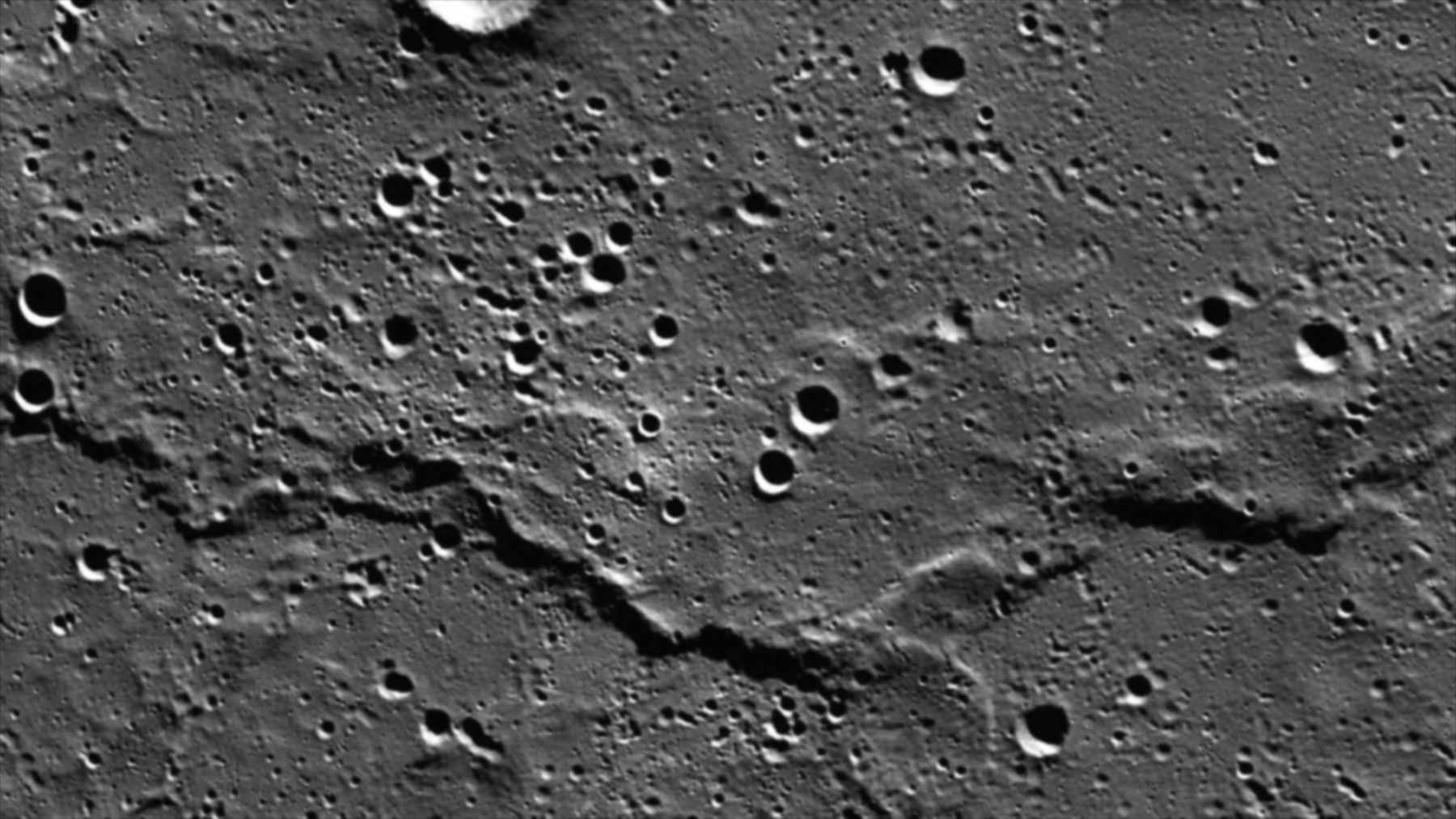
Mercury shrinks because it cools. As the inside loses heat it contracts, and the rocky crust buckles into ridges and cliffs, “some hundreds of miles long and soaring up to a mile high,” the same NASA page says. Scientists add up how much crust the wrinkles took in to get the amount of shrinking.
Nishiyama’s team laid a map of those wrinkles over a new map of how rough the ground is, built from data from NASA’s MESSENGER spacecraft, which orbited Mercury from March 2011 until its mission ended on April 30, 2015. The roughest ground had the fewest wrinkles.
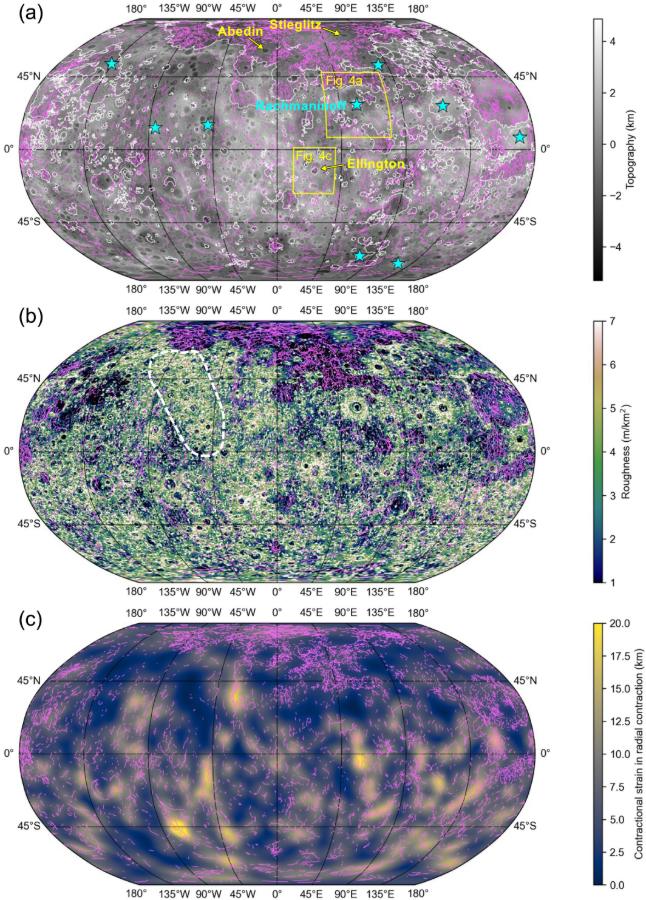
“It made us think that there’s a process obscuring shortening structures,” Nishiyama said in the release. He thinks debris thrown out by impacts could be covering the wrinkles in rough areas, the release says, and it compares that to fresh gravel hiding the ruts in a road. It’s one of three explanations the paper considers.
So the team used the smoother ground, where the record looked complete, as the yardstick for the whole planet. Counting all the wrinkles that have been mapped, the paper gets 8.3 kilometers (5.2 miles) of lost radius. With the correction it gets 11.6.
The top of the 10 to 30 percent range can be checked against those numbers. The 3.3 kilometers the correction adds, about 2 miles, are 28 percent of the corrected total.
The estimates haven’t all moved the same way. The new paper cites a 2021 analysis by Watters that put the loss at only 1 to 2 kilometers (0.6 to 1.2 miles), well under Byrne’s figure from seven years earlier. The difference between the two, the paper says, depends on how the small wrinkles are interpreted.
| Lost radius | Source and kind of figure |
|---|---|
| Up to 7 km (4.3 miles) | Byrne and colleagues, 2014, upper estimate |
| 1 to 2 km (0.6 to 1.2 miles) | Watters, 2021, range cited in the new paper |
| More than 6.9 km (4.3 miles) | Nishiyama and colleagues, 2026, the floor in the paper’s conclusion |
| 8.3 km (5.2 miles) | Nishiyama and colleagues, 2026, all mapped wrinkles before the correction |
| 11.6 km (7.2 miles) | Nishiyama and colleagues, 2026, after the correction, “a lower bound” |
What the bigger number can and can’t say
Scientists read the inside of the planet from that number. Contraction, the paper says, “reflects the net cooling of the interior and growth of the solid inner core.”
“More shrinking means Mercury could have a larger metal core, less light elements like silicon mixed into the metal core, or a higher starting temperature,” Nishiyama said in the release.
The release quotes him separately on the size of the correction. “30% is a little bit surprising, but the corrected amount of contraction actually makes sense to me,” he said.
The paper sets limits on its own figure. It says the correction “should be considered as a lower bound,” where the release words it as “up to.” It also says a definitive conclusion on the cause of the missing wrinkles is hard to reach. Debris may have buried them. The rough ground may make them too hard to pick out. Or the battered, porous crust there may never have cracked into big faults at all.
The figure also depends on whether the small wrinkles are signs of global cooling. If only the main ridges are counted, the paper says, the correction adds just 0.6 kilometers, about 0.4 miles.
Byrne told CNN it’s plausible that earlier studies, including one of his own, missed cracks because they were hard to see in rough areas or because they never formed in Mercury’s rugged crust.
Hannes Bernhardt, an assistant research scientist at the University of Maryland who is working on his own estimate, told CNN he found the paper’s method and results compelling and sound. He also said he believes a decrease that dramatic would have set off visible large-scale buckling across the planet’s surface.
One of the outside scientists CNN quoted, geologist Kelsey Crane of Seres Engineering and Services in Charleston, South Carolina, is thanked in the paper’s acknowledgments for review comments.
The Moon may be hiding some too
The paper ends with the Moon. Its highlands are 40 percent rougher than Mercury’s cratered plains at a scale of 10 kilometers (6.2 miles), and maps of lunar wrinkles have suggested the Moon shrank by less than 1 kilometer (0.6 miles), less than models of its cooling predict. The authors say wrinkles hidden by roughness may explain the gap, and that Mars could be subject to the same effect.
A third spacecraft is due in November
BepiColombo, launched Oct. 20, 2018, is due to enter orbit on Nov. 21, split into its two orbiters on Dec. 9 and 10 and begin its science phase in April 2027, the European Space Agency says. The geophysical union’s release says it will begin collecting sharper scans in November, five months before the science phase on the agency’s schedule. Nishiyama is part of the mission’s science team, the release says.
It is only the third mission to Mercury, according to the release. NASA’s Mariner 10 photographed nearly half of the surface in three flybys in 1974 and 1975, and Bernhardt told CNN those flybys revealed the wrinkles. MESSENGER mapped the entire surface in images, NASA says, but the paper notes that its most accurate topography, from a laser altimeter, is mainly limited to the north polar region. Crane told CNN that one of BepiColombo’s orbiters will also measure topography and roughness across the southern hemisphere.
| Mission | At Mercury | Surface covered |
|---|---|---|
| Mariner 10 (NASA) | Three flybys, 1974 and 1975 | Nearly half, in photos |
| MESSENGER (NASA) | In orbit, 2011 to 2015 | All of it in images, with the best topography near the north pole |
| BepiColombo (Europe and Japan) | Due in orbit in November 2026 | Global topography expected, the south included |
The detail is expected to change as well. The release says MESSENGER data can be used reliably only for features more than about 3 miles (5 kilometers) across. The study’s roughness map works at a scale of 10 kilometers, and the paper says BepiColombo’s laser altimeter will map roughness at scales as short as 100 meters, about 330 feet.
Byrne told CNN the new mission will make the first comprehensive global measurements of Mercury’s topography, something MESSENGER couldn’t do.
Bernhardt told CNN that data from orbit alone might not answer the question.
“With all the things that government money can buy, maybe supporting our best engineers and scientists to put robotic boots into Mercury’s scorched dust is one of the most inspiring ones,” he said.