
Researchers at the University of Hawaii in Manoa will harness seawater from the oceans’ depth to produce steady amounts of renewable energy.
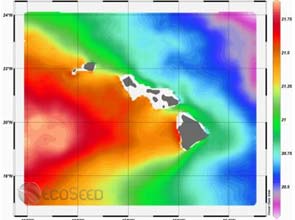
The western side of the Hawaiian Islands are said to be ideal for the application of ocean thermal energy conversion technology, which involves placing a heat engine between warm water collected at the ocean’s surface and cold water down below.
The technology converts solar radiation from the ocean’s natural thermal gradient, or the ocean layers’ different temperatures, into electricity. The flow of heat between the warm surface water and cold deep water is used to spin a turbine and generate electric power.
As long as the temperature between the warm water and the cold water differs by about 20°C, the technology can produce a significant amount of power.
The Hawaii National Marine Renewable Energy Center at the University of Hawaii has been studying the ocean thermal resource potential in the island. Analyzing data from the National Oceanic and Atmospheric Administration’s National Oceanographic Data Center, researchers found that the western side has a warm-cold temperature differential of about 1°C greater than that on the eastern side.
Albeit small, this difference translates to 15 percent more power for an ocean thermal energy conversion plant in the area.
The technology dates back more than half a century, but it has never really taken off because it is not cost-effective. However, the leeward side of the Hawaiian Islands, where temperature differentials are the greatest, will allow large ocean thermal energy conversion facilities to be the most cost-competitive.
With the oceans covering a little more than 70 percent of the earth’s surface, they are practically the world’s largest solar energy and storage system. On an average day, 60 million square kilometers of tropical seas absorb an amount of solar radiation equal to the heat content of about 250 billion barrels of oil.