
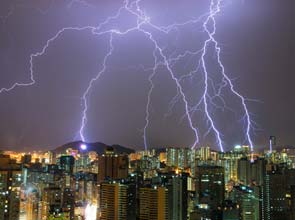
Rainy days might actually come in handy as a power source after Brazilian chemists from the University of Campas claimed they have figured out a 200-year-old riddle about how moisture in the atmosphere becomes electrically charged.
The team, lead by Fernando Galembeck, said that it was possible to develop a device that can harness charges of electricity straight from the atmosphere, allowing homeowners to reduce their electricity expenses.
The idea of tapping naturally formed electricity has baffled scientists for centuries, back when workers received painful electric shocks after touching steam leaking from factory boilers. They once thought that water vapor remains electrically neutral, even after coming into contact with the electrical charges on microscopic particles of dust and other materials in the air.
This theory, called the principle of electroneutrality, is widely accepted by chemists, including the International Union of Pure and Applied Chemistry.
However, new data shows that water in the atmosphere does pick up an electrical charge. Mr. Galembeck, who is also a member of the union, told the New Scientist that while he does not dispute the principle of electroneutrality, he believes that water has ion imbalances that could allow it to produce a charge.
He and his colleagues confirmed this hypothesis by simulating water’s contact with silica and aluminum phosphate, both common airborne substances. They found that silica becomes more negatively charged when high levels of water vapor are present in the air, while aluminum becomes more positively charged.
«This was clear evidence that water in the atmosphere can accumulate electrical charges and transfer them to other materials it comes into contact with. We are calling this ‘hygroelectricity,’ meaning ‘humidity electricity,'» Mr. Galembeck said.
This discovery can lead to the development of hygroelectrical panels, which can be used to capture atmospheric electricity and route it to homes, businesses and even the power grid. Hygroelectrical panels are suitable in areas with high humidity, such as Northeastern and Southeastern United States and the humid tropics, he added.
Such devices can also be used to prevent lightning from forming and striking, Mr. Galambeck explained. The panels will drain electricity out of the air and prevent the building of electricity charge released in lightning.
The research team are already testing metals to determine which has the greatest potential in capturing atmospheric electricity and preventing lightning strikes.
«We certainly have a long way to go. But the benefits in the long range of harnessing hygroelectricity could be substantial,» Mr. Galembeck said.