
Britain has finally installed a pioneering and the largest test site in the world for connecting new kinds of wave energy technology designs to a power grid.
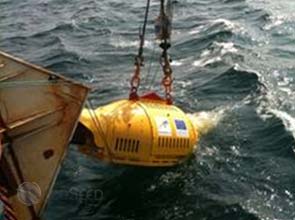
The 12-ton structure will allow developers of marine renewable energy projects to deliver their equipment’s power output to the grid. It will act as a giant grid-connected socket for devices that turn the energy of ocean waves into electricity. This will let developers know how their devices perform in real conditions out at sea.
The structure was lowered by the South West Regional Development Agency on the seabed under 55 meters of water 10 miles off Hayle town in Cornwall county.
Named the Wave Hub, it is funded with £12.5 million ($19.2 million) from the agency, £20 million from the European Regional Development Fund Convergence Programme and £9.5 million from the British government.
It has a 25-kilometer line linking the hub to the national grid that is capable of holding 20 MW of electricity. The £42 million project can connect four 5-megawatt marine energy installations at once.
The first devices for the Wave Hub will be installed next year. The first company that will plug into one of the slots is New Jersey-based Ocean Power Technologies. The company was awarded a £1.5 million grant from the British agency in July and another $1.5 million from the United States Department of Energy in April to improve its power buoy design.
The buoys are partly submerged, silent devices, a 150-kilowatt design of which is found off the northern coast of Spain under a contract with Iberdrola S.A.
The company plans to develop utility-scale 500-kW buoys with A&P Falmouth and the Peninsula Research Institute for Marine Renewable Energy, a partnership between the Universities of Plymouth and Exeter, which are all based in Britain.
Getting the hub to the site was hampered by a few delays after flotation devices that were meant to bring the 1,300-ton power cable safely ashore malfunctioned in two previous attempts last month.
The Wave Hub also overcame opposition in 2006 from surfers who feared it might lower the height of waves along the Cornish coast. Wave Hub is located 20 miles from Newquay, Britain’s surfing capital.
A recent report from Renewable U.K., a wind and marine energy group, estimated that Britain could harness up to 35 gigawatts of marine energy by 2050, representing over 20 percent of the country’s current consumption.
Energy from the waves and tides could be worth £2 billion by 2050 and create 16,000 jobs by 2040, said David Willetts, Britain’s science minister. He said 25 percent of the world’s wave and tidal technologies are being developed off the country’s shores.
“Wave Hub is a tremendously exciting development, and a truly world-leading project,” said Maria McCaffery, chief executive of Renewable UK. «It will focus global industry attention on Britain and put the South West firmly on the map in terms of marine energy research and development.”