
Google Inc. signed an agreement to finance an extensive subsea transmission cable network to be built around future wind power centers off the United States’ Mid-Atlantic coast.
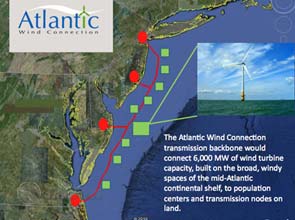
The Internet giant confirmed on Monday that it will invest 37.5 percent in equity in the initial development stage of the Atlantic Wind Connection, a network that upon completion will stretch 350 miles off the coast from New Jersey to Virginia and will be able to connect 6,000 megawatts of offshore wind turbine power.
Google joins other companies including project leader Trans-Elect, British company Good Energies and Japanese Marubeni Corporation.
Google did not specify how much its share was worth, but based on reports placing the entire project’s value at 500 billion yen (about $6 billion), the company’s share could be worth around $2.28 billion.
“We just signed an agreement to invest in the development of a backbone transmission project off the Mid-Atlantic coast that offers a solid financial return while helping to accelerate offshore wind development – so it’s both good business and good for the environment,” wrote Rick Needham, green business operations director at the company’s official blog.
If the envisioned underwater power network does connect 6,000 MW of electricity from offshore wind turbines, it will be able to power roughly 1.9 million households from 60 percent of the wind energy currently installed in the entire United States.
Securing transmission lines out at sea removes a major barrier to scaling up offshore wind, an industry that despite its potential only had its first federal lease signed last October 6 and still has no operating projects in the United States.
The lease was given to the controversial Cape Wind project after more than eight years of securing the necessary papers. Cape Wind will have an average expected output of 182 MW off Massachusetts’s Nantucket Sound.
Many coastal areas in the United States have large population centers, which also mean high energy consumption. The Mid-Atlantic region, for example, is home to six states that include Delaware, Maryland, New Jersey, Pennsylvania, Washington D.C. and Virginia.
These coastal states can take advantage of stronger and steadier winds offshore by using larger wind farms with larger turbines, Google said. Winds reportedly blow more than 60,000 MW of offshore wind potential in relatively shallow waters in the region that extend miles out to sea.
Google (Nasdaq:GOOG) also said it intends to contribute to the region’s transmission system congestion problem which it said could result in back-outs such as that of the Northeast in 2003 if not addressed. The Northeast blackout affected an estimated 10 million people in Ontario and 45 million people in eight American states.