
Turbines in wind farms should be placed farther apart from each other to achieve optimum power-generating efficiency according to scientists at Johns Hopkins University and Belgium’s Katholieke Universiteit Leuven.
Current designs of large wind farms commonly use turbines that have rotor diameters of 300 feet, and these turbines are typically spaced seven rotor diameters, or approximately 2,100 feet, apart from each other.
However, this wind farm layout limits the productivity of the wind turbines. “The early experience is that they are producing less power than expected,” explained Mr. Meneveau.
The new rationale of Charles Meneveau, a fluid mechanics and turbulence expert at Johns Hopkins, and Johan Meyers, an assistant professor in Katholieke Universiteit Leuven, calculates optimal spacing for a large array of wind turbines.
The researchers clarified that energy generated by a large wind farm is largely dependent on strong winds that turbines harness from higher atmospheric levels – contrary to the belief that horizontal winds are primary drivers of electricity generation in wind facilities.
Additionally, previous computational models for large wind farm layouts deal solely with the forces affecting single wind turbines.
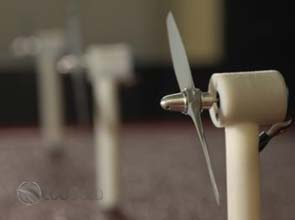
Mr. Meneveau and Mr. Meyers performed experiments using an array of miniature three-bladed wind turbines to imitate the interaction between full-sized wind turbines and air currents.
Initially, air passes through a curtain of perforated plates that rotate randomly to create turbulence and simulate real-life wind conditions.
The scientists used two high-resolution digital cameras, smoke and laser pulses to collect and measure the data.
They discovered correct spacing can allow wind turbines change the landscape to create turbulence, which stirs the air and helps draw more powerful kinetic energy from higher altitudes.
Placing the wind turbines 15 rotor diameters apart results in more cost-efficient power generation – twice more than what current wind farm designs dictate.
However, further research is still needed to know how different temperatures can affect power generation in large wind farms. Mr. Meneveau already applied for continued financing for further studies.