
But a new study led by Holly Gibbs, a Ph.D. researcher in the department of environmental earth system science in Stanford University, finds that big agribusinesses will have a big hand in ensuing this trend can be averted.
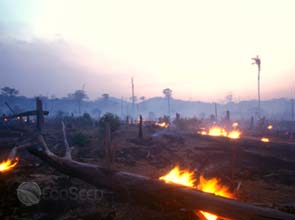
Around half a million square miles of new farmland was created in the tropics between 1980 and 2000, of which over 80 percent came from felling tropical forests, letting loose massive amounts of carbon into the atmosphere.
“The tropical forests store more than 340 billion tons of carbon, which is 40 times the total current worldwide annual fossil fuel emissions,” Ms. Gibbs explained. “If we continue cutting down these forests, there is a huge potential to further contribute to climate change.”
Ms. Gibbs and her colleagues at several universities analyzed Landsat satellite data from the United Nations and found that about 55 percent of tropical forests that had been cut in the past thirty years were intact forests and another 28 percent were forests that had experienced some degradation.
Burning forests releases a lot of carbon, but simply casting aside the trees can contribute to global warming, as the bulk of the carbon enters the atmosphere during decomposition.
However, the research team observed encouraging signs on how this trend can be slowed down.
During the 1990’s, large, corporate-run farms were more responsible for cutting down forests than small family farms that used to dominate the deforestation activities in the 1980’s. The researchers believe that big agribusinesses tend to be more open to global economic signals, as well as pressure campaigns from advocacy organizations and consumer groups, than individual farmers.
For instance, a campaign by Greenpeace and other organizations resulted in agreements by key companies to slow down the expansion of soy production, which caused direct forest clearing and pushed cattle ranching off pastureland and into forested areas. Instead, big businesses worked to increase production on land already in agricultural use.
“These farmers effectively increased the yield of soy on existing lands and they have also increased the head of cattle per acre by a factor of five or six,” said Ms. Gibbs. “It is exciting that we are starting to see how responsive industry can be to consumer demands.”
Ms. Gibbs also noted that improvements in technology and advances in yield intensification can slow the expansion of farming into forests. Other analyses on land use changes between 2000 and 2007 show that the pace of deforestation has begun to decelerate in some regions.
However, global agricultural production must continue to rise to keep pace with increasing population growth, likely leading to the cutting down of millions of additional acres of tropical forests over the next 40 years, the United Nations Food and Agriculture Organization estimated.
“It is critical that we focus our efforts on reducing rates of deforestation while at the same time restoring degraded lands and improving land management across the tropics,” Ms. Gibbs said.
Pressure from consumer groups and nongovernmental organizations combined with international agreements could shift the tide in favor of forest conservation rather than farmland expansion – as long as both big agribusiness and small individual farmers are willing to listen.
Ms. Gibbs’s complete study was published in the online Early Edition of the Proceedings of the National Academy of Sciences. The National Aeronautics and Space Administration provided that initial funding for the study, while Ms. Gibbs is currently funded by the David. H. Smith Conservation Research Fellowship.