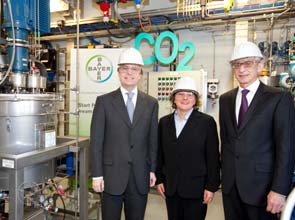
The pilot plant at Bayer’s headquarters in Leverkusen will convert carbon dioxide to polyether polycarbonate polyol. This and another essential component, propylene oxide, will be processed further to produce polyurethane, which Bayer primarily uses in making soft and rigid foams.
German utility RWE Power A.G. will provide carbon dioxide from its power plant in Niederaussem, where the chemical is separated from the flue gas through a carbon dioxide scrubber.
If testing is successful, Bayer said they will begin the industrial production of plastics using the new process in 2015.
The technology is the result of a collaborative research by Bayer and the German government, through the Education and Science ministries. The government subsidized about 55 percent of the 9 million-euro ($12 million) project.
Germany’s Minister for Science and Research Svenja Schulze said the project exemplifies successful cooperation between industry and universities on a central climate policy issue.
The new process will make carbon dioxide a raw material that will substitute petroleum as the chemical sector’s main source of the key element carbon.
“The debate on climate change has portrayed CO2 as the villain of the piece in the public eye. Now we are supporting research into alternative solutions that could make good use of CO2 as a raw material,” said parliamentarian state secretary Thomas Rachel.
Bayer said the use of polyurethanes as insulating materials in buildings can save around 70 times more energy over its lifetime than is needed to produce it.
The project was also supported by RWTH Aachen University, an academic partner of the Ministry of Education, and CAT Catalytic Center, which the university and Bayer jointly run.