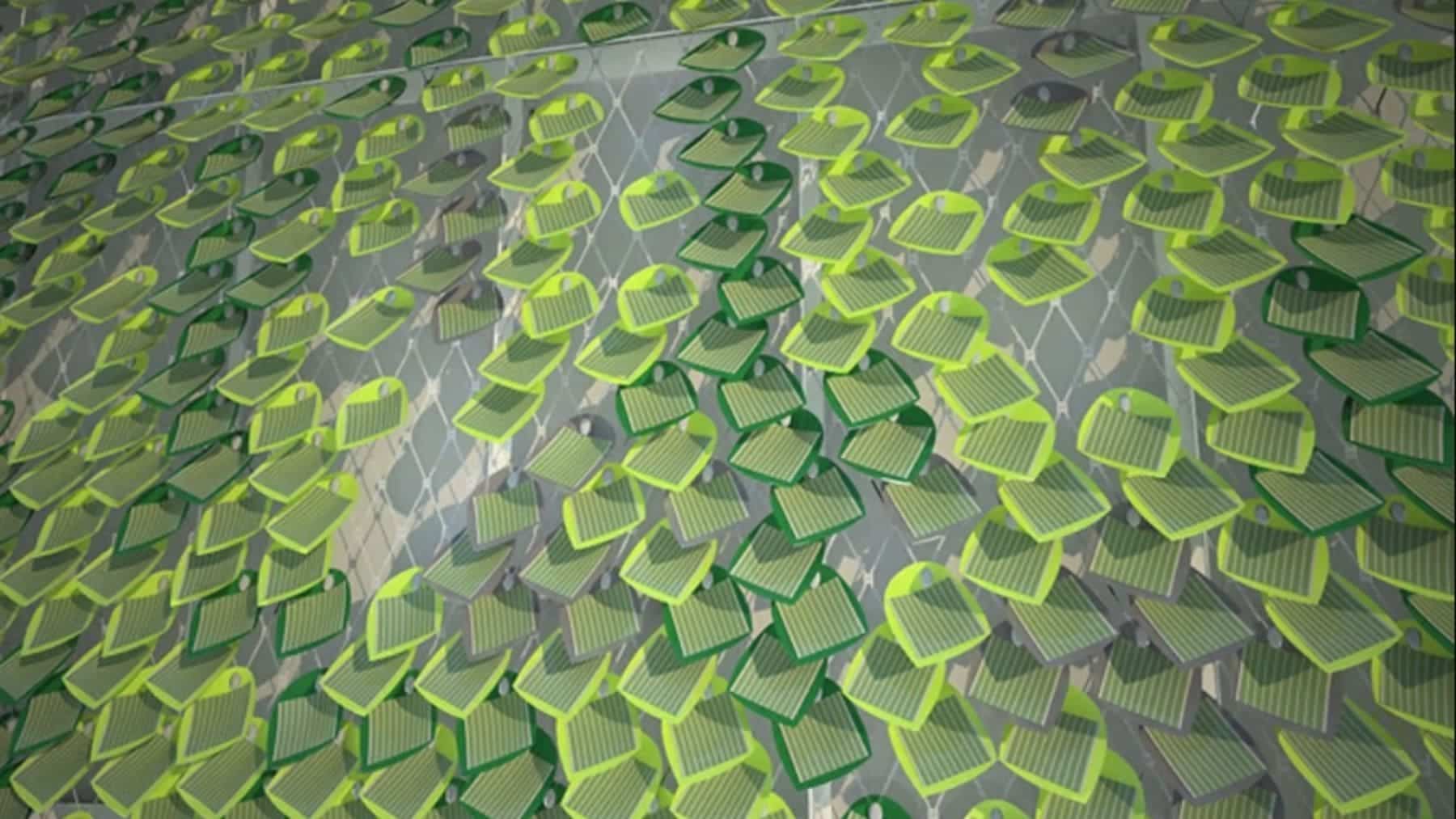
Said to produce 0,5 watts per leaf and offer 35 years of energy production, sustainable and aesthetic elements seem to go hand-in-hand for this project. Thus far, a new form of solar technology has taken root. Pulling out a page from nature’s design playbook, this solar innovation started as a graduate thesis and has grown into a rather flexible and beautiful technique to harvest solar energy. A vision that started approximately two decades ago is changing our perspective of renewable power and green architecture.
How does art meet renewable energy?
Grounded in sheer creativity came the thought of using solar panels to mimic plant life. Back in 2005, siblings Samuel and Teresita Cochran created a concept of Sustainably Minded Interactive Technology (SMIT) while developing their thesis. The creation by the siblings resembled ivy vines climbing a building and was not just an aesthetic gesture, it worked to integrate energy generation seamlessly into the built environment.
A solar energy solution inspired by nature: Solar Ivy
At this point, Solar Ivy offers a modular solar solution that draws inspiration from leaf-like photovoltaic panels attached to a steel mesh framework. The mesh is shaped in such a way that it curves around buildings or drapes like ivy across flat walls. Every leaf tends to be not only lightweight and flexible but also customizable in shape and color. In this way, homeowners and architects can incorporate them into the natural or built landscapes with hardly any disruption.
However, the system is not only about beauty. Every leaf includes a solar panel able to generate electricity. In terms of the leaves, three main types of leaves are available:
- Amorphous silicon leaves at $23 a piece, which generate 0,75 watts each.
- CIGS thin-film leaves use an efficient material that costs $21 per leaf and generates 4 watts each.
- Organic leaves that are made up of non-toxic materials, costing around $18 each, and producing 0.5 watts.
It is believed that a residential installation would utilize approximately 500 leaves, producing an average of 250 watts of energy that is able to power small household appliances, support lighting systems, or reduce dependency on traditional grid energy. Since each leaf is individually replaceable, the system offers scalability as well as long-term maintainability. Solar Ivy mixes innovation and endurance in a design that stretches to up to 35 years. However, leaf-shaped panels have often displayed bizarre behavior before.
Green energy in a green space
Solar Ivy’s most striking feature is its adaptability to novel environments. With all cities seeking to integrate renewable energy into the residential and public spaces without compromising on aesthetics, Solar Ivy provides a way forward. Soon school campuses, train stations, and urban gardens will boast solar foliage with each “leaf” quietly harvesting the sun’s rays.
As opposed to traditional panels, Solar Ivy offers the flexibility of working with nature. The installation process is relatively easy by utilizing a mesh base that could be applied to nearly any surface. The good news is that it is suitable for older buildings that cannot support heavy rooftop panels.
The best part is that the modularity of the leaves, which suggests that technology can be tailored to fit different climates, building types, and design goals. Imagine being able to simulate the look of autumn leaves whilst harvesting clean energy.
The first photovoltaic moss grows in your garden
The concept has evolved even further. Although record-breaking solar panels are leaf-shaped, this project is taking a new twist. While drawing inspiration from the moss-covered surfaces of gardens and urban walls, the next generation of this technology mimics not ivy, but moss. Being thinner, more densely packed, and designed for horizontal surfaces, the innovation seeks to bring the world’s first photovoltaic moss into everyday environments, including backyards and balconies.