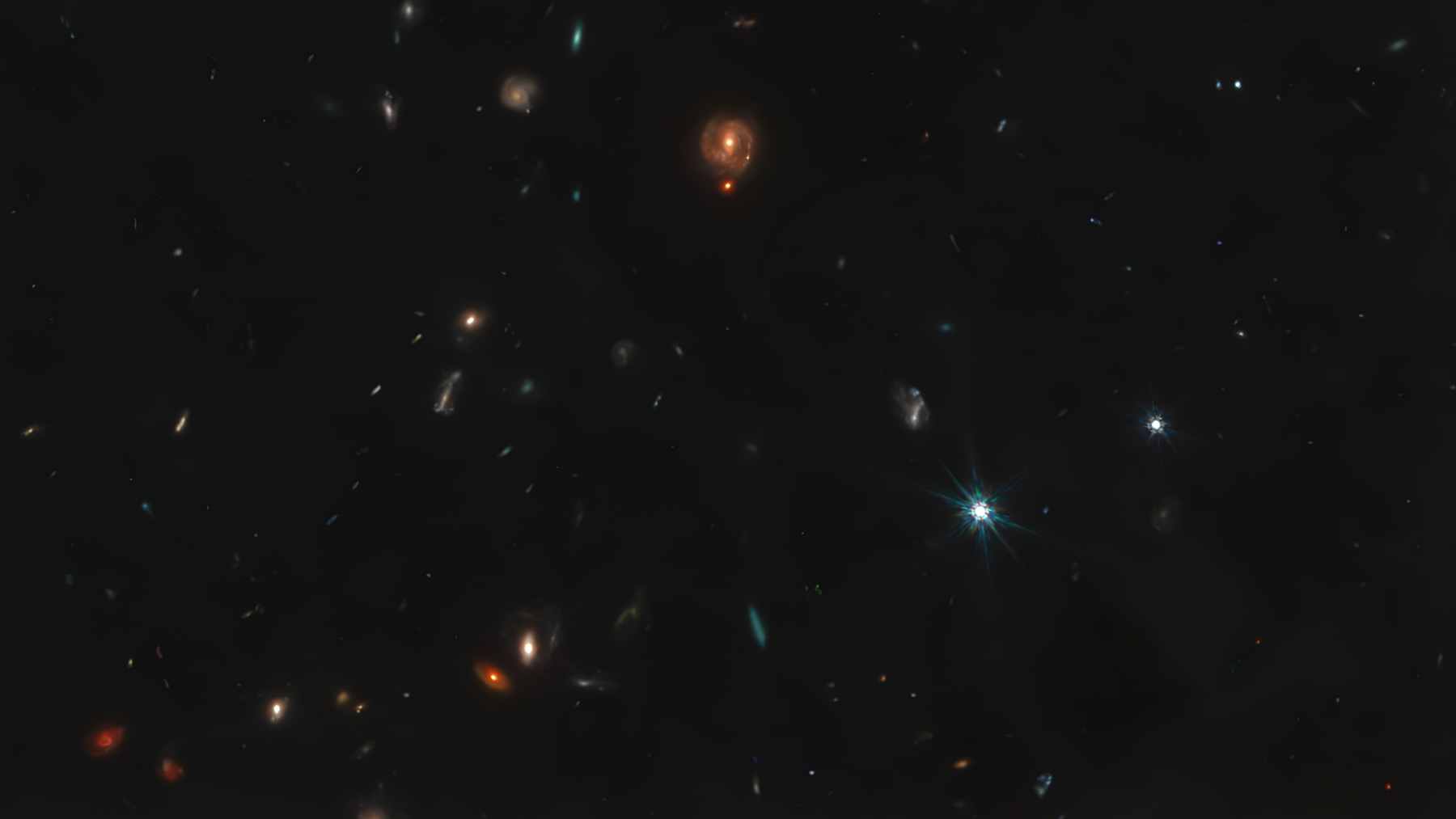
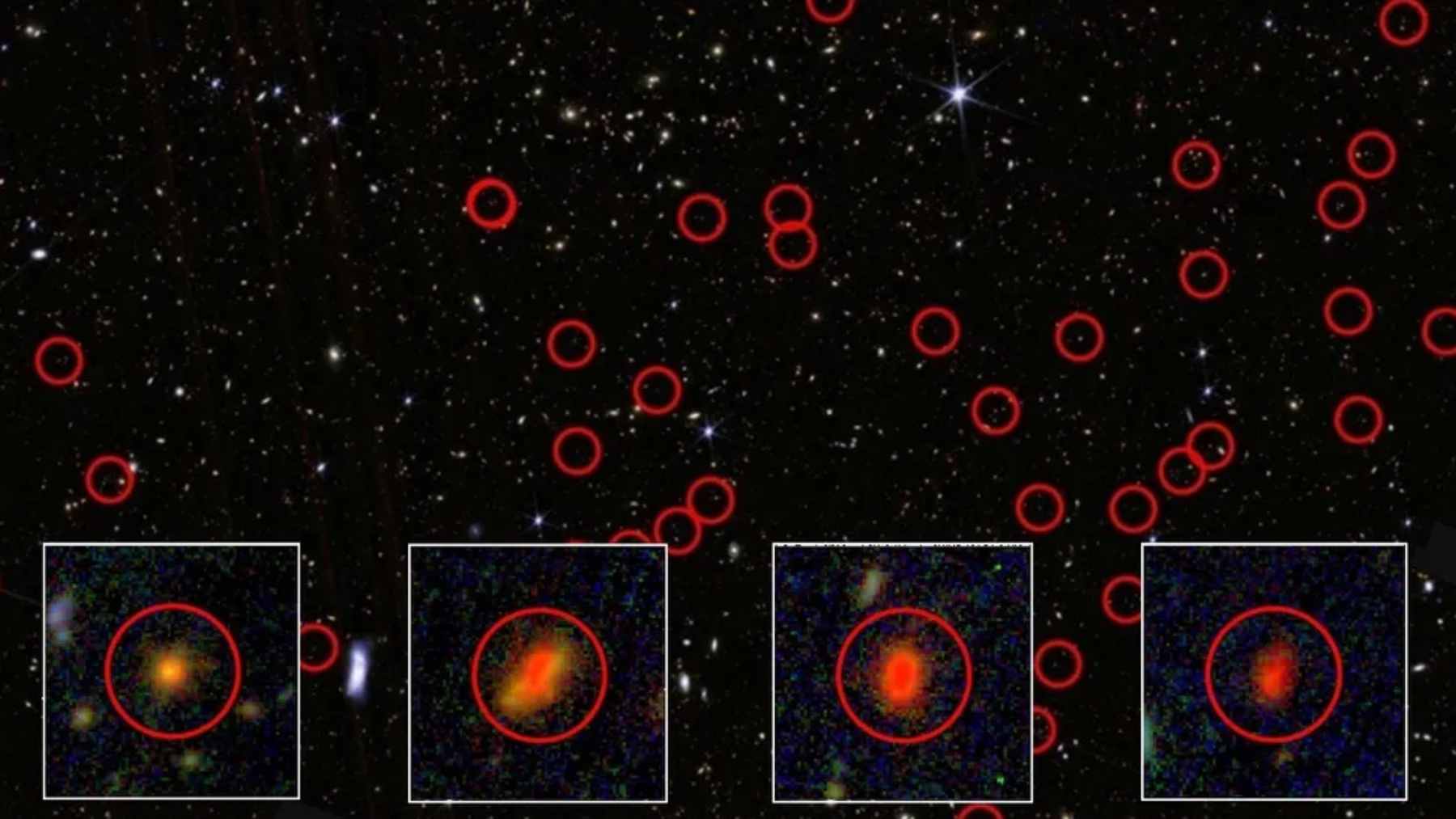
What if some of the strangest lights in the early universe were not giant, impossible galaxies at all, but young black holes hiding in plain sight? A new study based on James Webb Space Telescope data argues that many of the mysterious “little red dots” are compact galaxies powered by growing supermassive black holes wrapped inside dense cocoons of ionized gas.
The real breakthrough is not just that Webb found these objects. It is that researchers now think astronomers were reading their spectra the wrong way. Broad hydrogen and helium lines that looked like signs of gas moving at extreme speeds appear, in many of the best observations, to be shaped mainly by electron scattering inside extraordinarily dense gas.
That changes the whole story.
Why the little red dots matter
Since Webb began science operations, astronomers have spotted many tiny, bright, reddish objects that were especially common during the universe’s first 1.5 billion years. These sources looked compact, showed unusual colors, and often appeared surprisingly weak in X-rays and radio, which made them hard to fit into the usual picture of an active black hole.
That uncertainty mattered for a bigger reason. If most of their light came from stars, some of these early galaxies would have seemed uncomfortably massive and mature for such an early era.
On the other hand, if black holes were involved, astronomers still needed a better explanation for the odd spectra and the missing high-energy signals.
What Webb saw in the light
In the new Nature paper, the team analyzed 12 compact galaxies with high-quality JWST/NIRSpec spectra at redshifts 3.4 to 6.7, then added 18 more objects in a stacked spectrum.
They focused on the broad Hα feature (a key hydrogen fingerprint) and asked a simple but crucial question. Was the line width really tracing fast motion, or was the light being spread out by photons bouncing off free electrons in thick ionized gas?
The answer seems to favor scattering. In most of the strongest spectra, an exponential profile fit the line wings better than a Gaussian one, and the wings stayed remarkably straight and symmetric in the kind of test astronomers use to check line shapes.
It is a bit like a streetlight looking broader on a foggy night, where the glow spreads even though the lamp itself has not changed.
Smaller black holes with a faster growth spurt
Once the extra broadening from electron scattering is removed, a narrower intrinsic core appears underneath.
That pulls the estimated black hole masses down to roughly 100,000 to 10 million times the mass of the Sun, about two orders of magnitude below many earlier estimates. In other words, these objects may be young supermassive black holes, not impossibly oversized cosmic heavyweights.
As Darach Watson of the University of Copenhagen put it, they are “far less massive than people previously believed.”
The study adds that these may be the lowest-mass black holes yet identified at high redshift, and many appear to be accreting near the Eddington limit, which is what astronomers would expect from black holes in a rapid growth phase.
The gas cocoon may explain the rest of the puzzle
The numbers behind that cocoon are extreme. The study infers electron column densities of about 0.7 to 4.2 × 10^24 per square centimeter and sizes no larger than about 100 light-days, with some cases possibly shrinking to just a few light-days if the gas is even denser. In practical terms, that means a huge amount of power packed into a very small region.
That tight, dense cocoon could also explain why these sources often look oddly faint in X-rays and radio. The authors argue that the gas reprocesses much of the central radiation, dominates the optical and near-infrared light, and reshapes the spectrum into the pattern Webb sees.
Better still, they say only black hole accretion can realistically provide that much ionizing power inside such a cramped space.
What this means for the early universe
This is not the final word, and the researchers are careful about that. Some details still need follow-up, especially the full range of behavior in these objects and why their X-ray output can remain so weak. But the study offers the clearest physical explanation yet for one of Webb’s most puzzling discoveries.
For the most part, the bigger message is both reassuring and exciting. Webb may not be showing us impossible early galaxies after all.
Instead, it may be catching a short, messy stage of black hole growth that burned bright, stayed wrapped in gas, and then largely faded from view as the young universe evolved.
The study was published in Nature.