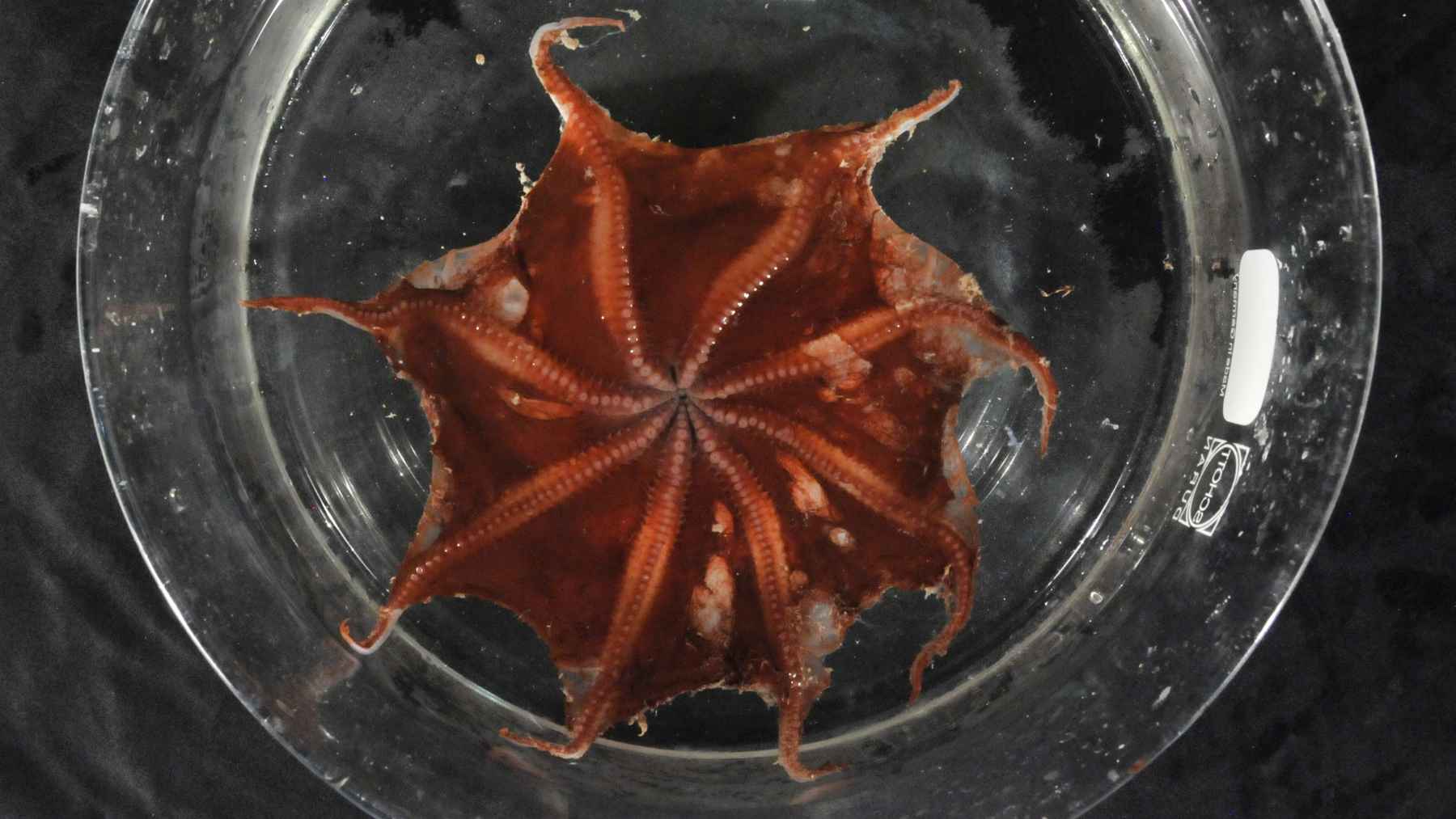
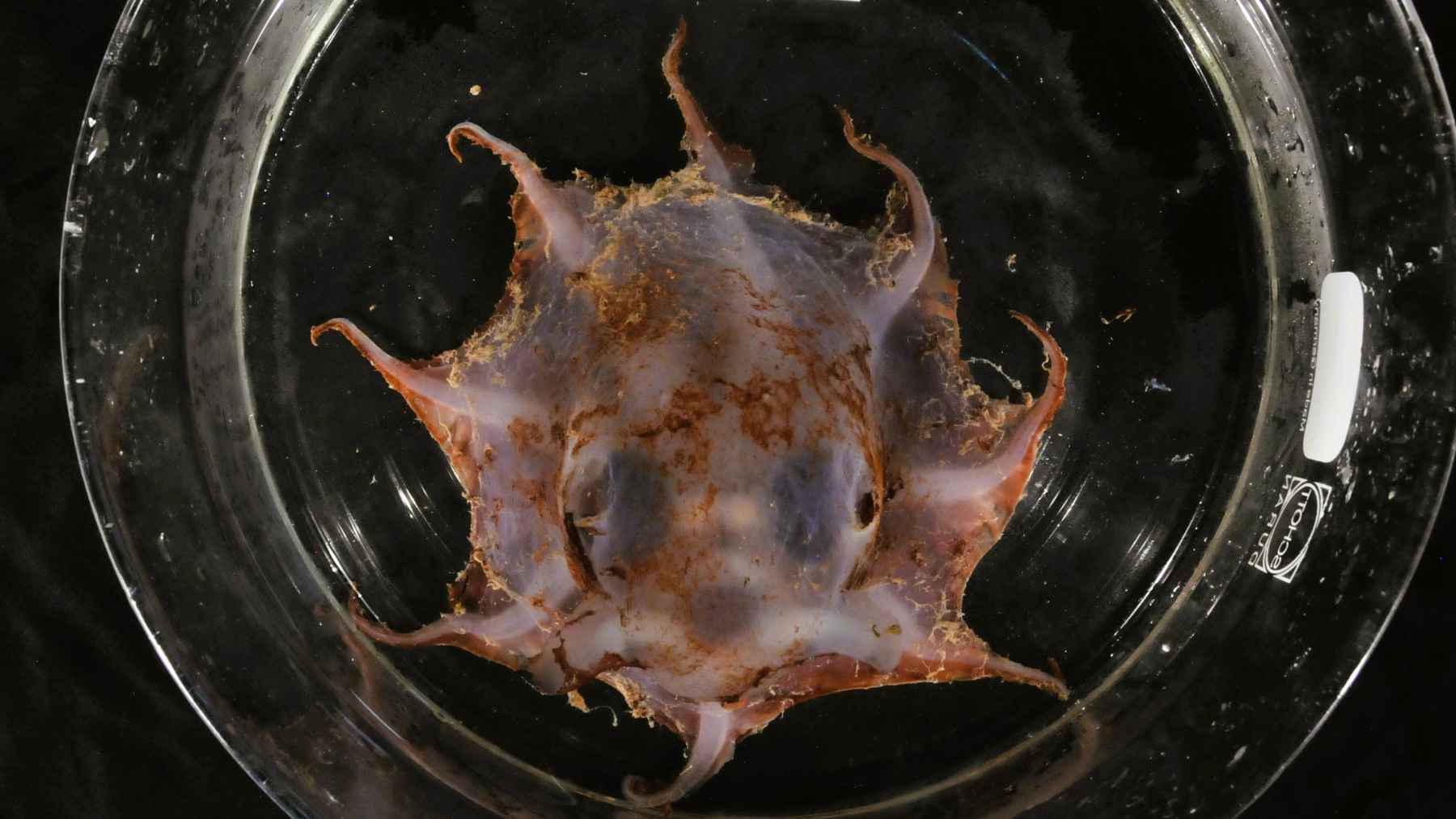
A new deep-sea octopus with unusually large eyes has been named from specimens collected off northwestern Australia, adding another small but revealing piece to the puzzle of life far below the waves. The animal is called Opisthoteuthis carnarvonensis, or the Carnarvon flapjack octopus, after the canyon region where it was found.
It is not a large animal. At about 1.6 inches across, it could fit easily in a shallow dish, yet its discovery points to something much bigger. Australia’s deep marine parks still hold many species that scientists have not formally described, and this soft-bodied octopus is now one of the newest examples.
Meet the Carnarvon octopus
The species was described by Tristan Verhoeff, a volunteer systematic taxonomist with the Tasmanian Museum and Art Gallery. His work was based on five specimens collected off northwestern Australia and examined alongside related flapjack octopuses from nearby waters.
So what makes it special? The Carnarvon flapjack octopus has a soft, dome-shaped body, thick arms, rows of suckers, small fins near the back of its body, and eyes that look very large for its size. In a place where sunlight barely reaches, those eyes are not just a curious feature.
Life below sunlight
The first specimens came from deep canyon habitat in and around the Carnarvon Canyon and Gascoyne marine parks. The Commonwealth Scientific and Industrial Research Organisation (CSIRO) reported that the octopuses used for the description were collected from roughly 3,400 to nearly 5,000 feet below the ocean surface.
That is a world most people will never see. No beach waves, no coral colors, no bright fish flashing past like something from a nature documentary. Down there, animals often save energy, move carefully, and rely on small advantages that help them find food or avoid trouble.
Why its body stands out
The Carnarvon flapjack octopus belongs to a group often called cirrate, or “dumbo,” octopuses. In simple terms, these are deep-sea octopuses with fins and webbing between their arms, giving them a rounded, umbrella-like shape when they spread out.
Unlike many shallow-water octopuses, this group does not fit the classic image of a fast color-changing escape artist. Dr. Verhoeff noted that these animals are soft and gelatinous, grow slowly, and do not make ink or change color like many better-known octopuses. That makes their lifestyle feel quieter, but not less complex.
Naming it matters
Describing a new species is not just a naming exercise. Taxonomy, the science of identifying and classifying living things, is how researchers prove that one animal is truly different from another. Without that careful work, deep-sea surveys can turn into a blur of similar-looking creatures.
In practical terms, that means scientists compare body shape, internal anatomy, sucker patterns, and older museum specimens. The Carnarvon flapjack octopus was separated from its relatives partly by its large eyes, the structure of its digestive gland, and distinctive sucker patterns on the arms of adult males.
The same study also reviewed related deep-sea octopuses from northwestern Australia and nearby Indonesian waters. It clarified material linked to Opisthoteuthis philipii and moved Opisthoteuthis extensa into another genus, helping researchers build cleaner identification guides for future surveys.
A voyage full of surprises
The octopus was collected during a month-long 2022 voyage by the research vessel RV Investigator. The mission surveyed poorly explored seafloor habitats in Western Australia, using cameras, nets, and sleds to document animals living thousands of feet below the surface.
This was not a hunt for one strange octopus. It was a broader biodiversity survey, the kind of expedition where researchers bring back many specimens and then spend months, sometimes years, sorting through what they actually found. That is where the slow work begins.
CSIRO said the Carnarvon flapjack octopus is the tenth new species described from that voyage, which has also produced finds such as the painted hornshark and the parallel-spine scorpionfish. By the agency’s own estimate, more than 1,000 species may still be waiting to be described from RV Investigator voyages over the past decade.
Why marine parks need this
Marine parks are often drawn on maps long before scientists fully understand every species inside them. That does not make them less useful, but it does mean managers need better information as new discoveries come in.
A formally described species gives conservation teams something solid to track. They can connect museum specimens, future survey images, feeding studies, and possible population changes to a real scientific name instead of a guess. Tiny details can matter.
For the most part, this is patient work rather than headline-grabbing drama. Still, a 1.6-inch octopus from a dark canyon can change what researchers know about a whole habitat. Small animal, big clue.
What remains unknown
Scientists still know very little about how this octopus behaves in the wild. Its soft body and webbed arms suggest it may move slowly near the seafloor, saving energy rather than darting through open water. But that still needs direct observation.
Its reproduction is another open question. Related flapjack octopuses tend to produce small numbers of eggs over extended periods, but researchers will need live observations or more specimens before they can say whether the Carnarvon species follows the same pattern.
Future work could include genetic testing, deep-sea video, and comparisons between adults and young animals. Those studies may reveal whether this species is limited to a small canyon system or spread more widely across the Indian Ocean floor.
The main study has been published in Australian Journal of Taxonomy.