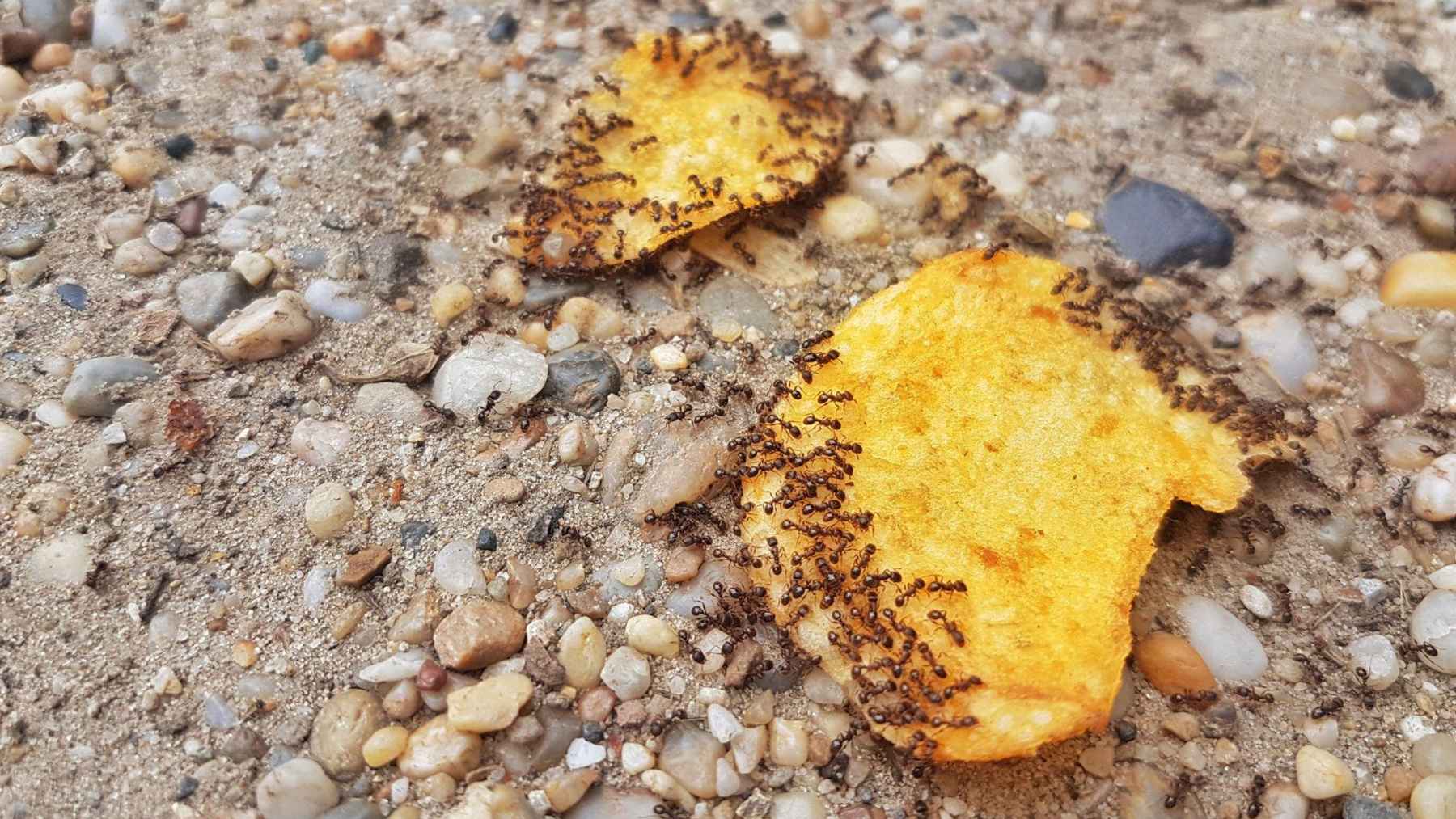
A few cookie crumbs on a hiking trail may not look like much, but a new study suggests that processed food leftovers can pull ants away from seed- moving work that helps plants spread through forests, parks, and other green spaces.
The research, carried out in Panama, found that ants removed seeds more slowly when potato chips or cookie pieces were nearby. In some tests, seeds near human food leftovers were removed about half as fast as seeds left alone, which means a tiny snack spill could become a small ecological detour.
Why ants move seeds
Ants are not just picnic pests. Many species act like tiny gardeners, carrying seeds across the ground and sometimes burying them in places where new plants may grow.
Some seeds have a small food-rich part called an elaiosome. It is packed with fats and proteins, so ants carry the seed home, eat that part, and often leave the seed itself intact.
This kind of ant-based seed dispersal is called myrmecochory. The word is technical, but the idea is simple. Ants move seeds, and plants get a better chance to spread.
A study born in class
The project began during a master’s course taught by animal ecologist Dumas Gálvez at the University of Panama. Brenda Morris and other students developed the experiments with Lara Dominguez and Emily Marple, who were linked to the Smithsonian Tropical Research Institute through global sustainability work.
The team wanted to know whether everyday food litter changes how ants handle seeds. This meant putting oat seeds near common snacks and watching what ants did next.
The snacks were familiar ones. Researchers used Lay’s potato chips and Oreo cookies without the filling, since those are the kinds of foods people often bring on walks, hikes, or trips into natural areas.
Chips and cookies won
In the first test, the team set up 126 seed stations on university grounds near buildings used by students and staff. Some seeds were surrounded by chip crumbs, while others had no junk food nearby.
That first design raised a fair question. Were ants truly distracted, or were the chips acting like a wall? So the researchers changed the setup and placed chip or cookie crumbs along one side of the seed stations instead.
This time, the experiment included 96 stations near chips, 94 near cookies, and 100 controls. The work was repeated on the campus and in a forest at Soberanía National Park, giving the team both an urban site and a more natural one.
The effect was fast
The result was clear. Chips and cookies significantly reduced how often ants interacted with the seeds, and the type of snack did not seem to matter much.
“Essentially, the ants were distracted from the seeds by the processed foods that we left out,” Dominguez said. She also noticed that ants could swarm chip crumbs in roughly 30 seconds, much faster than they usually reacted to seeds.
Here is the twist. More ants visited the seed stations at the urban site, but they did not remove more seeds than ants in the forest. That suggests city ants may be especially easy to pull away from their usual ecological work.
Distance made a difference
The final experiment tested whether the snack had to be right next to the seeds to cause trouble. The researchers placed potato chip crumbs directly beside some seed stations, about one foot away from others, and about 2 ft. away from another group.
Ants were distracted when the chips were right beside the seeds or about one foot away. However, the effect faded when the chips were about 2 ft. away, suggesting that the disruption was strong but local.
That matters because trail crumbs, picnic scraps, and snack litter usually sit in small patches. A few dropped chips may not change an entire forest, but they can change what happens on the ground right around them.
Why this matters
At the end of the day, the concern is not that ants like chips. The concern is that human leftovers may interrupt a natural service that many plants rely on.
A 2015 study of Manhattan ants found that some urban species carried chemical food clues linked to processed human foods, especially in more heavily urbanized places. A separate 2023 study found that some city ants forage more during the daytime, possibly matching their activity to human food waste patterns.
So the new study fits into a bigger picture. Ants are adapting to people, but those changes may come with trade-offs for the plants around them.
Not every seed is the same
There is still a limit to what the experiment can prove. The researchers used oat seeds, which ants can carry, but they do not have elaiosomes like many ant-dispersed wild plants.
Clint Penick, an insect ecologist at Auburn University who was not involved in the study, noted that “Plants don’t move.” He said it would be useful to test whether the same pattern holds for seeds such as trillium and bloodroot, which are more typical of ant-assisted dispersal.
That kind of follow-up would show whether snack crumbs disrupt seed dispersal in the plants most dependent on ants. For now, the study points to a real behavioral shift, but not the full ecosystem outcome.
Small crumbs, bigger questions
Gálvez plans to repeat the experiments in more urban and forest locations. He also wants to test nocturnal ants and look at how a junk food diet might affect ant bodies, not just ant behavior.
The takeaway is simple enough for any picnic table. Food litter is not just messy. In busy parks and natural areas where many people drop leftovers every day, even small scraps could pile up into a larger ecological problem.
The main study has been published in Biology.