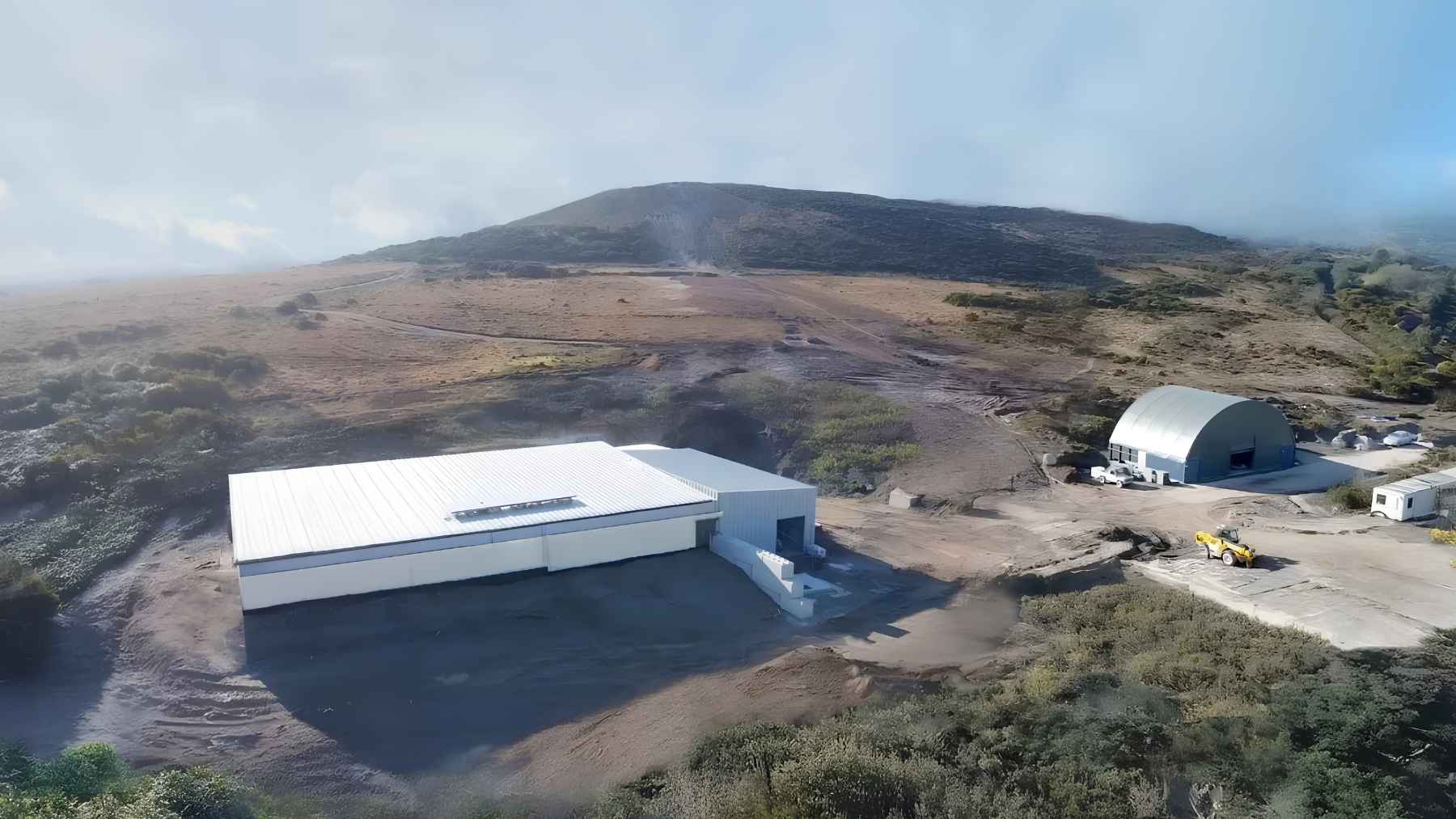
On a hillside located in Devon, England, there is a small power plant running at full capacity by using a liquid so dense it can make a concrete block float. According to RheEnergise, the British-Canadian company that is carrying out this project, this 500-kilowatt plant started running at its full power on January 27, 2026, and has maintained that level since then.
Why is this so important? Because it could make pumped-hydro storage possible in places where there are no high mountains or large reservoirs. RheEnergise works using a fluid 2.5 times denser than water, so it can achieve similar results on lower hills, using around 40 percent the size of a regular operation. The results of the pilot show that the system works, but it still has to be tested on bigger projects.
So dense even concrete floats
This system is called High-Density Hydro and the fluid used is known as R-19. IEEE Spectrum describes it as a mixture based on minerals, which contains around 80 percent solid particles. The CEO of RheEnergise, Stephen Crosher, says it looks like chocolate milk.”
However, this fluid does not always have the same consistency. When it is still, it is thick and looks like a paste, but when it starts moving through a pipe, it becomes thinner and flows more like water. This behaviour is called shear thinning, and it is a type of non-Newtonian reaction. RheEnergise also says that, in the event of a spill, the mineral particles would not dissolve into the water, they would settle and dry. This does not mean that larger projects will not need to follow strict measures to avoid possible natural disasters.
A power plant inside a hillside
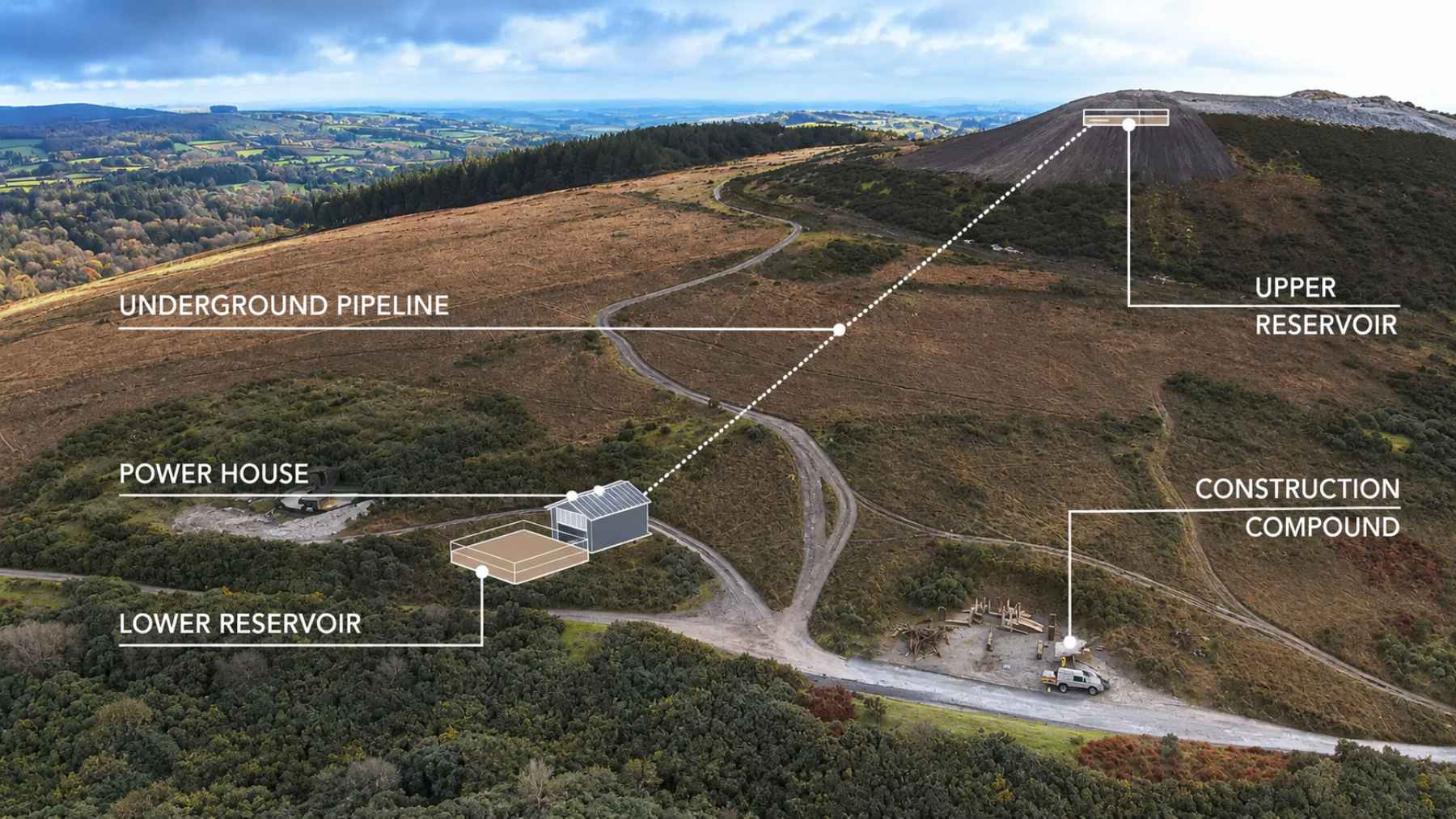
The Cornwood facility is located near Dartmoor, on a place where Sibelco extracts kaolin, the white clay used in sinks, toilets, and ceramic tiles. It is not a regular open-air reservoir, the plant has three fiberglass pipes in which they store R-19. Each pipe measures about 200 feet long and more than 8 feet wide, and they can hold approximately 343,000 gallons of fluid, about 260 feet above the lower reservoir.
Underground, there is a large concrete tank used as the lower reservoir. Chief technology officer, Tamas Bertenyi, called it “almost a very big swimming pool.” The two reservoirs are connected by a steel pipe. The pump, controls, and a custom turbine are inside the powerhouse. standard hydropower turbines would not work as they are made for water.
The map is changed by the density. A conventional hydro pump requires around 500 meters of elevation to properly perform, whereas, according to New Civil Engineer, this can be achieved at around 200 meters with the new technology. Thanks to this reason, sites in lower altitudes and nearer urban areas could be used, placing them closer to where the electricity demand lies.
500 kilowatts is enough for a significant trial, and here´s why
Cornwood is relatively small. The project was backed by the United Kingdom with £8.25 million through its Net Zero Innovation Portfolio, And the enterprise’s research and development was supported with a £2.15 million. The intention was not to redefine the country’s grid from one day to the next, but rather to test if the custom turbine, adn the chemistry, pipes, controls and pipes worked as intended in a practical use.
And, as claimed by RheEnergise, they did work. By the company’s estimates, in the lapse of a whole year, the plant’s output would provide 400 homes with energy year-round. Although currently this output remains on site. In an effort to reduce kaolin production emissions, Sibelco uses part of the stored energy during demand peaks.
Conventional plants could be 200 times bigger
According to RheEnergise, their projected undertaking will produce anywhere between 10 and 100 megawatts, with storage ranging from 6 to 20 hours. This means that the more conservative proposal would be 20 times Cornwood’s power rating, and the largest 200 times bigger. The initial sites are scheduled to use between two and four 5-megawatt turbines.
Projects are being made in the United Kingdom, Spain, Poland, Italy and North America, and the company foresees its initial completely commercial system by late 2028. A 40-megawatt plant which is capable of working for 10 hours was presented as an example for investors adn the company foresees it could provide energy to 32,000 U.S. homes in that time, with over 80% round-trip efficiency.
The potential is present, but there are also obstacles
As grids include solar power and variable wind, long-duration storage capacity is gaining importance. 22 gigawatts is already present in the United States, with the majority of it being built in the 1970’s, which comes to the the usefulness of this technology when the electricity is needed across many hours, rather than a few minutes.
But, construction does not cease to exist because of the denser fluid. Permits, financing and major civil works will still be required, with increased competition as sodium-ion and flow batteries costs falls. RheEnergise has already proven a 500-kilowatt plant can work, but there are still no announcements for the financing of a specific 10-megawatt project.
That is precisely the point to observe. Cornwood has proved the laboratory potential could be applied to a fully operational practical plant, but whether this can be applied at a bigger scale is what will prove this new technology’s effect.
The official statement was published on RheEnergise.