Chinese researchers have tested a small wind-tunnel model representing an aircraft concept that could carry more than 800 passengers, according to August reporting by EFE and the South China Morning Post. The proposed design would span about 279 feet (85 meters), with its central body blending into its wings to create a broad lifting surface.
The environmental appeal is straightforward. A shape that moves through the air with less resistance could help reduce fuel consumption, but the available results concern a scale model, leaving the performance of a complete passenger aircraft unproven.
What China actually tested
The work comes from the China Aerodynamics Research and Development Center (CARDC). EFE reports that researchers used a model at one fifty-second of the proposed aircraft’s size, roughly 31 inches long and 5.2 feet across, to examine aerodynamics, stability, and structural deformation at Mach 0.4 through Mach 0.8.
According to Interesting Engineering, the maximum lift-to-drag ratio was approximately 20 below Mach 0.7, falling to 17.6 at the proposed Mach 0.8 cruise speed. A ratio of 20 means about 20 units of lift for each unit of drag under those conditions. These measurements do not establish a percentage reduction in fuel use or emissions for an airline flight.
Why the shape could reduce fuel use
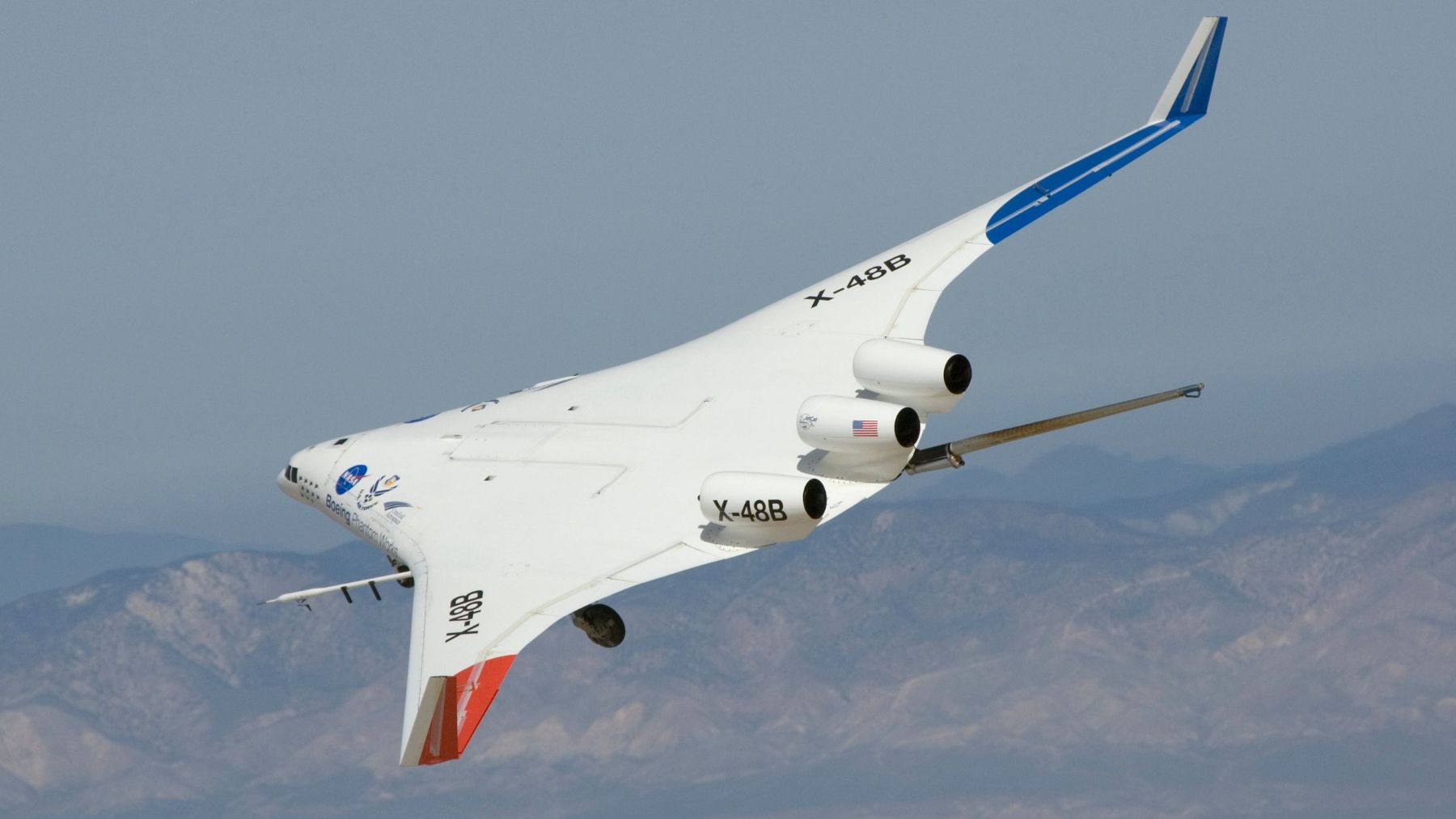
A blended-wing-body design merges the passenger-carrying center section with the wings, allowing more of the structure to contribute to lift. NASA has explored this approach with Boeing through its X-48B research aircraft, describing potential advantages that include “high fuel efficiency, low noise and a large payload volume.” These benefits explain the interest in changing the familiar airliner silhouette.
For an airline, lower drag could translate into a smaller fuel bill over thousands of flights. Burning less conventional jet fuel would also reduce carbon dioxide from combustion, but the size of that benefit would depend on the engines, aircraft weight, route, and number of passengers carried. The Chinese model tests alone cannot settle those questions.
Why the 1,000 km/h headline needs context
Reports describe a proposed cruise speed of Mach 0.8, sometimes converted to approximately 987 km/h (613 mph). But Mach measures speed relative to the local speed of sound, which changes with air temperature and therefore with atmospheric conditions.
As NASA explains, that relationship matters when comparing wind-tunnel experiments with flight. Without the relevant conditions, 987 km/h is an incomplete conversion, and it should not be treated as a demonstrated cruising speed. The available reporting supports a design target and a range of laboratory test conditions.
Wider than the A380, with a different shape
The proposed 85-meter wingspan would exceed the Airbus A380’s approximately 79.8 meters, although the Chinese concept would be much shorter. Its reported length is 43 meters (141 feet), compared with about 73 meters (240 feet) for the A380, illustrating how differently the two designs distribute their size.
Passenger numbers also need a fair comparison. Airbus says the A380 can accommodate more than 850 passengers in an all-economy layout, so an 800-plus-seat proposal alone does not establish a new capacity record. The more revealing question is how much energy a future aircraft would need to carry each passenger over the same distance.
Airport space could become a major hurdle
An 85-meter span would extend beyond the wingspan range of the International Civil Aviation Organization’s Code F category, which runs from 65 meters to less than 80 meters. That creates a practical planning challenge for taxiway clearances, parking positions, and movement around other aircraft, even before passengers reach the boarding gate.
Still, the category boundary is not proof that the aircraft could never use an existing airport. ICAO’s published guidance explicitly addresses planning for aircraft with wingspans greater than 80 meters. The practical implication is that airport compatibility would need individual assessment, potentially involving infrastructure changes or operating restrictions.
What the next steps would need to show
The coverage reviewed for this article identifies no full-size aircraft or announced commercial service date. To judge the environmental promise, airlines would eventually need evidence from a complete design and representative operations, including fuel consumption with passengers, baggage, and onboard systems accounted for.
Earlier experiments show why that takes time. NASA’s X-48B program investigated handling at low speeds, stall behavior, and control after an engine failure, all essential questions when moving an unfamiliar shape toward practical flight.
The official overview of that separate blended-wing-body research program was published on NASA.