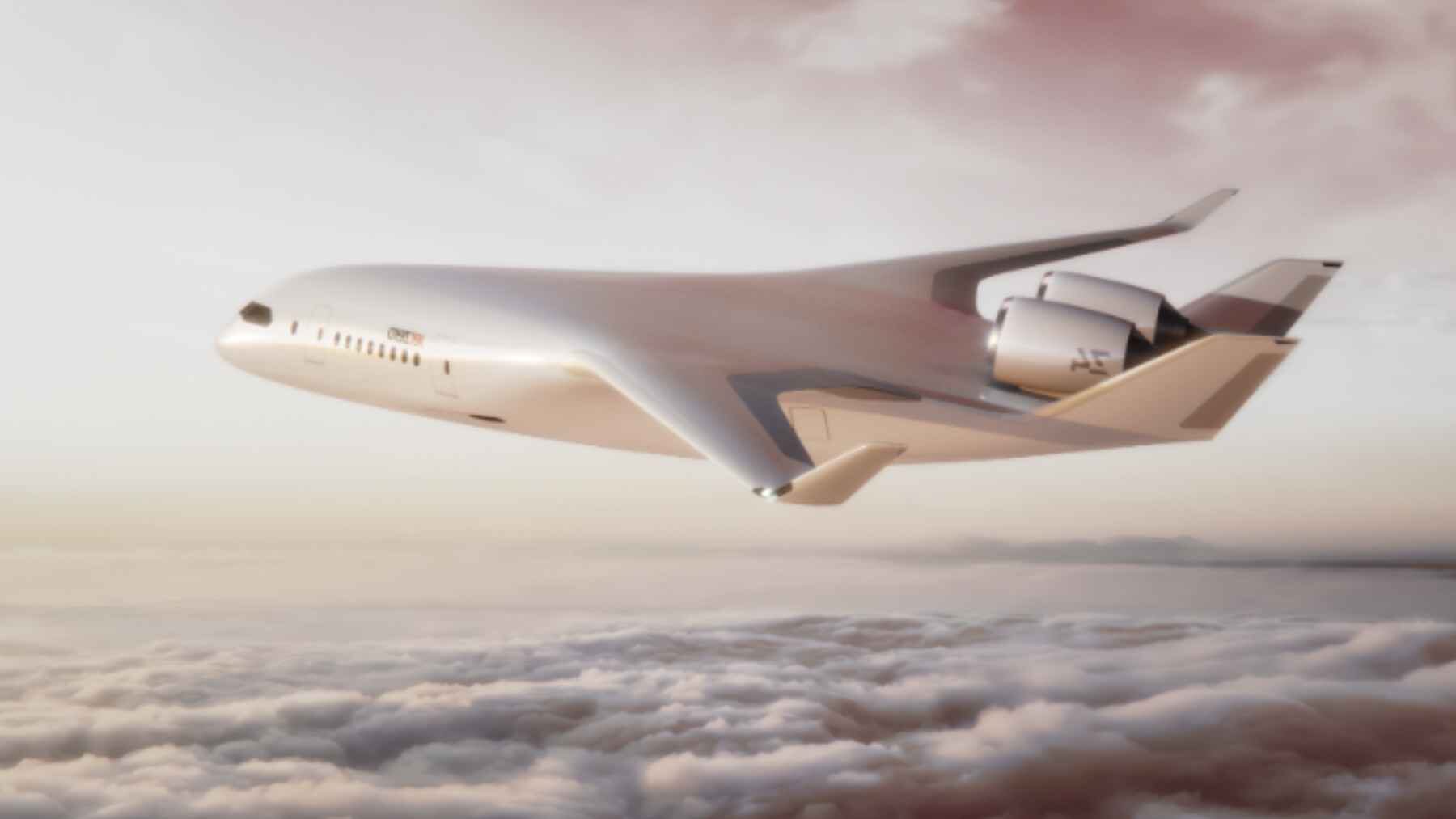
Japan Airlines is joining the development of the JetZero Z4, a 250-seat passenger jet that blends its body and wings into one broad lifting shape. The program targets a 30 to 50 percent improvement in fuel efficiency and a range of about 5,750 miles.
Announced on July 21, 2026, at the Farnborough Airshow, the move has been described in some summaries as an investment. The official release, however, confirms operational and design collaboration but discloses no cash investment, purchase commitment, or aircraft order.
A jet with no separate tube
Most passenger planes look like a long tube with wings joined to the sides. The Z4 uses a blended wing body, meaning the center section flows smoothly into the wings and helps produce lift instead of mainly adding weight and drag.
That is why the Z4 looks more like a manta ray than the airliner parked at a typical gate. More of the aircraft helps hold itself up, while the smoother shape cuts drag, the air resistance that makes engines work harder.
What the airline brings
The carrier will feed in experience from flight operations, cabin service, maintenance, and ground handling. The two companies also plan to study gate use and a future maintenance, repair, and overhaul framework, the industry term for long-term aircraft servicing.
“Collaborating with JetZero on the Z4 aligns perfectly with our commitment to sustainable innovation and net-zero emissions by 2050,” said Takao Suzuki, executive officer for corporate strategy. In practical terms, the carrier wants the airplane to work not only in computer models, but also during boarding, servicing, and daily airline schedules.
Range for long routes
The planned cabin holds around 250 people, while the stated range is about 5,750 miles. On paper, that would cover many medium and long-haul routes, including flights between Tokyo and major cities on the U.S. West Coast.
JetZero also says the Z4 will fit existing airport infrastructure, avoiding specialized gates or costly terminal changes. That matters because even a highly efficient airplane can struggle commercially if airports must rebuild around it.
The announcement does not provide a final cabin layout or seat dimensions. So the questions travelers notice right away, including aisle width, window access, and elbow room, are still open.
The fuel claim needs proof
The headline number comes with an important caveat. A 30 to 50 percent fuel-efficiency gain is a design target, not a result measured from a certified passenger Z4. That distinction matters.
Earlier research gives the idea a scientific foundation. NASA and Boeing flew the smaller X-48 test aircraft and showed that a blended-wing design could be controlled at low speeds, although engineers had to refine its flight-control software.
That is the trade-off. Removing the familiar tail can improve aerodynamics, but it puts more responsibility on control software, structural engineering, and certification. The shape has promise, but the hard part is making it routine.
What happens next
The next big milestone is a full-scale demonstrator scheduled to fly in 2027, backed by a $235 million U.S. Air Force program. The military says the project is meant to mature the technology and give both defense and commercial aviation more options.
Commercial service is targeted for the early 2030s, but testing and certification will decide whether that calendar holds. For now, the Z4 remains a promising aircraft under development, not a finished replacement for today’s jets.
The official press release has been published by Japan Airlines.