Hawaii has been trying to slow strawberry guava for decades, and a team at the University of Hawaii at Hilo now says drones can help. Working with the U.S. Forest Service, the researchers found that “drone-based aerial deployment using a small 4-unit system was nearly 5 times faster than a ground-based approach” for releasing an insect that attacks the invasive strawberry guava.
“To our knowledge, this is the first time biocontrol has been released via drone in the state,” said Ryan Perroy, a professor of geography and environmental science who headed the project, in a July 2025 UH Hilo story about the paper.
His co-authors are UH Hilo assistant professor of aeronautical science Roberto Rodriguez III, Olivia Jarvis of Perroy’s Spatial Data Analysis and Visualization Lab, and Forest Service research entomologist Tracy Johnson.
Strawberry guava has been spreading in Hawaii since 1825
Strawberry guava “was introduced to Hawai`i in 1825 and has since advanced through Hawai`i’s native forests,” the Hawaii Department of Agriculture said in a 2011 news release. “Mechanical removal is extremely difficult in remote forest areas.”
“This action needs to be taken,” said Russell S. Kokubun, then chairperson of the department. “The native forest cannot protect itself from invasive strawberry guava.”
The release cited a University of Hawaii study showing that “strawberry-guava-infested forests lose 27 percent more water than native ohia forests,” and, citing the USDA, said the dropped fruit is “a primary source of oriental fruit flies” that cost Hawaii millions of dollars a year.
According to the new paper, “Two-thirds of seedlings now found in Hawaiian forests are non-native species, and the most abundant of these is Psidium cattleyanum Sabine (strawberry guava).”
Springer Kaye, a conservation technician quoted in the agriculture department’s 2011 release, described crews who would “helicopter into remote areas, spend three days camping, spending the entire time ‘killing’ waiawī.” When the crews went back, Kaye wrote, “it was like we had done nothing!”
“There is too much guava to practically control by chemical or mechanical means. Biocontrol is the only solution,” J.B. Friday, a forester at the University of Hawaii at Mānoa, wrote in the same release.
Florida lives with a similar legacy from Australian melaleuca trees planted in 1906, which have since invaded nearly 500,000 acres.
A Brazilian insect that weakens the tree without killing it
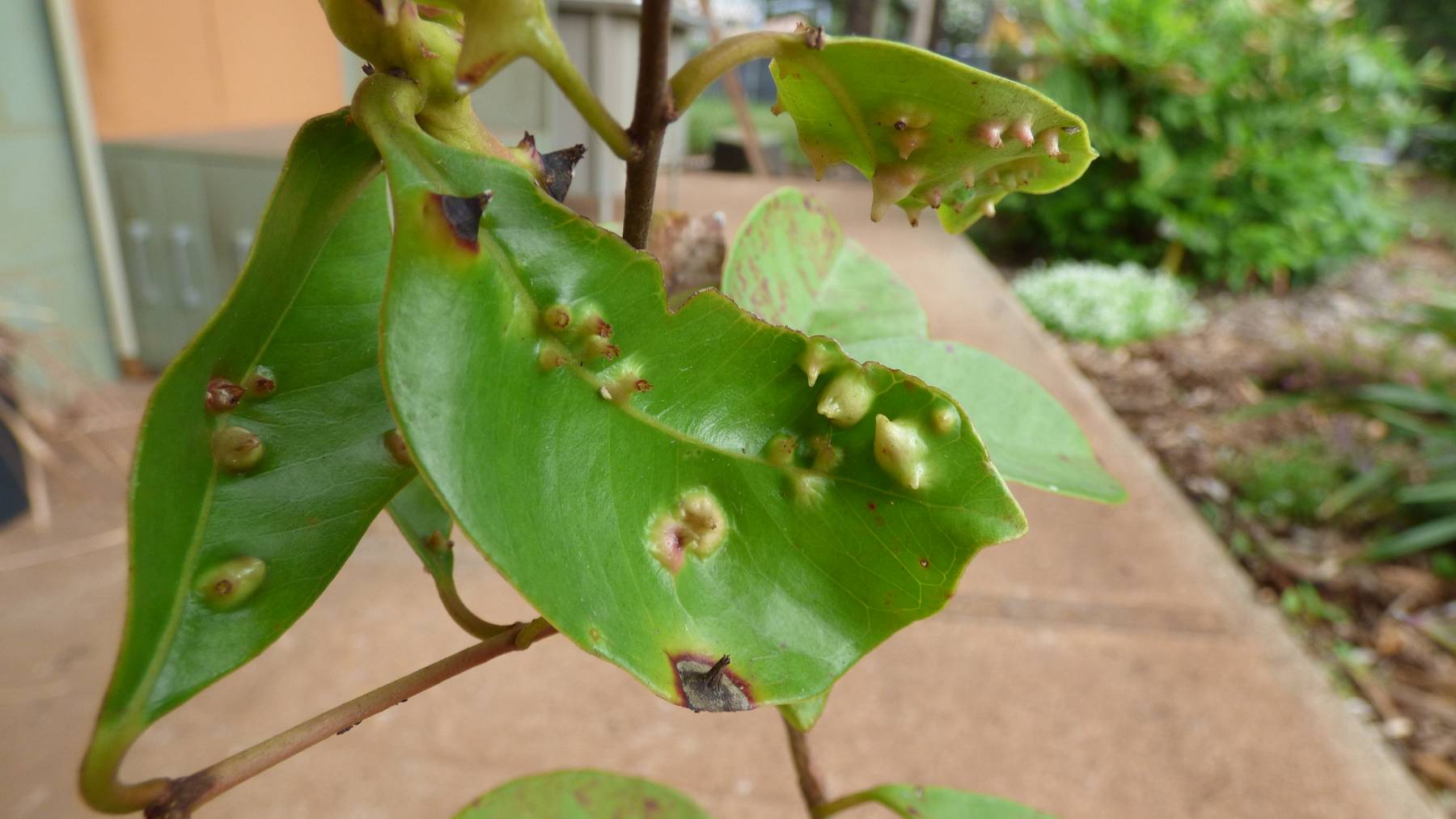
Biological control, or biocontrol, means using a pest’s natural enemy to keep it in check. Tectococcus ovatus “is a tiny scale insect that is native to Brazil where strawberry guava came from,” the agriculture department said, and it “lives most of its life inside the strawberry guava leaves, causing leaf galls or bumps, which reduces the vigor of the plant, but does not kill it.”
The Forest Service had been testing candidate insects “for more than 15 years” by 2011, and T. ovatus was introduced to Hawaii in 2012.
“We hope that people understand that release of this biological control insect will not kill all strawberry guava,” Johnson, then the Forest Service’s lead researcher in Hilo, said in the 2011 release. “There will still be a lot of strawberry guava around. Slowing its reproduction and invasiveness will help restore the balance in favor of the native forest plants like ‘ohia.”
The insect does not choose its next tree. It spreads “passively, with the wind or by crawlers,” Johnson said at a 2008 public meeting, as reported by Environment Hawaii. “They can’t control where they end up.”
Until this work, the study says, deployment “has occurred solely via ground-based methods, using slingshots, hand-throws, or extendable poles,” which kept releases near roads and trails.
Drones beat poles on speed and later infection
The insects travel on what the team calls bolas. Each one “consisted of 30 cm of jute twine, with a bundle of 2 to 4 T. ovatus-galled strawberry guava leaves tied to each end,” the authors write. That is about a foot of string.
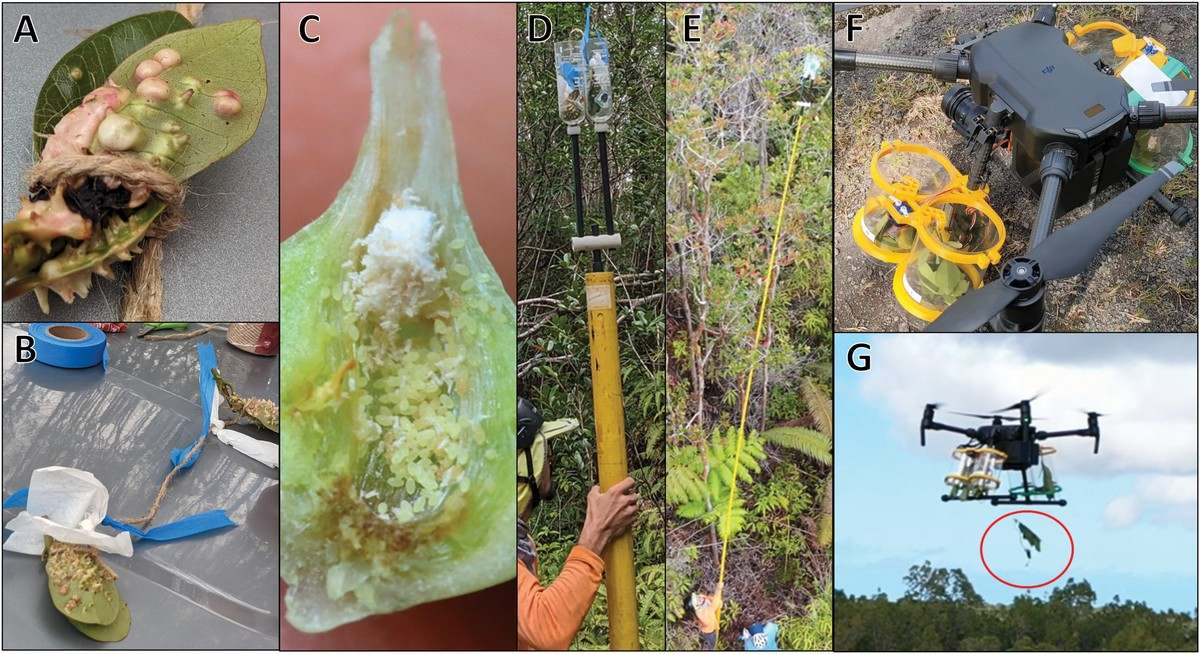
“During the Olaʻa forest reserve field trials, T. ovatus bolas were deployed onto 129 trees: 62 by the pole method and 67 by the 4-bolas drone method,” the paper says. The pole hung its bola 97.6 percent of the time and the drone 86.6 percent, but the drone cut “average treatment time by 77%,” to 2.8 minutes per tree from 12.
After a year, 63 percent of drone-treated trees had galls, compared with 38 percent of the pole-treated ones. “This difference, 63% vs. 38% gall success at 12 mo, suggests that there may be something about the aerial-based placement of the bola that contributes to a higher success rate,” the authors write.
Video of the drops points to where. Pole placement “was almost always (97% of the time) on the edge of a strawberry guava canopy,” while the drone put bolas “in the center and upper branches of the target strawberry guava canopy more than half the time.”
Low flights to find very small galls
“The post-release repeat monitoring aspect is critical,” Perroy told Entomology Today in August 2025, “and since the galls that form are quite small, doing this effectively required the collection of millimeter-resolution imagery. So that meant flying very low and using good cameras.”
At a site in the Upper Waiākea Forest Reserve where Johnson and colleagues had fired galled leaves into about 25 trees with slingshots in 2017, 23.1 percent of the 2021 photos that showed strawberry guava also showed galls. In the 2024 survey, every imaged strawberry guava tree had them.
Bigger drones and a helicopter for remote forest
For larger areas, the lab built release systems holding 16 and 54 bolas in 3D-printed frames. The 54-unit version “is named Kūhualūlū to reflect its Hawaiian origins and the concepts of vertical movement (Kū), yield (hua), and scattering or sowing (lūlū).”
“3D printing allows this to proceed at a very rapid pace, where you can move from concept to physical testing in a matter of days or even hours, and that was really powerful,” Perroy said.
Near Keaʻau, the team pitted Kūhualūlū against bolas thrown by hand from the rear seat of a Hughes 500 helicopter. Hang rates were similar, 71.6 percent for the drone and 68 percent for the helicopter, but on a painted target line 93 percent of the drone’s bolas landed within about 6.5 feet (2 meters), compared with 68 percent of the helicopter throws.
Perroy had flagged the trade-off at the Hawaii Conservation Conference in 2022. “If we really want to scale up, we really need to go to helicopters,” he said, according to Environment Hawaii.
Under 100 helicopter hours for the whole state
As a thought experiment, the researchers mapped drop points over the part of the roughly 42,000-acre (17,000-hectare) Watershed Reserve Section of the Hilo Forest Reserve that strawberry guava has invaded. With one drop every 0.6 mile (1 kilometer), a helicopter would need 65 drops and about 1.3 hours.
Across the estimated 1.17 million acres (475,000 hectares) of forest statewide potentially affected by strawberry guava, that grid means 4,750 drops and 92.5 hours of flying, not counting ferrying and refueling. “In the context of annual conservation-related helicopter mission hours that occur across the state, this amount is not unreasonable,” the authors write.
Their cost model also found helicopters the most economical option at every grid spacing, and, unlike other aerial programs, “there would be no need for additional deployments after successful initial T. ovatus releases.”
Limits of the trials
“The demonstration trial described here was also limited in scope, with the furthest trees involved in the study being 41 m from the central road,” the authors note. Federal Aviation Administration rules still restrict drone flights beyond visual line of sight, and radio range limits current drones.
Rotor wash “caused a number of bolas to be blown off of apparently successful drops.” The statewide estimate also “assumes strawberry guava trees are evenly distributed and visible from the air across the target area, which we recognize to not be the case.”
And after a release, “2 to 4 yr are required before galling levels begin to increase significantly and spread beyond the inoculated trees,” the paper says. Natural enemies can also be undercut by other species, as happens with the Argentine ants that weaken biological control in California.
Lessons for tropical forests elsewhere
The authors write that their findings “are relevant to others working to deploy and monitor biocontrol in tropical and forested ecosystems worldwide.” The project joins other efforts that put living allies to work against invasive plants, as British scientists have done.
“Drones and innovative attachments can be effective tools for better managing and protecting our forests,” Perroy said. “We went through a lot of trials and ideas that turned out to not work, but all those provided valuable experience and feedback.”
The full study was published in June 2025 in the Journal of Economic Entomology.
Photo: Forest and Kim Starr / Wikimedia Commons (CC BY 3.0)