When NASA’s Perseverance rover reached the inner edge of Jezero Crater in September 2023, the team expected lakeshore sediments. What it found instead were igneous rocks in what it calls the “Margin Unit,” and a new study shows that those rocks met water at least three separate times, the last as hot fluid that left fluorite behind.
The rover’s SuperCam instrument analyzed more than 185 bedrock targets across the unit, a band of rock that hugs the inner edge of the crater’s rim. Below the lake’s second terrace level, the paper says, the exposures “reveal a complex history of water-rock interaction,” and each of the episodes left the same rocks with a different chemistry and look.
The lead author is Candice Bedford, a research scientist at Purdue University in West Lafayette, Indiana. She worked with Eleni Ravanis of the Hawai’i Institute of Geophysics and Planetology at the University of Hawai’i at Mānoa, Roger Wiens of Purdue and researchers from Europe and the United States.
Orbiters pointed to a lakeshore
Perseverance landed in Jezero, a crater about 28 miles (45 kilometers) wide, in February 2021. NASA sent it there to read the geological record and look for signs of ancient life, because a lake once filled the crater and an inlet channel built a fan of sediment on its western side.
Orbiting spacecraft had picked up especially strong carbonate signals from a narrow strip along the inner margin, and on Earth that family of minerals often forms in shallow lakes and seas. Mission planners hoped those carbonates had settled out along the old shoreline, which the authors describe as “an environment favorable to the preservation of biosignatures,” meaning chemical or physical traces left by life.
Bedford said in NASA’s release that the main hypothesis before the rover got there, based on what orbiters had seen, “was that the carbonate seen from orbit formed from interaction with the lake that existed in Jezero Crater.” She went on, “But now we know that this location became a sort of crossroads for aqueous systems. The Margin Unit findings are important because Jezero Crater sits inside one of the largest exposures of carbonate on Mars, so what we learn here reaches well beyond this crater.”
A laser that reads rocks from 21 feet away
SuperCam sits high on the rover’s mast. If the science team spots a rock it likes, the instrument can fire a laser at targets up to 21 feet (6.5 meters) away, and the light from that tiny burst of plasma tells the team what the rock is made of.
It also takes close-up images and measures how the rock reflects light, which helps pin down minerals. Running the chemical readings through a cluster analysis, Bedford and her colleagues ended up with eight groups, and those include olivine, two kinds of carbonate, silica, dust coatings and a rare calcium-rich group.
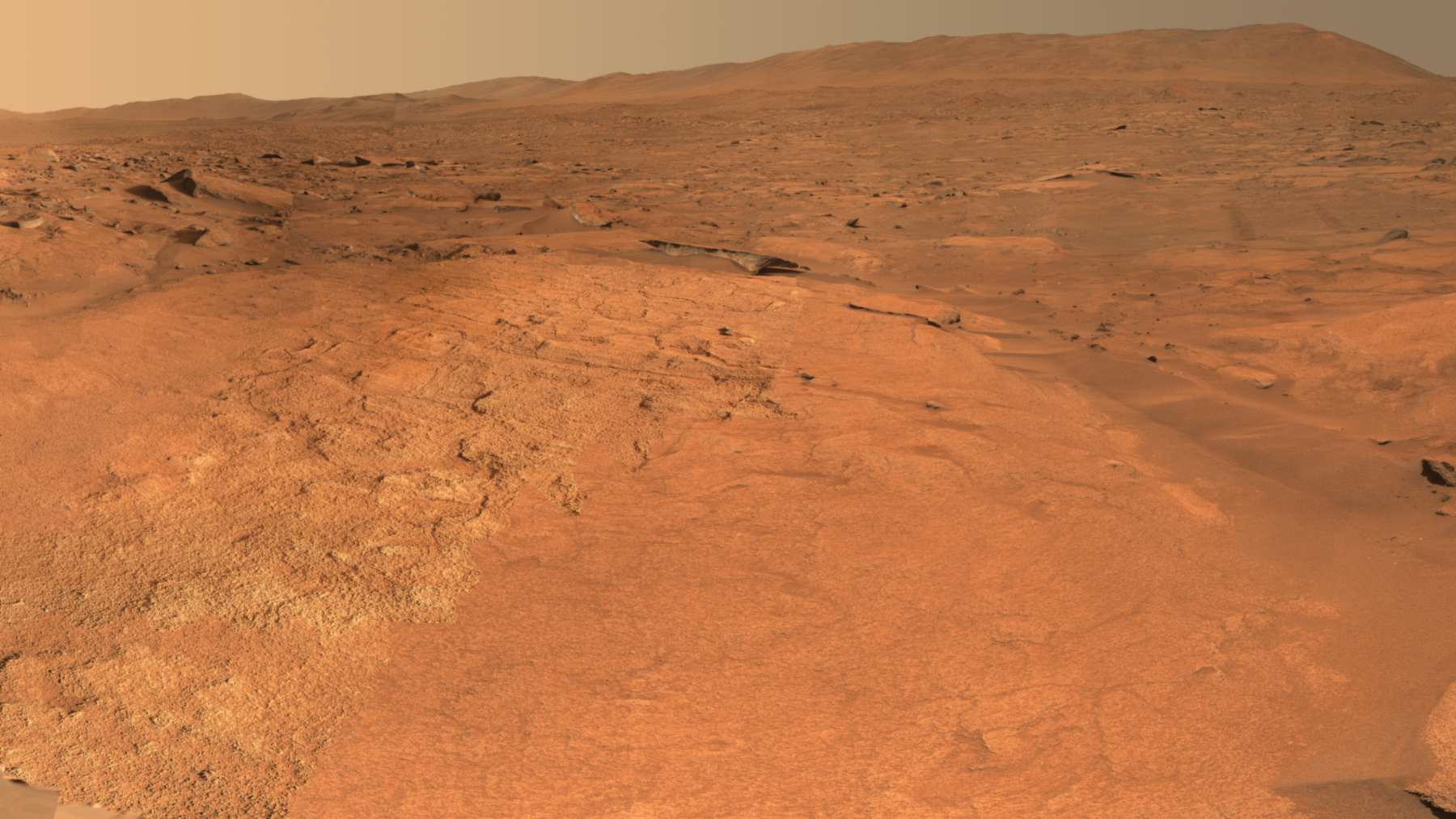
Perseverance explored the Margin Unit across about 870 feet (265 meters) of elevation, in four stretches the team calls the East, West, North and High Margin. It drilled several rock cores on the way, including samples named Pelican Point, Lefroy Bay and Comet Geyser, and stored them for a possible return of Mars samples to Earth.
The rocks began as cooled magma
Up in the High Margin, SuperCam saw coarse rock full of olivine, a green mineral rich in magnesium and iron, and almost no sign that water had ever touched it. The authors say those textures “are indicative of a crystalline, in-place igneous unit” and that they “are also similar to textures observed in the olivine cumulate rocks of the Séitah formation” on the crater floor.
Their reading is that the grains “likely formed due to slow cooling and the accumulation of olivine in a magma body” deep underground. The rock got to the surface only once the ground above it had eroded, which lines up with other evidence of long-lived magma systems on Mars.
Lower down, near the old lakebed, it was the same olivine but in much worse shape, cracked and altered, with silica filling in the gaps between the grains.
There are rubbly layers in the East and West Margin where grains are eroding out of the bedrock and still have their original crystal shapes. Since none of them look rounded, the authors write that “it is unlikely that they occurred as pebbles transported in a river or lake shore environment.”
Groundwater carved the first ridges
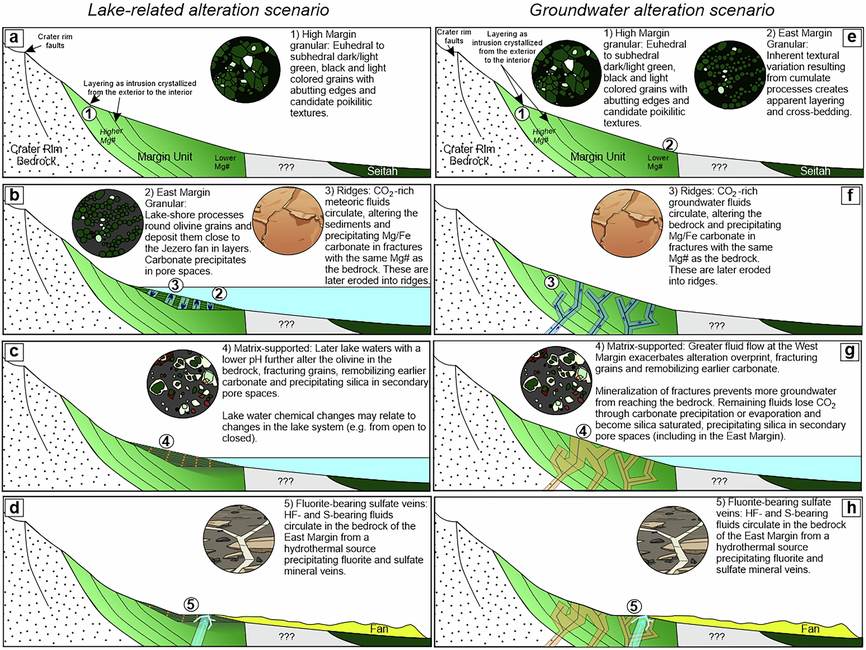
Bedford’s team could work out which water event came first, second and third, but it has no dates for any of them. For the first one, the paper says that “neutral-to-alkaline CO2-rich fluids circulated within the bedrock,” so groundwater carrying carbon dioxide seeped through cracks and reacted with the olivine.
That reaction filled the fractures with carbonate. The authors explain that this “made this carbonate-rich fracture fill more resilient to later erosion than the bedrock,” so when the softer rock wore away the filled cracks were left standing as ridges, much like the mineral ridges left by groundwater that Curiosity has studied in Gale Crater.
More than half of the SuperCam readings on both kinds of ridges matched carbonate, with almost no silica. The carbonate also kept the same ratio of iron to magnesium as the olivine it replaced, which is what the team would expect if it formed directly from that olivine.
The old lake may have left silica
The second episode may be tied to the lake that once filled the crater. Cooler, more acidic water seems to have dissolved some of the carbonate, opened new pore spaces and put silica inside them, something the authors compare to Earth rocks called listvenites, which “can become silica-dominated when circulating fluids become cooler and more acidic.”
“Some of the Margin Unit rocks also contain silica,” said Ravanis, a planetary scientist at the University of Hawai’i at Mānoa. “Turning olivine into carbonate can leave silica behind, and we see more of that silica in rocks that sat below the water line.”
The silica-rich group turns up only in the East and West Margin, the stretches below a second terrace level that orbital mapping links to the lake’s level after its second breach. Sedimentary layers in the upper part of the western fan, laid down in the same lake, also hold plenty of carbonate and silica.
Hot water came last
In the third and latest episode, the authors write, “late-stage hydrothermal fluids flowed through younger fractures.” They left a mineral vein about 10 inches (25 centimeters) thick at a site in the eastern Margin, which navigation images show running several yards to the east and northeast, and SuperCam detected calcium sulfate and fluorite in it.
On Earth, fluorite typically forms when hot water circulates through volcanic rock, and the team says the setting of this large vein “is more similar to fluorite precipitation in hydrothermal settings on the Earth.” The surrounding bedrock has little calcium, sulfur or fluorine, so in the paper’s words these fluids “must have a different source to those that formed the ridges.”
The crater sits near the Syrtis Major volcanic province and has a possible volcanic structure on its edge. With that in mind, the authors write that “later volcanism-induced hydrothermal circulation is a likely formation mechanism for fluorite vein precipitation at this site.”
Why these minerals matter for life
On Earth, when water reacts with olivine it can release hydrogen that some microbes use as food. The same reactions leave carbonate and silica, two minerals that are good at preserving traces of past microbial life.
The authors write that this sequence of fluid events “reinforces the Margin unit as a locality of astrobiological interest.” They also argue that it puts the unit and the samples Perseverance collected there among the primary targets in the search for signs of ancient life, which has guided the rover since it began its long drive across Jezero.
“If there is one thing I have learned after 10 years working with Mars rovers, it is that Mars constantly throws surprises at you,” said Bedford. “It is very rare that things are as we expect them to be from orbital data. I hope this work helps reshape how scientists view the history of water in Jezero Crater and across Mars. Ultimately, I hope it helps planetary scientists reconstruct the changing climate and habitability of early Mars.”
What the study cannot settle yet
The rover data give an order of events without dates, so nobody can say yet how far apart the three episodes were. The team lays out two scenarios, depending on “whether alteration was driven by lake–groundwater interactions or groundwater alone.”
The patchy spread of altered rock below the old water line could also point to several different groundwater systems rather than the lake. And some layered textures that look like lakeshore deposits “can occur in layered igneous intrusions due to grain settling and convection-driven magma currents,” the authors note.
Séitah, a rock formation on the crater floor, is much less altered than the East and West Margin or the western fan, which the authors call “unexpected if interaction with the Jezero paleolake waters is what caused this alteration across all units below the lake level.”
The full study was published in Communications Earth & Environment.
Details about the rover observations and the team’s comments are also available in NASA’s release from September 21, 2026.
Image: NASA/JPL-Caltech/ASU/MSSS