At Dragomirna Monastery, near Suceava in northeastern Romania, a marble slab lies in the porch floor. Its Greek text honors “the architect Epikrates of Byzantion, the son of Nikoboulos, on account of his virtue and goodwill towards the people,” in the words of its English translation.
“It is a legislative text of extraordinary importance,” Florian Olteanu wrote on September 19, 2026, in Evenimentul Zilei, under the headline “The hidden treasure in the floor of Dragomirna Monastery.” Then: “Unfortunately, the damaged text does not mention which city issued the decree.”
Victor Cojocaru, an epigrapher who has written a detailed study of it, notes “the long debate epigraphists have had regarding its place of origin.”
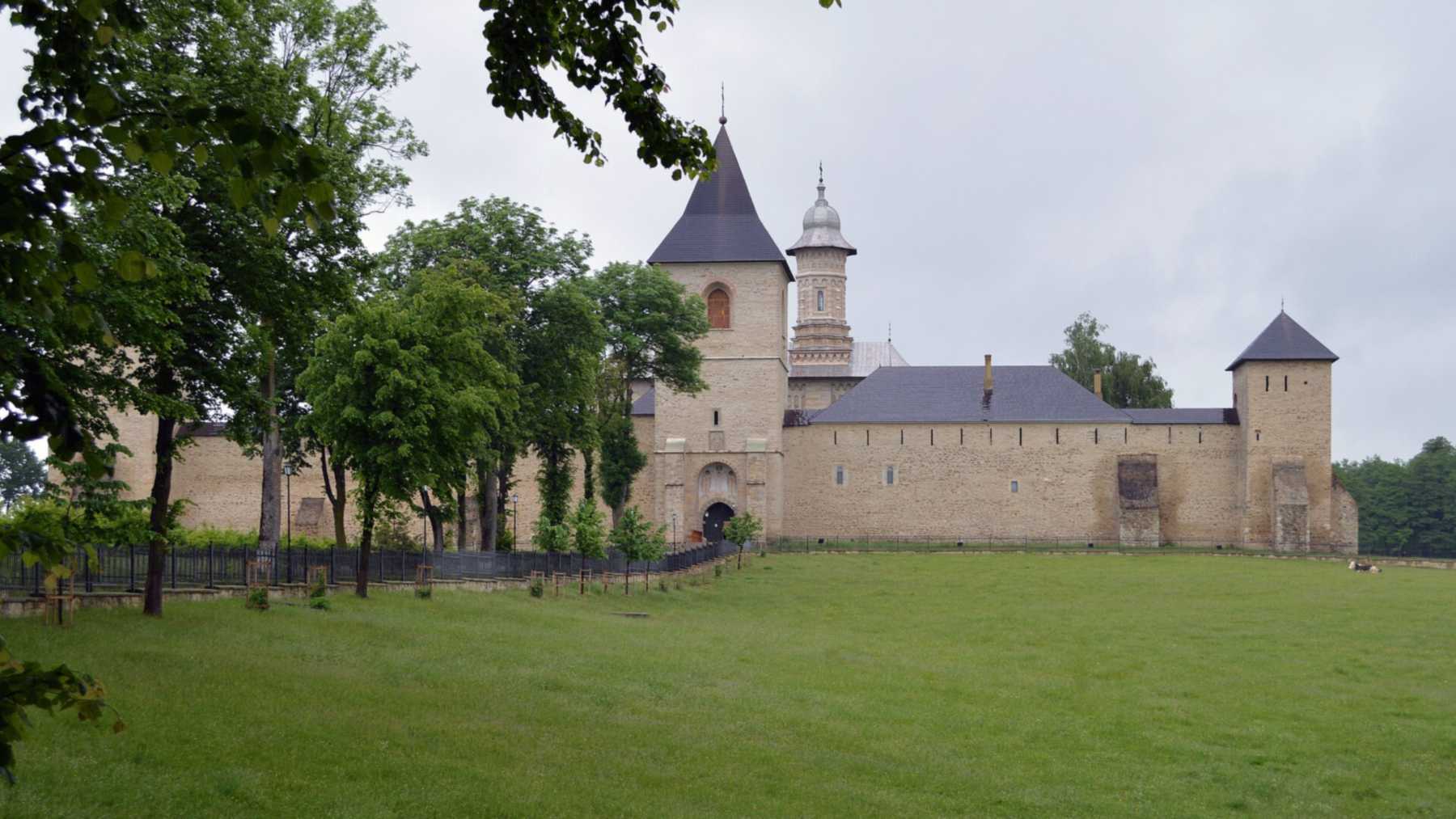
A tall church behind fortress walls
The monastery is about 7.5 miles (12 kilometers) north of Suceava. Its main church, per the Suceava County tourism page, is 35 meters long, about 9.5 meters wide and about 42 meters high, or roughly 115 by 31 feet and 138 feet tall.
Metropolitan Anastasie Crimca built it in the early 1600s. The walls came in 1627, from Prince Miron Barnovschi-Movilă: 1.7 meters (5.6 feet) thick, around 11 meters (36 feet) high, four towers at the corners.
“It is tall and narrow like a casket of holy relics and is one of the most brilliant monuments of our old architecture,” Nicolae Iorga wrote of the church. The line is quoted on the monastery website.
An architect hired from Byzantion
The stone is Syll.³ 707. Its first lines are lost, and the English translation on Attalus picks up mid-story: “Eupolis son of Philomelos, who was sent to Byzantion with instructions to procure an architect, hired Epikrates, who on arriving here performed many advantageous things in addition to letting out tasks.”
Then: “he adapted himself to the situation in the city and accepted the pay that the people determined; and when the Olatic war was announced, he prepared everything necessary for the occasion with skill and zeal.”
The city made him “supervisor of the walls for two years.” He stayed “for many years.” He “conducted himself blamelessly.”
For that he got a golden crown “in the theatre at the Thargelia,” a festival of Apollo, and “proxeny, citizenship, the right to sail into and out of the city, both in war and in peacetime,” for himself and his descendants.
Proxeny made a foreigner the city’s official friend. “Today, in modern Greek, ‘proxenos’ means ‘consul’ and ‘proxenia’ means ‘consulate,'” Olteanu wrote.
The magistrates had to put the decree “on a stone stele and place it in the temple of Apollo.” Walls like the ones Epikrates looked after could decide a war, as in the siege of Ambracia against Rome.
Histria, or Olbia
The top of the stone, with the city’s name, is gone. Dionisie M. Pippidi, a Romanian historian, put it in the corpus of inscriptions from Histria, a Greek colony on Romania’s Black Sea coast, and dated it to the first half of the 3rd century BC.
Olteanu leans the same way and ties it to a 3rd-century BC fight between Byzantion and Kallatis over the trading post at Tomis. “Possibly in this context the architect Epikrates came from Byzantion to Tomis or Histria, where he offered his services as an architect, for possible restoration work on parts damaged by the conflict,” he wrote.
Cojocaru, a senior researcher at the Institute of Archaeology in Iași of the Romanian Academy, disagrees. “As the Histrian origin looks questionable I am discussing it again, trying to provide a more credible argument,” he wrote.
“Unlike my predecessors, who seem to have revealed only convenient arguments leaving out far more important details, I propose a much more complex approach.”
That approach runs “from the festival of Thargelia and olatikos polemos, to onomastics and Sarmatians ‘tamga’-signs.” It ends at Olbia, a Greek city at the mouth of the Southern Bug in what is now Ukraine.
“The analysis undertaken allows me affirm with a great degree of probability that Olbia should be considered Epicrates’ city of residence,” Cojocaru wrote. O. Fiebiger had suggested Olbia about a hundred years earlier.
Sarmatian marks inside a wreath
Three laurel wreaths are carved in a row on the stone, Olteanu writes. Inside it, somebody later scratched signs that look like tamgas, the clan marks of the Sarmatian nomads who lived north of the Black Sea.
Two Soviet epigraphers, Yuri Vinogradov and Petr Karyshkovsky, took this up in a 1984 review. They credited the scholar E. I. Solomonik with spotting the marks. With them, they said, the decree’s origin, “or at least the location,” can be tied to one of the northern Black Sea cities “with great probability.”
E. A. Kozak had already noted in 1903 that the marks were “incised by a later hand,” which is why Vinogradov and Karyshkovsky hedged with “or at least the location.”
Then the “Olatic war.” Some thought the mason meant “Galatic,” for the Celtic Galatians. Fiebiger checked a paper squeeze of the stone and wrote in 1917 that the idea of the mason carving the wrong word “appears too daring.” Attalus says “nothing else is known” about this war, probably fought against a local Thracian tribe.
Nobody agrees on the date either
Attalus gives “c. 270-220 B.C.” Pippidi said the first half of the 3rd century BC. Adolf Wilhelm, the Austrian epigrapher, put it at the end of the 2nd century BC. The monastery’s website says the 2nd or 1st century BC. Olteanu writes of the Hellenistic era, “somewhere in the 3rd century BC.”
The historian Michael Rostovtzeff had warned about this kind of dating in general. “The forms of the letters are not a sure guide, and the political, economic and military situation of the cities remained the same for a long time,” he wrote.
The monks called it the architect’s grave
S. Kritikos printed the text first, in March 1885, in Hesperos, a Greek paper published in Leipzig. Grigore Tocilescu put it into a Vienna journal in 1887. Cojocaru calls him “the founder of the Romanian school of epigraphy.”
Tocilescu got little out of Dragomirna. “The monks know next to nothing about the origin of the stone. They say it is the gravestone of the monastery’s architect,” he wrote.
People long believed Dima, the legendary builder of Dragomirna, was buried under it, the county page says.
Scarlat Lambrino went to look. The archive “kept no trace of the arrival of this monument,” he wrote. All the monks had was “a legend without value,” which he called “a characteristic example of a legend based on a false interpretation of an ancient epigraphic text.”
Kozak saw five slabs in a row in the porch. The marble one, he noted, “cannot be connected with the person resting beneath it.” Jeanne and Louis Robert said it had served as a funerary slab in the narthex “since the second half of the 18th century.”
From the Black Sea to Suceava
Cojocaru suggests the slab “could have been brought from Suceava, already during the reign of Alexander the Good,” who ruled Moldavia in the early 1400s. The county page adds that it may have come with the relics of Saint John from Cetatea Albă, on the Dniester.
Or later, he wrote, “based on the contacts with Mangup and Genoese Crimea during the rule of Stephen the Great, or the links of the merchants of Suceava with the cities of the Northern Black Sea region, Ochakov included.”
Olteanu has his own route. “The inscription could have reached Dragomirna through monks or merchants who retraced the route from Dobruja to Moldavia,” he wrote. Or it went first to Brăila or Galați, on the Danube.
“The writing and the look probably led the builders to use it as a flagstone for the floor.” Romania keeps surprises like this one, as with a 6,000-year-old pottery kiln.
What is still open
“Although the city is not explicitly named, most scholars agree with the opinion of Sylloge³, that it was a decree of Olbia,” the Attalus editors write. The monastery sticks with “an unidentified town on the shores of the Pontus Euxinus,” the Black Sea.
Cojocaru’s own wording is “with a great degree of probability.” Epikrates’ hometown later became Constantinople, home of Hagia Sophia.
Quotes from the older German, French, Russian and Romanian sources are our translations.
The full study, “Noch einmal zur Herkunft des Ehrenbeschlusses für Epikrates, Sohn des Nikobulos,” was published in Acta Musei Varnaensis.
The slab is still in the porch floor at Dragomirna.
Image: DimiTalen / Wikimedia Commons (CC0)