Imagine hearing Roman pickaxes beneath your street and realizing an army is tunneling under the city walls. In 189 BCE, defenders of Ambracia in northwestern Greece answered that nightmare with a device built from clay, iron, fire, feathers, and a blacksmith’s bellows.
The historian Polybius recorded that the machine forced Roman miners out of a cramped tunnel with thick, biting smoke. A 2025 systematic review of chemical warfare includes Ambracia among ancient toxic-smoke incidents, but the episode is best described as one of the earliest detailed cases of deliberately weaponized smoke, not unquestionably the first poison-gas attack in history.
Rome hits a wall
Ambracia was one of the leading cities of ancient Epirus and had once served as the royal center of Pyrrhus, the king remembered for his costly victories against Rome. By 189 BCE, the city was tied to the Aetolian League and faced an assault led by Roman consul Marcus Fulvius Nobilior.
The Romans attacked with battering rams and other siege machinery, repeatedly damaging sections of the defenses. The Ambraciots answered by building inner walls behind the breaches, dropping heavy objects onto the rams, and launching sudden attacks on the soldiers working outside.
That resistance forced Rome to look below ground. Polybius wrote that Roman crews began a mine behind a covered walkway about 200 ft. long, working in shifts day and night as they tried to undermine the wall.
Listening for hidden miners
At first, the digging went unnoticed. Then the mound of excavated soil outside the Roman position grew too large to hide, warning the defenders that danger was moving under their feet.
Finding the exact tunnel was harder. The Ambraciots dug a trench inside the city, placed thin bronze vessels along it, and listened for vibrations caused by Roman tools striking the earth. It worked like a simple underground alarm system, centuries before electronic sensors.
Once they located the noise, the defenders dug a counter-tunnel at a right angle and broke into the Roman mine. Soldiers initially fought with spears in the darkness, but shields, screens, and the narrow passage made ordinary combat ineffective. So the Ambraciots changed the air itself.
A jar that breathed smoke
Polybius described an earthenware jar made to fit the width of the tunnel. The defenders filled it with fine feathers, added a small fire, fitted a perforated iron lid, and connected an iron funnel to bellows like those used by a blacksmith.
They sealed the gaps around the vessel so the smoke would move toward the Romans rather than blow back into their own passage. As the bellows fed the fire, the jar pushed a dense cloud into a space where the miners had little room to turn, see, or breathe.
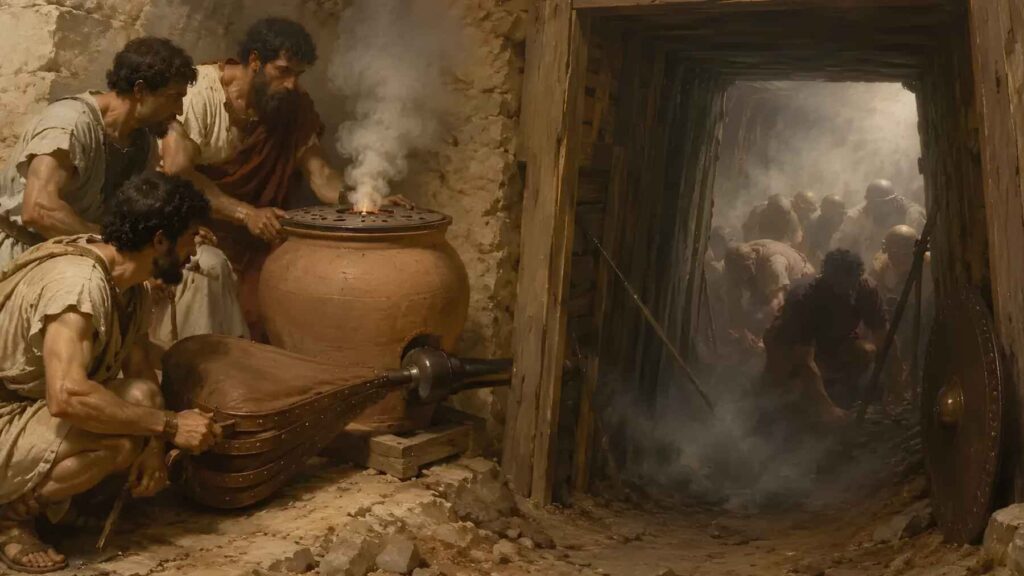
Polybius called the smoke “exceedingly pungent” and wrote that the Romans could neither stop it nor endure it. The account does not report deaths, but it does say the miners were left in a deeply distressing position and the siege was prolonged.
Was this really poison gas?
Modern headlines often call Ambracia the first poison-gas attack, but that label needs care. A recent systematic review describes much older reports involving poisoned weapons, contaminated water, and toxic fumes across ancient India, China, and the Mediterranean.
A 2023 paper in Military Medicine went further and described Ambracia as the earliest deliberate use of sulfur dioxide as a chemical weapon. Its authors argued that the burning material likely generated the gas, but the conclusion remains a modern reconstruction because Polybius identified no chemical compound.
In practical terms, “weaponized toxic smoke” is the more accurate phrase. It explains what the device did without making the scene sound like an industrial gas attack from World War I.
More than a strange ancient trick
The most striking part of the story is not simply that feathers burn badly. The defenders created a full response system combining acoustic detection, counter-mining, airflow control, a tight seal, and a smoke source chosen for its harsh effect.
Think about the sequence. They spotted the discarded soil, listened through bronze vessels, calculated where to dig, met the enemy underground, and built a device shaped for that exact tunnel. The cleverness was in the chain of decisions.
It also carries an environmental lesson that still feels familiar. Materials do not have to be synthetic to become dangerous when fire, poor ventilation, and confined space come together. Anyone who has coughed beside a smoky backyard fire knows the basic sensation, though the Roman miners faced it in darkness with no easy exit.
Smoke delayed Rome but did not save Ambracia
The smoke disrupted the mining attack, but it did not reverse the war. Negotiations followed, and Ambracia surrendered under terms that allowed the Aetolian garrison to leave while the Romans took control of the city.
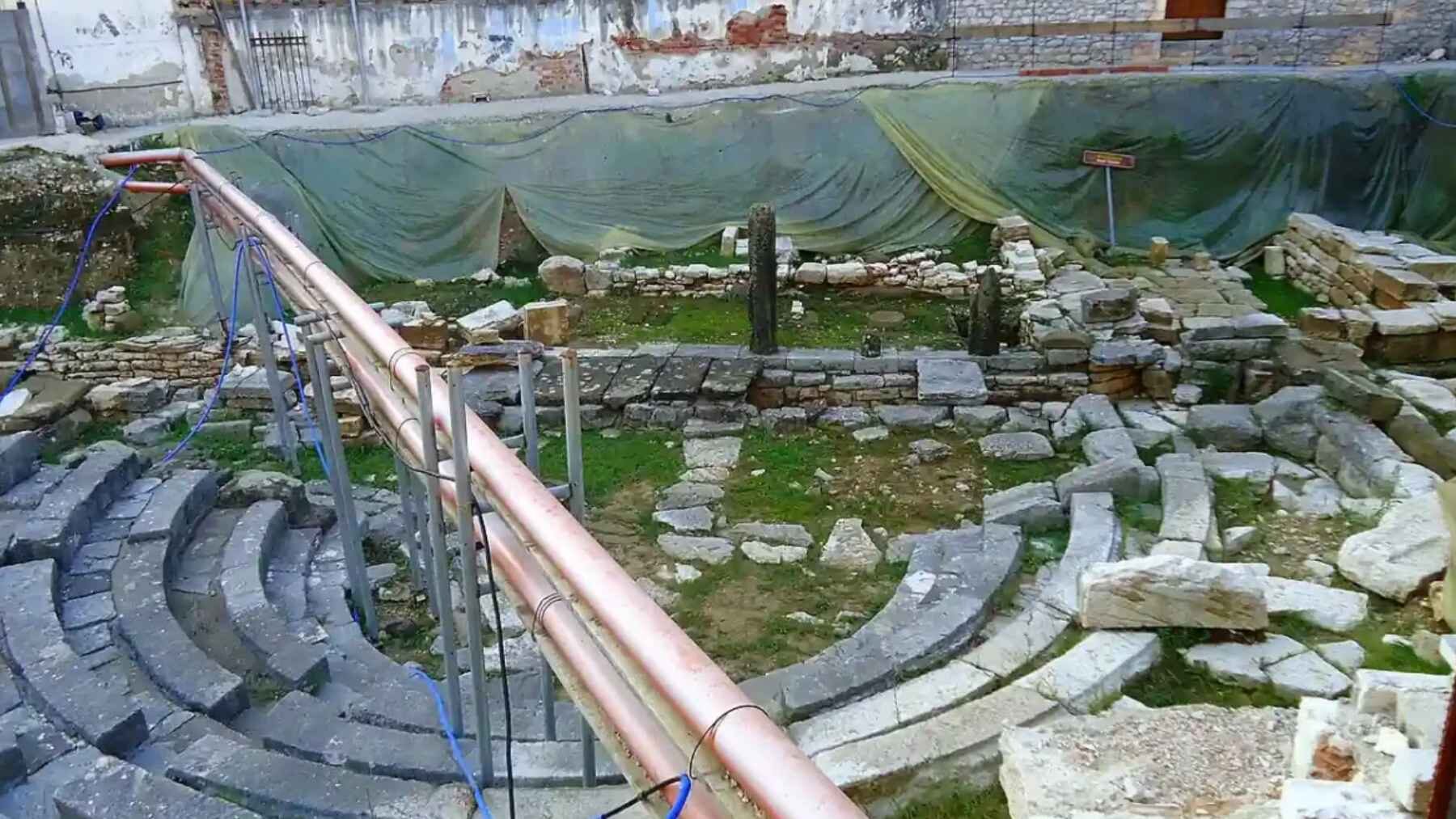
Polybius wrote that Fulvius removed statues and paintings because Ambracia had once been a royal residence of Pyrrhus. The city later declined, while modern Arta grew across the same landscape and preserved only scattered windows into the ancient settlement.
Greece’s Archaeological Museum of Arta describes Ambracia as an urban, political, economic, and artistic center of ancient Epirus. That makes the tunnel episode more than an odd battlefield anecdote. It is a glimpse of how a sophisticated city used observation and local materials to resist one of the ancient world’s strongest armies.
Why Ambracia still matters
Chemical warfare did not begin with factories, cylinders, or laboratory-made agents. Long before modern chemistry, people understood that smoke, airflow, plants, minerals, and animal materials could be turned into weapons.
The Ambraciots did not win the siege, but they solved an immediate problem with remarkable precision. For a brief moment underground, Rome’s military machine was stopped by a clay jar and a cloud of burning feathers.
The systematic review was published in the Journal of Toxicology.