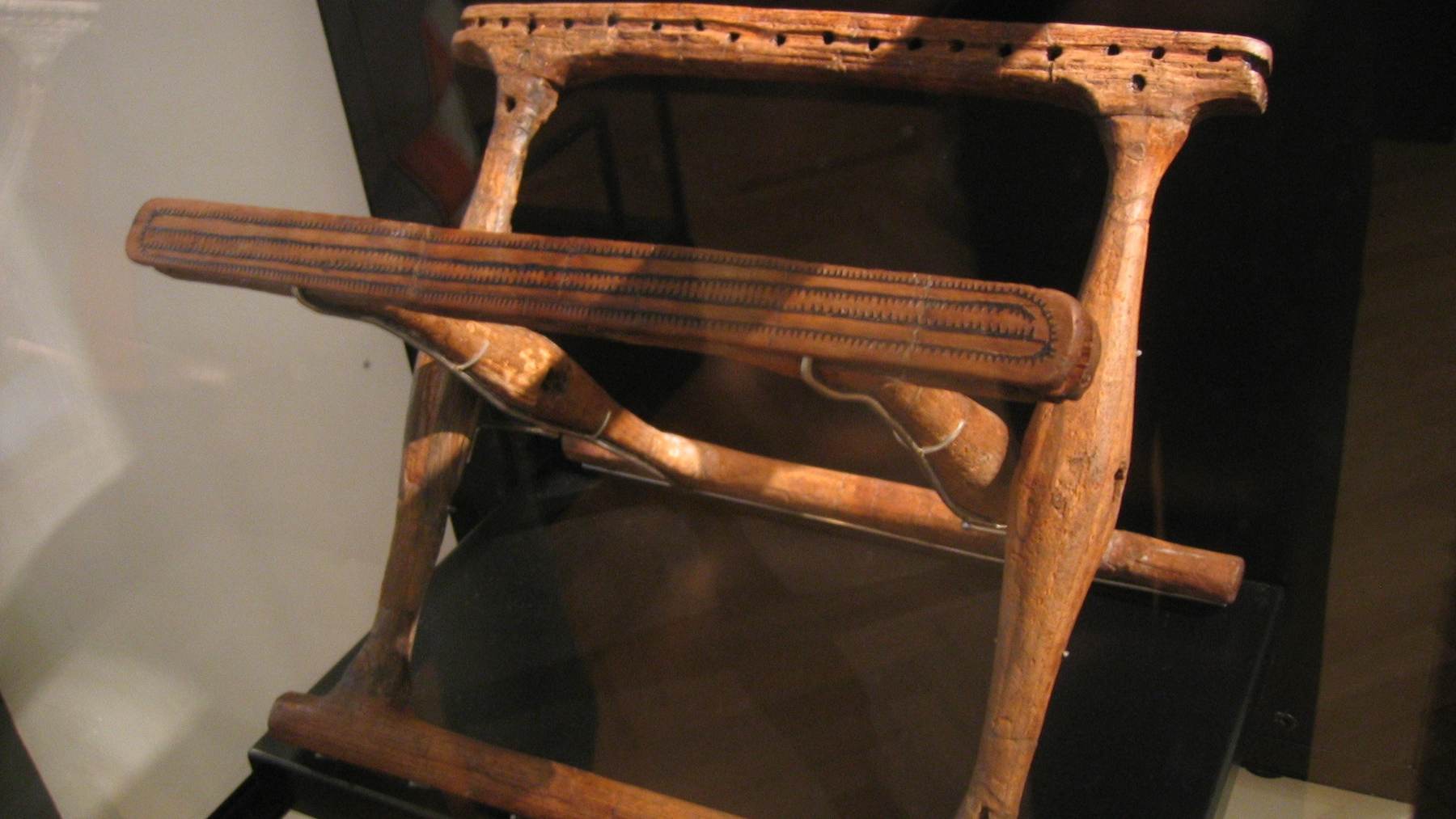
In July 1891, in the rain, archaeologist Vilhelm Boye opened a plow-damaged burial mound near Vamdrup in southern Jutland, and the National Museum of Denmark tells it this way: “Among the objects in the barrow were an oak coffin containing the body of a man. At his feet lay a very unusual object,” the museum writes, and then, with an exclamation point, “a folding chair!” More than 130 years later, that Bronze Age folding chair is, in the museum’s words, “the only completely preserved chair from the Bronze Age in Europe.”
“The fine little chair, which was very well preserved, was made of ash wood with carved patterns featuring black pitch inlay. The seat was of otter skin,” according to the museum, which dates it to the second half of the 1400s BC, roughly 3,400 years ago, and adds that only a fragment of the skin is left.
Boye’s friend Henry Petersen, then the inspector for the preservation of ancient monuments, saw the finds when they were unpacked in Copenhagen and wrote back to him in Danish, “Stolen aah! Magnifique,” or “The chair, ah! Magnifique,” in a letter that also mentions he still owed for the wagon and the beer at the inn.
The mound was called Gold Hill
Guldhøj means “Gold Hill,” and it had once been more than 98 feet (30 meters) across and close to 16 feet (5 meters) high, before plowing cut away several meters of it, according to a 2003 profile of Boye by Anders Otte Stensager in the Danish archaeology yearbook Kuml.
Stensager writes that Boye and Petersen “became close friends with a common interest in new finds, as during the excavation of Guldhøj in 1891. Boye had no draftsman at the excavation, but he did have a local photographer who recorded some aspects of the opening of the first oak coffin. These are the first photographs ever to be taken during an excavation, even though photography by then was nothing new.”
In one of them, the caption notes, “Boye stands on the far left with his characteristic white builder’s cap, with Henry Petersen next to him in the tall white hat.” The photographer was a local school headmaster named Hansen.
Boye apparently liked to introduce himself to farmers with a line Stensager used as the title of his article, “My name is Boye, I dig cairns and old mounds.”
Three coffins and a man of rank
“When Guldhøj was excavated, three oak coffins from the Bronze Age were found,” the museum writes. One adult coffin “had been robbed,” and a child’s coffin “had been lined with black goatskin,” with remains of woven clothing, two dried apples and an arrow shaft inside, and the child’s body had “decomposed into a gruel-like reddish mass, as the finder put it.”
“The third oak coffin belonged to an adult male. He had been given the unusual folding chair. But his prosperity did not end there.” The museum lists a bronze dagger, a bronze axe, a bronze pin and two wooden bowls, along with “a bark box and a spoon of horn.”
Finds of textiles in that coffin, the museum says, reveal that “the buried man was dressed in a woven garment of wool,” with fragments of two hats with round crowns, a woolen shoe or mitten, a leather shoe and “a cloak or kilt made of textile.”
Its finder wondered if it was a table
Boye was not so sure the chair was a chair. “It looks like a folding chair, but because the framework is so slender, it is possible that it was used as a kind of table,” he wrote in Danish in his 1896 book on oak-coffin finds, in a passage Stensager quotes.
A 1999 study in Kuml by Kirsten Prangsgaard, now a curator at Museum Odense, and colleagues gives the measurements. Its two frames are each 13 inches (33 centimeters) tall, and set at a 45-degree angle they give a seat height of about 9.4 inches (24 centimeters), on a seat roughly 9.4 by 13.8 inches (24 by 35 centimeters). The bronze nails that should hold the legs where they cross are missing, and the authors think those were removed before the chair went into the grave.
The study grew out of a different grave. At Bredhøj, one of five mounds excavated at Lejrskov, west of Kolding, in 1995, a stone cist (a box-shaped grave built of slabs) held “four bronze caps from a folding chair.”
Chairs that turn up beside warriors
Counting Bredhøj, “folding chairs are known from 16 graves and one hoard in Denmark, Southern Sweden, and Northern Germany,” the authors write, and only Guldhøj’s survives whole.
“The folding chairs are often found in connection with swords. However, this is not the case in the Danish finds,” they write. At Guldhøj the man had a dagger and an axe, and at Storehøj there was an empty sword scabbard.
Their Danish text links the chairs to Early Bronze Age warrior graves, but the summary is careful: “Folding chairs are considered evidence of high status. However, not all contemporary warriors’ graves contain folding chairs.”
A Mediterranean idea, built in Denmark
“In the Mediterranean area folding chairs like the one from Guldhøj were important pieces of furniture,” the museum writes, and “the chairs were also used as grave goods in the richest graves.” Tutankhamun, who died in 1327 BC, had one in his tomb, and “it was made of ebony and ivory and it had gold fittings.”
“There is no doubt that the folding chair itself did not make the journey from the Mediterranean area to Denmark. But the idea or design of the chair did travel that long distance,” the museum says. “The idea came from far away, although the chair itself is a domestic product.”
Prangsgaard and her co-authors see the chairs as a sign of something larger: “The occurrence in the North mirrors a network with many ramifications and centres, connecting the peoples from Greece across Italy and farther, through Europe to Northern Germany and Denmark.” Amber was the main known raw material heading south along it, the same fossil resin that has exposed trade routes that crossed half of Europe even earlier.
According to the 1999 study, the Etruscans, whose high-ranking dead still turn up in Italian tombs, took the folding chair over from the Greeks, and it later became the Roman sella curulis used by the Republic’s top officials.
A bowl with tin stars
The man’s other prize sat beside the chair, a wooden vessel “decorated with tin tacks hammered in to form a star pattern; perhaps a symbol of the radiant sun.”
Of the 22 Early Bronze Age wooden vessels known from Denmark and northern Germany, 14 carry tin tacks, and the museum’s verdict is that “both the folding chair and a turned wooden bowl decorated with tin tacks can only be described as rare objects of high prestige.” In Britain, status and belonging took other forms, such as the massive meat feasts held about 3,000 years ago.
What is still uncertain
The date has a small spread. The museum gives 1389 BC for the man’s coffin from dendrochronology, which matches the oak’s tree-ring pattern against a known sequence of growth years, while the 1999 study gives 1381 BC in its Danish text and 1382 BC in its English summary.
Only a scrap of the otter-skin seat survives and the other Nordic chairs are known from fragments, so how typical Guldhøj was can’t be checked; the study even estimates from the cap positions that the Bredhøj chair was about twice as large.
How the chairs were used is inferred from graves and from Mediterranean parallels, since Bronze Age Scandinavia left no writing. In the museum’s words, “the folding chair marked the high rank of the seated person in connection with ceremonies.”
On show in Room 9
The chair is exhibited in Room 9 of the National Museum of Denmark in Copenhagen. “The design of the chair is simple and practical,” the museum notes, and Ole Wanscher reworked it in 1934 as his PJ-2000 chair, as Poul Hundevad did with his “Guldhøj Stool.”
Boye finished the manuscript of his oak-coffin book in April 1896 and, Stensager writes, “soon after the book was published Boye became ill.” He died on September 22 that year.
Photo: Bullenwächter / Wikimedia Commons (CC BY-SA 3.0)