The General Conference on Weights and Measures, meeting in Versailles, west of Paris, adopted a rule on Oct. 15, 2026, that ends leap seconds starting May 20, 2027. Noël Dimarcq, president of the Consultative Committee for Time and Frequency, said the decision closes three decades of debate among the world’s timekeepers.
“After 30 years of debates, Resolution 5 establishes a new rule to ensure the continuity of UTC, thus eliminating leap-second discontinuities,” Dimarcq said.
A few weeks earlier, a geodesist in Greece had published a separate study finding that Earth’s solid surface is getting slightly rounder, a change he links to melting polar ice.
Leap seconds end in May 2027
The 28th General Conference met from Oct. 13 to 15 at the Palais des Congrès de Versailles. Resolution 5 makes continuous UTC effective on May 20, 2027, and sets the largest allowed gap between Earth time and atomic time at 3,600 seconds (1 hour).
Why one second caused trouble
The National Institute of Standards and Technology explains the mismatch. UTC is an atomic time scale, based on clocks that are more stable than Earth’s rotation, while time based on Earth’s turning, called UT1, is irregular. Leap seconds keep the difference between the two under 0.9 seconds, and since 1972 there has been one about every year and a half on average.
Dimarcq said those jumps disrupt industries and critical infrastructure that depend on precise and continuous synchronization, including transportation, energy and telecommunications. The last leap second came at the end of 2016, and on July 6, 2026, the IERS Earth Orientation Center at the Paris Observatory said in Bulletin C 72 that none would be introduced at the end of December 2026.
So far, every leap second has been positive, NIST notes, though the rules allow negative ones, which would skip a second and leave a 59-second minute. The resolution cites a March 2025 workshop of Earth rotation experts who estimated that the probability of a negative leap second will increase rapidly, reaching 30 percent by 2035. One has never been applied, and the text says it would pose a “high risk of causing anomalies and disruption to critical infrastructures that are largely unprepared,” with preparations costing industry about as much as the millennium bug.
GPS stations show a rounder planet
The shape study, by Christopher Kotsakis, a full professor of geodesy in the School of Rural and Surveying Engineering at Aristotle University of Thessaloniki, appeared Sept. 9 in the Journal of Geophysical Research: Solid Earth. Earth is slightly flattened at the poles and bulges at the equator, his plain-language summary explains, and that shape is not fixed. That bulge is why Ecuador’s Chimborazo sits farther from Earth’s center than Mount Everest.
Kotsakis used vertical speeds from 886 GNSS stations, the satellite positioning receivers that include GPS, between 1997 and 2015. Uplift near the poles rose from about 0.5 millimeters a year in 1997 to 2000 to nearly 1 millimeter a year by 2011 to 2015, or from about 0.02 to 0.04 inches, while ground near the equator sank at a similar pace. “This means that solid Earth’s overall shape is becoming slightly less flattened,” the summary says.
Ice loss lifts the ground
Land is still rebounding from ice-age glaciers, which keeps Finland rising from the sea, but the models put that polar effect below 0.3 millimeters a year. Kotsakis points instead to the growing loss of ice in Greenland and Antarctica, which makes the solid Earth deform in response. NOAA’s 2025 Arctic Report Card puts the net loss from Greenland’s ice sheet at about 129 billion metric tons in the year ending Aug. 31, 2025, and the sheet has lost ice every year since the late 1990s.
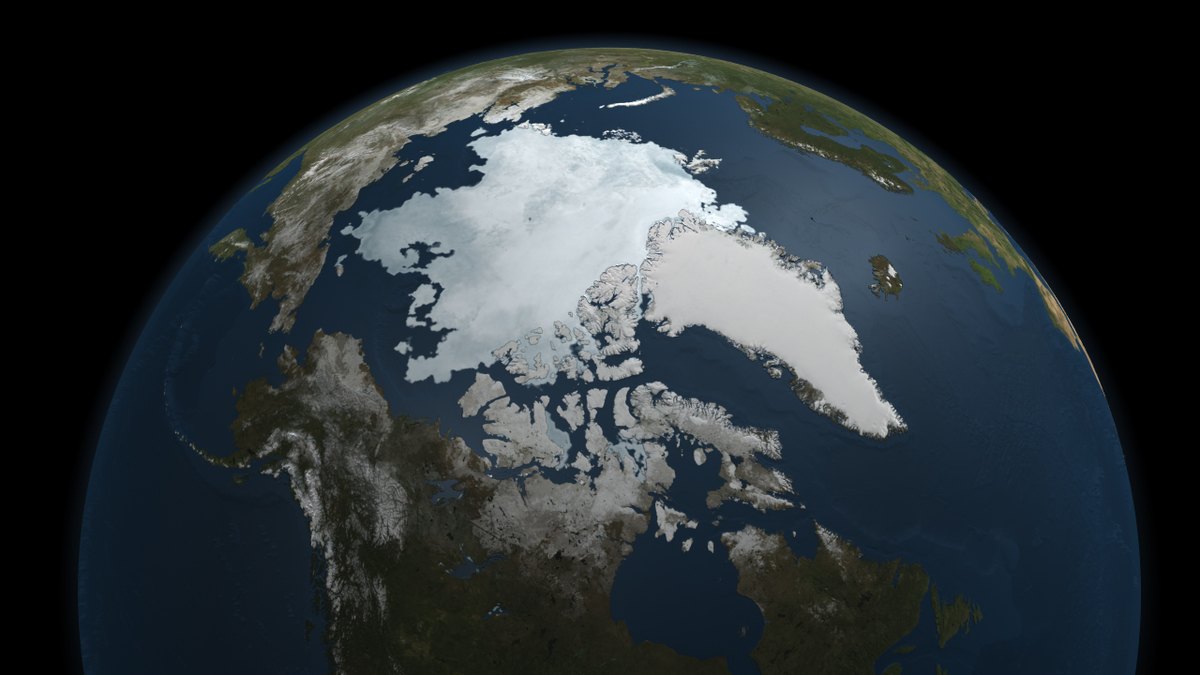
At the equator, he writes, the sinking likely reflects meltwater moving toward lower latitudes, where the added weight on the ocean bottom pushes the seafloor down.
Satellites that track Earth’s gravity have seen the opposite since about 2000, with the geoid, the shape the ocean would take under gravity alone, becoming more oblate. Kotsakis writes that the two effects are physically compatible: meltwater moving from high to low latitudes lifts the poles and lowers the equator while concentrating more mass around the equator.
Meltwater slows the spin
Moving mass toward the equator also slows the planet, NASA says, much as an ice skater slows a spin by lowering and spreading their arms. NASA-funded researchers found that since 2000, days have been getting longer by about 1.33 milliseconds per 100 years, faster than at any point in the prior century.
“In barely 100 years, human beings have altered the climate system to such a degree that we’re seeing the impact on the very way the planet spins,” said Surendra Adhikari, a geophysicist at NASA’s Jet Propulsion Laboratory and co-author of both papers.
Deep inside, Earth’s liquid core pushes the other way. In a 2024 paper in Nature, Duncan Agnew of the Scripps Institution of Oceanography reported that the core has been slowing since 1972, which has sped up the rest of the planet. He projected that UTC as now defined would need a negative jump by 2029, three years later than it would have without the recent acceleration in polar melting, and concluded that “global warming is already affecting global timekeeping.”
The IERS schedules leap seconds only for the end of June or December and has ruled out December 2026, so continuous UTC begins before the next possible date, even as climate change keeps tugging on the world’s clocks.
What remains uncertain
Kotsakis’s record ends in 2015, and GNSS stations are thin in polar regions and over the oceans. For the equator, his tests support confidence in the trend but call for caution about its absolute size. Still, he writes, the results agree across methods and with independent gravity data, which suggests a genuine geophysical signal.
Earth time will still be published after May 2027, in GNSS navigation messages and by the IERS and national labs, according to the resolution. Older radio equipment gets a transition until 2035, and no later than 2040 where it cannot be replaced earlier, under a rule adopted by the 2023 World Radiocommunication Conference.
The full study was published in Journal of Geophysical Research: Solid Earth.
Photo: BIPM