Chinstrap penguin droppings across Antarctica release an estimated 490,000 metric tons of methane a year. That is about 540,000 U.S. tons, according to a study published on September 23 in npj Climate and Atmospheric Science. Scientists from Spain’s Institute of Marine Sciences of Andalusia (ICMAN-CSIC) and the University of Granada measured the gas at two colonies on Deception Island.
Methane traps more heat than carbon dioxide but breaks down faster. Penguins had not been treated as a relevant source in the global methane inventory, the Spanish National Research Council (CSIC) said. It announced the results in Spanish on October 8.
Vapour Col and Baily Head
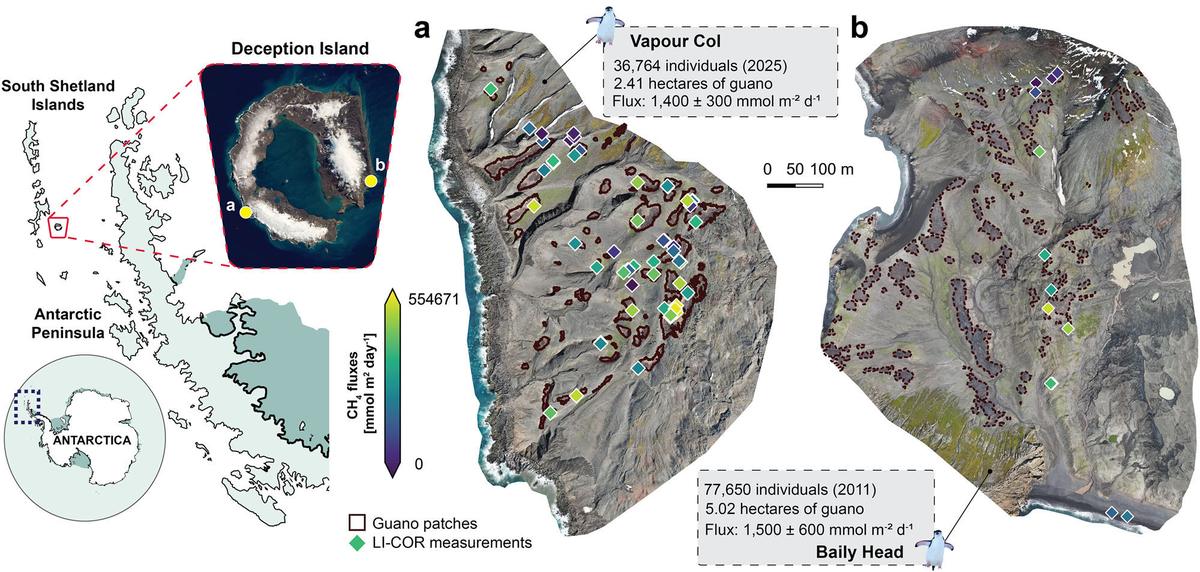
Deception Island lies in the South Shetland Islands, west of the Antarctic Peninsula. Its penguin colonies sit on steep slopes that lose their ice each summer. The team sampled methane at 87 points in two of the island’s largest chinstrap colonies.
Vapour Col got 74 of those points, spread over January 22 and 25, 2025, because it was easier to reach. Baily Head, on the eastern coast, got 13 on February 1.
First author Alejandro Román, a researcher at ICMAN-CSIC in Puerto Real, worked with Emma Huertas, who supervised the study. According to CSIC, Huertas runs the DICHOSO project together with Antonio Tovar.
Chambers below, drones above
On the ground, the researchers set an airtight PVC chamber about 4.7 inches (11.9 centimeters) wide over the soil. A tube carried the trapped air to a LI-COR gas analyzer that logs one methane reading per second. How fast the gas built up inside showed how fast it was leaving the soil.
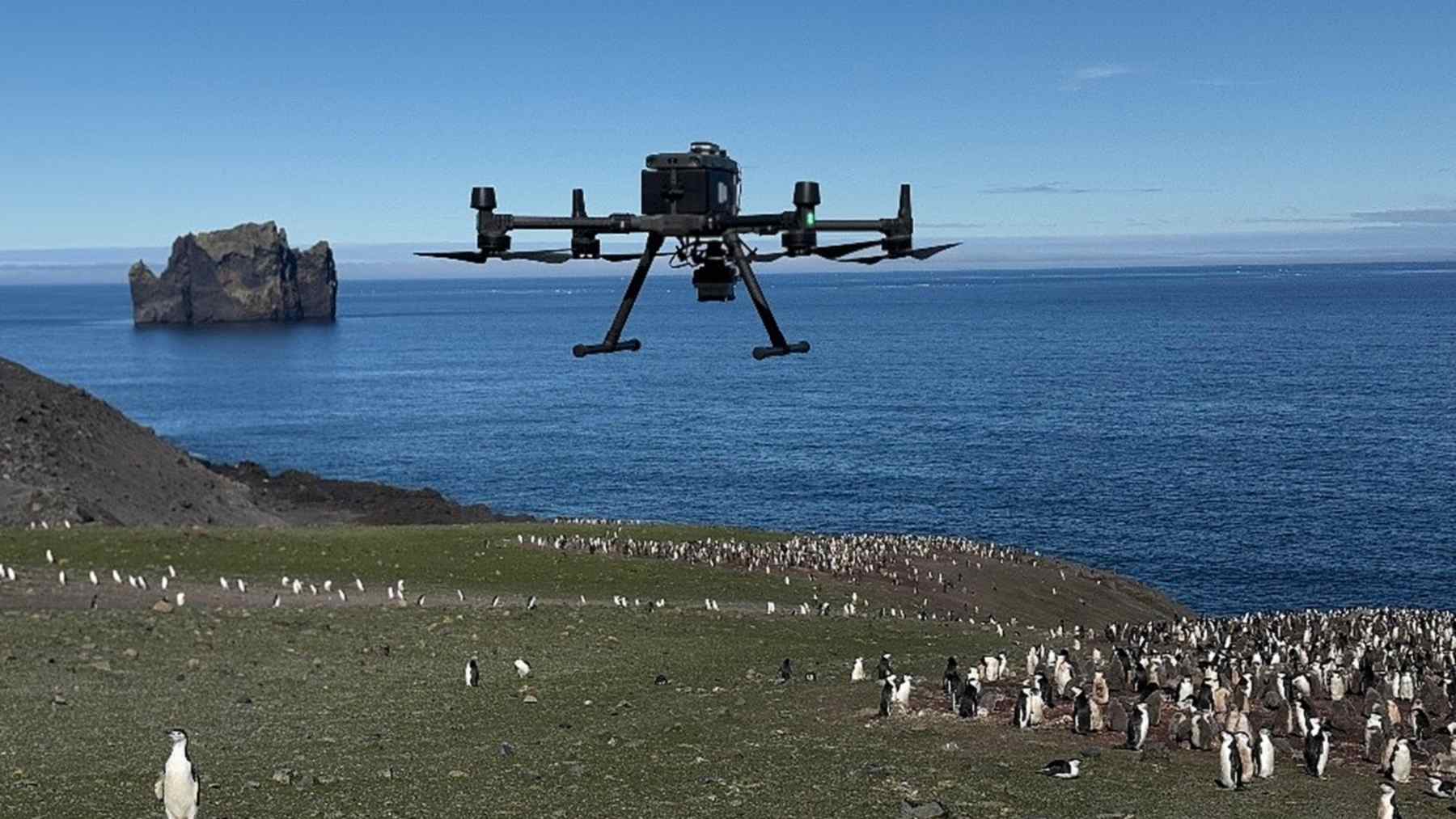
Each reading covered only about 15 square inches (0.01 square meters). To scale up, the team flew two drones, one with a multispectral camera and one with a regular color sensor.
From those images, the scientists outlined every brown guano patch and counted the birds. At Vapour Col, a deep-learning model found 36,764 penguins, including 22,274 chicks.
Accumulated guano “generates extraordinarily intense methane emission hotspots that until now had not been measured or quantified on the ground,” Román said in the CSIC statement, translated from Spanish.
Guano patches against bare ground
Over guano, methane flux reached about 12,000 millimoles per square meter per day at Vapour Col. At Baily Head it hit 23,000. On soil without guano in the same colonies, average fluxes were orders of magnitude lower and close to zero.
Scientists call this ground ornithogenic soil, built up by bird waste and rich in carbon and nitrogen. Microbes feed on it. Where oxygen runs short, some of them make methane while others consume it, so moisture and soil chemistry set the balance.
One Vapour Col reading came in about ten times higher than any other, and the team left it out. Keeping it would have roughly doubled that colony’s guano flux, so the published numbers lean conservative on that point.
Per year, Vapour Col works out to about 1,700 metric tons of methane and Baily Head to 6,700. Baily Head is simply bigger, at 76 hectares (188 acres) against 21.5 hectares (53 acres).
Scaling to every chinstrap colony
For a continental total, the team used a 2020 global census of chinstrap colonies. It paired that with the nesting density seen by the drones, 1.5 birds per square meter. The result was about 4.4 square kilometers (1.7 square miles) of guano.
Multiplying that area by the guano emission rate gave 0.49 teragrams a year, plus or minus 0.16. A teragram is a million metric tons. The margin works out to roughly 176,000 U.S. tons either way.
The authors write that the number is “best interpreted as an order-of-magnitude constraint rather than a precise flux inventory.” CSIC likened it to the methane from the world’s entire coastal ocean.
Under 0.1 percent worldwide
Worldwide, sources put out roughly 575 teragrams of methane a year, which leaves the chinstrap share under 0.1 percent. Farms and fossil fuels dwarf it, and the authors say so plainly.
Small is relative here, though. The figure is about as big as the usual error bar on several single lines of the Global Methane Budget, around 1 teragram a year. Per square meter, the colonies also outpace most natural land and marine environments.
NASA estimates that about 60 percent of today’s methane emissions come from human activities. The gas lasts 7 to 12 years in the air. Pound for pound, it warms 28 times more than carbon dioxide over a century, according to the EPA.
Gaps in methane accounting have turned up elsewhere too. One New Jersey landfill emitted five times more than reported, and Siberian summer emissions roughly doubled between 2010 and 2023.
Winter emissions were never measured
Each colony got one or two days of sampling, all at the peak of the 2025 breeding season. The team then stretched those readings across 365 days, so the paper labels the yearly figure “an upper-bound, first-order approximation.”
Winter is the obvious blind spot, since snow and frozen ground likely slow the microbes down. Baily Head is another, because its nine sampled patches covered just 9.7 percent of its guano and its last census dates from January 2011.
Huertas went further in the CSIC statement. If all ground the birds affect is counted, she said, emissions “could reach about seven million tons of methane a year,” or about 7.7 million U.S. tons, in the same range as termites worldwide. The paper is more careful and says that number “should not be interpreted as an alternative emission estimate.”
Chinstraps have declined in parts of the region as sea ice and krill shifted, so this source can move too. The authors want penguin colonies written into future methane inventories, and CSIC says warming could alter both the birds and the soil microbes of Antarctica as polar ice loss continues.
The full study was published in npj Climate and Atmospheric Science.
Photo: ICMAN-CSIC