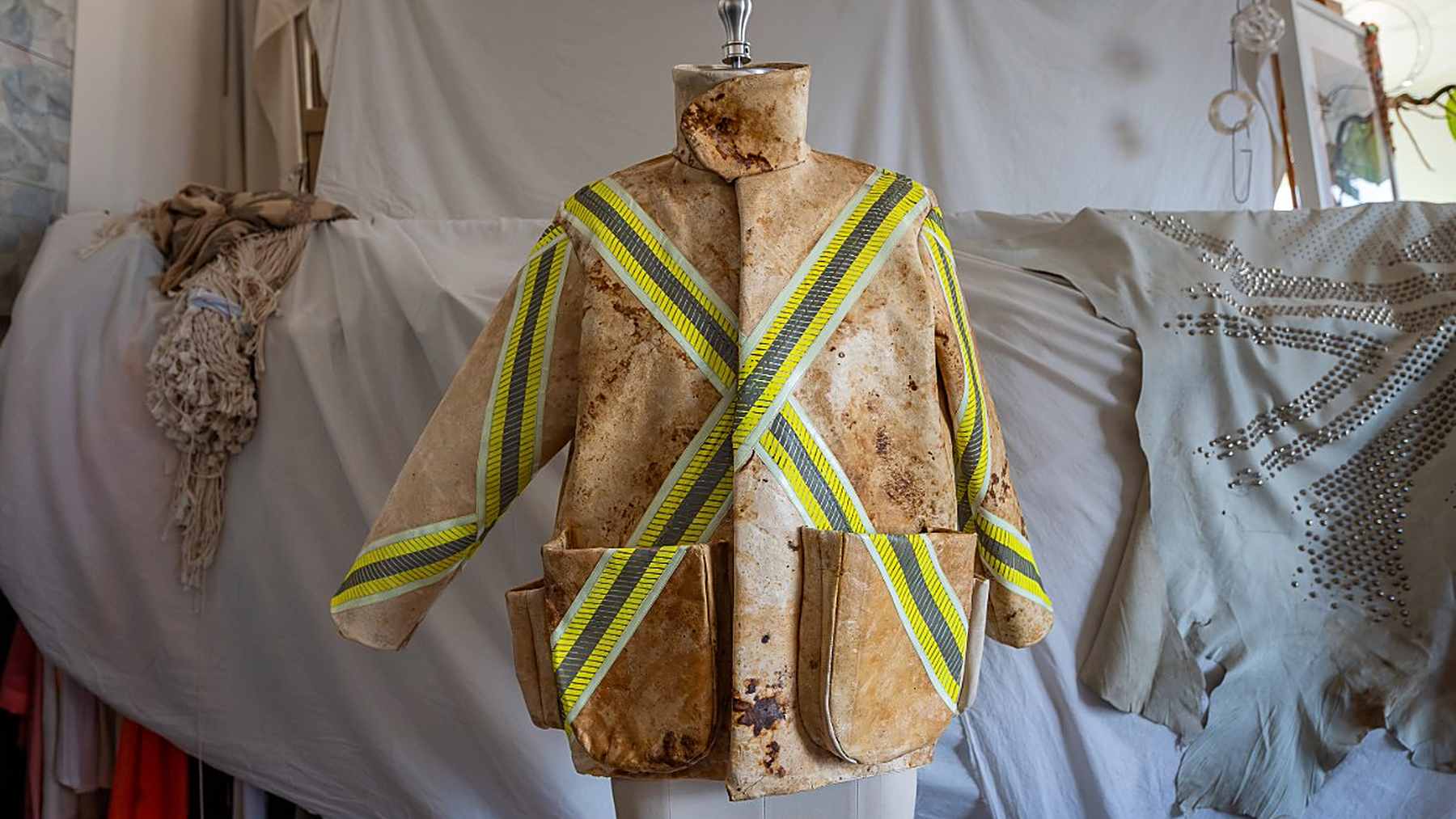
Researchers at RMIT University in Melbourne have built a wildfire jacket prototype from mycelium leather. The material grows from fungal networks fed with agricultural waste and water. Visitors can see the garment through February 7, 2027, in Plant Life: The Nature of Design, a free show at the National Gallery of Victoria.
RMIT’s September 17 announcement says the material already meets key international safety benchmarks. The only benchmark it names deals with harmful chemicals. So far, neither the university nor the gallery has released any fire-test figures.
A commission from Melbourne’s gallery
The gallery’s exhibition label says it commissioned the piece in 2026 with RMIT’s support. Four people get credit on that label. They are industrial designer Judith Glover, material scientist Tien Huynh, microbiologist Mohamad Arekha Bentangan and bio-designer Alexi Freeman.
Mycelium is the mass of fine threads a fungus grows through its food. Other labs have used it to shape living building blocks. For this coat, controlled growing conditions produced a leather-like sheet.
Huynh, of RMIT’s School of Science, traces the idea to the run-up to another Australian fire season. “Heading into another bushfire season made me reflect on the growing impacts fire has on communities, landscapes and ecosystems,” she said.
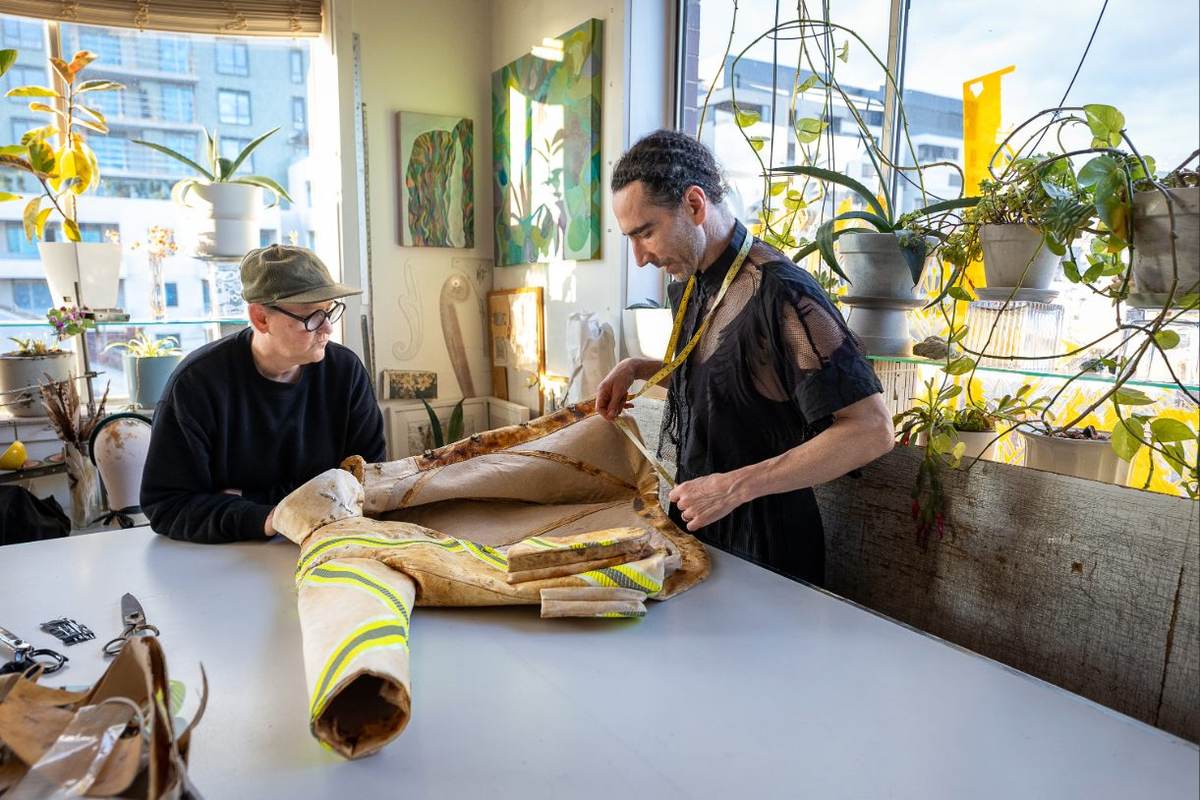
Glover works in RMIT’s School of Design and sees the coat partly as a teaching object. “The jacket demonstrates the power of creative practice to make emerging technologies visible, accessible and engaging,” she said.
Bed-linen rules for firefighter gear
RMIT reports that the material holds OEKO-TEX STANDARD 100 Product Class II certification. OEKO-TEX uses bed linens as its example for that class, which covers direct skin contact. Certified items get tested against a list of more than 1,000 harmful substances.
That matters for a coat someone might wear for hours on a fire line. Still, the standard measures chemical safety. It says nothing about how a sleeve behaves in flames.
OEKO-TEX also lists an optional certification for personal protective equipment, and it names firefighter clothing as an example. RMIT’s statement does not mention that credential.
According to the gallery, the material was also independently screened for PFAS, the so-called forever chemicals. Formaldehyde, heavy metals and phthalates were on the list too. The label gives no results, so readers can’t see what turned up or at what levels.
Char from an earlier cladding project
RMIT’s interest in burning fungi goes back several years. In 2023 a team there reported growing thin, uniform mycelium sheets for possible use in building cladding. The chemistry appeared in the journal Polymer Degradation and Stability.
Associate Professor Everson Kandare, a co-author who studies flammability, explained the appeal at the time. “The great thing about mycelium is that it forms a thermal protective char layer when exposed to fire or radiant heat,” he said.
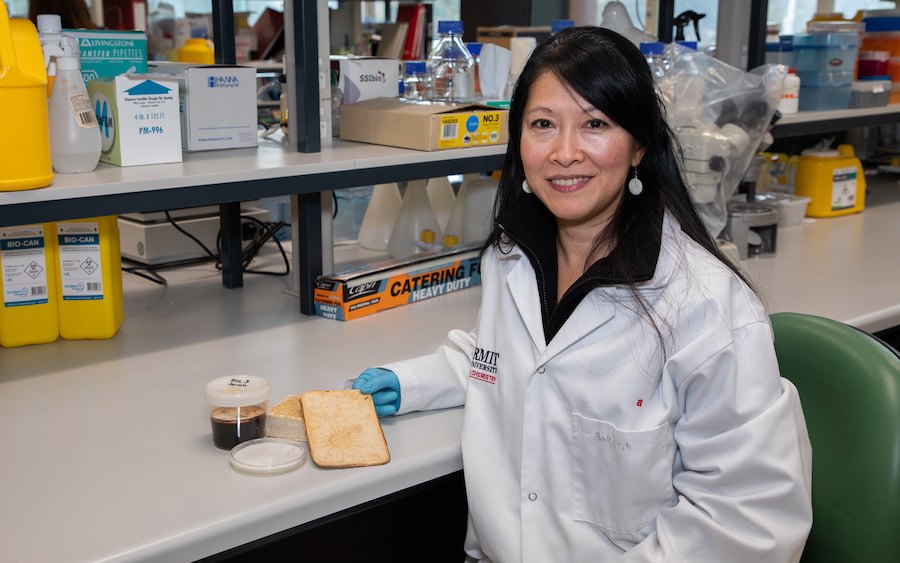
How well that works depends on how long the char survives and at what temperature, Kandare added. He also warned that flame retardants based on bromine or iodine can escape and persist in the environment.
Cladding and clothing face different demands, of course. Walls don’t bend at the elbow or go through the wash after a shift. The 2023 work explains the interest in fungi but tells us little about a coat.
Polyester and PVC on the label
Glover’s main argument concerns what happens after the coat wears out. She said mycelium could replace materials with “bigger ecological rucksacks and forever chemicals” using something biodegradable grown from agricultural waste.
This particular prototype is a mixed garment, though. The gallery lists Tencel, polyester, nylon, PVC and metal components next to the mycelium leather. Plastics and metal won’t break down the way cotton did in a Swiss soil experiment.
Neither institution has published a carbon footprint for the jacket. There is no lifetime comparison with standard protective clothing either.
Mushroom growers and slow harvests
Back in 2023, Huynh compared fungi with plastics and pointed to a basic production problem. She said “fungi is slow to grow and relatively harder to produce at scale.”
Mushroom companies had approached her team about their fungal waste, she said then, and using it would remove the need for new farms. RMIT’s new statement gives no update on any such supply.
No burn times published yet
RMIT says the prototype demonstrates durability, fire resistance, thermal insulation and the ability to self-extinguish, or stop burning on its own. The gallery’s label is more cautious. It says testing of those same four properties is still going on.
Neither source gives an ignition time, a temperature rating or a flame-spread score. Neither points to a peer-reviewed paper on the jacket itself. Without those numbers, outsiders can’t compare it with the gear crews wear during large wildfires.
The official details come from RMIT University’s announcement of September 17, 2026, and the National Gallery of Victoria’s exhibition label.
Photo: RMIT University