Engineers at the University of Edinburgh have tested a model tidal turbine with rubber blades developed with the tire maker Michelin. The blades produced as much energy as a standard design whose blades are turned by motors. According to the study, published in Nature on November 11, 2026, they also cut damaging load swings by up to 29 percent.
The tests took place in a large round tank in Scotland that copies the turbulence of real tidal channels. The university says the design could one day remove some of the costliest parts of a tidal turbine. For now, the work is still at the research stage.
Blades that bend on their own
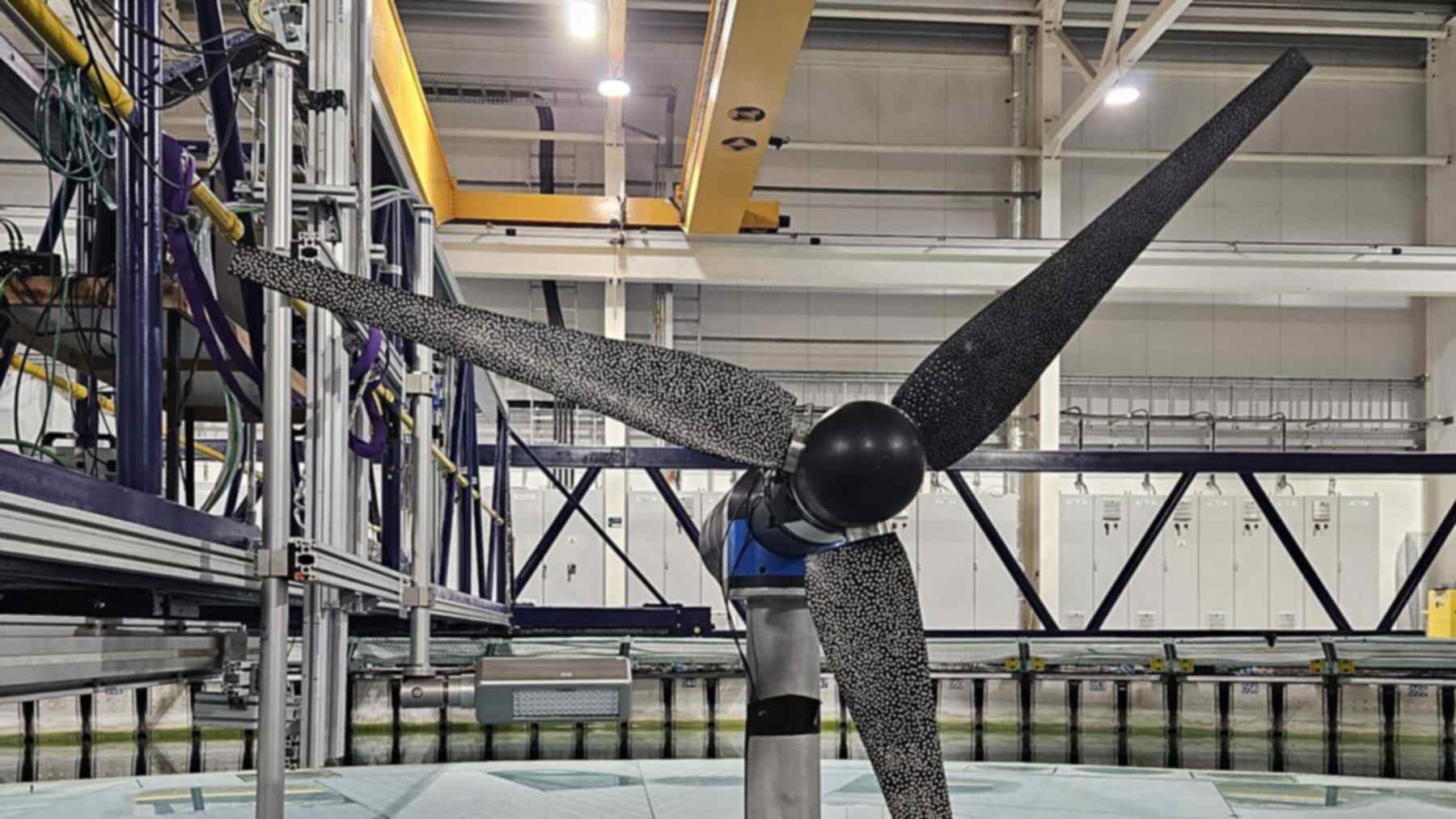
Each blade is made of flexible rubber around a stiff steel spar that runs from root to tip. When the current gets stronger, the back edge of the blade bends upward. That flattens the curve of the blade, so it sheds extra force without hinges, bearings or actuators.
The idea came from nature, the university explains. Fish and trees bend to cope with strong flows of water and wind, and the blades copy that trick.
Rubber also has almost the same density as water. Because of that, the blades can be made neutrally buoyant, so they neither sink nor float. The team says this limits the load swings even more.
A 4-foot rotor at FloWave
The model turbine measured 1.26 meters (4.1 feet) across. It was tested at FloWave, the university’s ocean energy research facility, a round basin 25 meters (82 feet) wide that creates currents and waves.
According to the paper, the water moved at 0.5 to 1.0 meters per second, or about 1.1 to 2.2 mph. The team compared the rubber blades with rigid blades fitted with active pitch control. That system turns the blades away from the flow when it gets too strong.
The researchers then combined their tank data with simulations of a full tidal cycle. Over that cycle, the rubber-bladed turbine produced the same total energy as the conventional one. It also cut the fast load swings that cause fatigue damage by up to 29 percent.
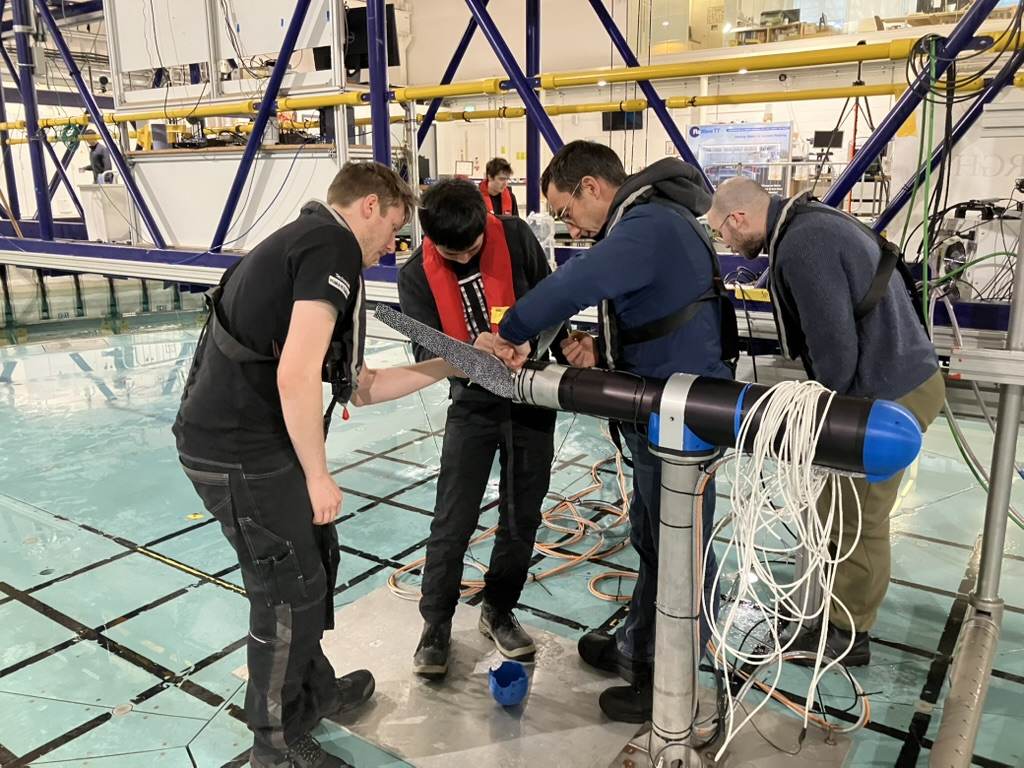
“Our research shows that flexible blades can reduce damaging loads without compromising energy capture,” said Dr Zhehong Zhang of the School of Engineering. He added that this could make it possible to use turbulent tidal currents that are now too hard to exploit.
Motors and bearings underwater
Fast tidal channels are among the harshest places on Earth to run a machine. Turbulence, waves and shifting currents hit the blades with forces that keep changing. Over time, the university says, that causes fatigue, shortens the life of the turbine and leads to costly stops.
To cope, the largest tidal turbines use pitch control, a set of motors, sensors and bearings. These parts are expensive and hard to maintain underwater. According to the researchers, they are also a major source of breakdowns.
Britain has studied very different tidal projects, from a 22.5-kilometer tidal barrier with 125 turbines to a river wall with 28 turbines. The Edinburgh blades are meant for tidal stream turbines instead. These machines stand in the current, much like underwater wind turbines.
“Tidal energy is one of the most predictable renewable resources we have, but the sea is so unforgiving that turbines have needed complex machinery just to survive it,” said Professor Ignazio Maria Viola of the School of Engineering.
Michelin files a patent
Three of the seven authors work for Michelin in Clermont-Ferrand, France. Michelin and the Engineering and Physical Sciences Research Council funded the work, with help from Edinburgh Innovations, the university’s commercialisation service.
“Michelin’s expertise lies in understanding how rubber performs under heavy, repeated loads in demanding environments,” said Bertrand Daval, the company’s vice president for research and development in composite solutions.
Michelin has filed a patent on the technology, and the university holds related patents. Other engineers are also trying to remove moving parts from renewable machines, as with a bladeless wind turbine that sways in the wind.
Britain’s 1-gigawatt tidal goal
To test the idea at full size, the team simulated a turbine 20 meters (66 feet) across. The paper says that size and a 3-meter-per-second current match modern commercial machines. In those simulations, the rubber blades worked just as well.
Early calculations also suggest full-size rubber blades could outlast the 20-year service life of current turbines. If larger tests confirm this, blades and support structures could be lighter. Maintenance could also get cheaper, which would lower the cost of tidal power.
The UK aims to install 1 gigawatt of tidal stream capacity by 2035, enough for around 1 million homes. Other ocean power ideas are being tested nearby, such as a wave-power buoy in the Bay of Biscay.
Still waiting for sea trials
All the measurements come from a small model in a tank, with currents far slower than at strong tidal sites. The full-size results are simulations only. The paper also notes that the steel spar cannot simply be scaled up, so other spar designs will be needed.
The university says more development and testing must come before any industrial use. No date has been given for a trial at sea, and the study does not say how much cheaper tidal power could become.
The full study was published in Nature. The University of Edinburgh described the results in its announcement on November 11.
Photo: University of Edinburgh