Imagine your gardening tools hanging on the garage wall without any brackets, screws, or hooks holding them there. A new iron-rich finish called Ironplac can do exactly that with the help of a flat magnet.
Twenty-nine-year-old Argentinian student Marco Agustín Secchi came up with the compound that can reduce clutter and make organizing the workshop or garage much easier. The selling point is in its simplicity, but Ironplac is still in the prototype phase and not yet for sale. Further testing is needed to show how well it does the job through years of actual use.
What the wall actually does
Once applied to the wall, the mineral and iron-containing particles spread through the mix turn the surface into something you can stick magnets to, a bit like a refrigerator. No electric power is needed to charge the surface.
In other words, the holding force is due to the magnet you slap on it, not the wall itself. Metal objects will not get pulled towards the wall, and you cannot simply hang your keys on it.
Marco is not the first person to recognize that cement mixes could have magnetic response. Recent research that centered on infrastructure and wireless power solutions in Results in Engineering showed that cement mixes holding magnetic sand and magnetite powder could do exactly that while still performing its mechanical function, supporting Ironplac’s concept.
Why the drill is the real target
If you have ever drilled into a masonry wall to hang a frame or hook, you can see the practicality–say goodbye to the noise and mess made by putting permanent holes in the wall. This gives renters and landlords less to fight about at the end of a lease.
In the US, 46.8 million homes are renter occupied according to recent housing data. This represents a large portion of the population that must concern itself with the move-out ritual of repainting, patching, sanding, etc. if they hope to get their security deposits returned.
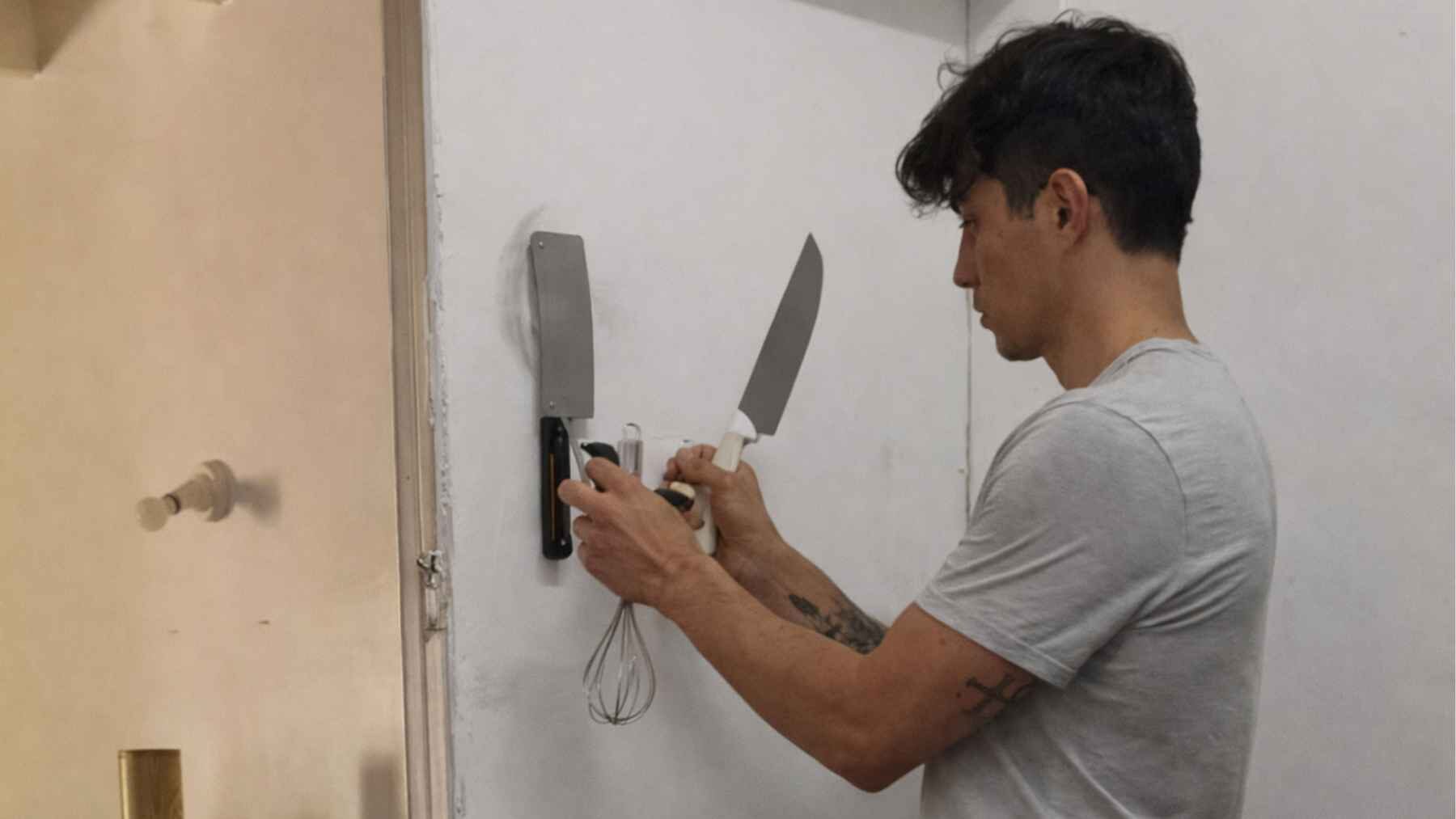
These sorts of primers are nothing new–home and paint shops offer various products designed for placing photos, artwork, or notes on the wall with magnets. Ironplac is taking that concept further, targeting heavier objects like shovels, rakes, hammers, etc.
How Ironplac goes on the wall
For traditional wet construction, the powder is mixed with water and applied with a trowel as a thin finishing coat. The project is also working on versions for dry-panel construction, so the material could be built into boards and coatings instead of replacing the whole wall.
The simple application could make the product very easy to market: no special wiring needed, no sensors, and with a familiar workflow. It goes on like plaster and behaves like metal only with a magnet stuck to it.
“Necessity is the mother of invention,” one might say, and Marco would agree. Walls don’t always serve a functional purpose, he says, and this idea is to give a garage or workshop flexibility of organization as people acquire more accessories and changes in their lives. No need to drill another hole.
From workshop prototype to possible product
As the product goes through further testing, it is looking to secure patent protection and business partnerships. It has not yet landed on store shelves.
In a recent interview with the 29-year-old, he said the current prototype can hold objects weighing up to almost 4.5 lbs., and that he was exploring even stronger compounds. Based on project-reported results, the latest version has been humidity and corrosion tested, and delivered consistent performance even under several coats of paint.
As he waits for the patent, he and his team must begin planning for manufacturing at scale. The Universidad Católica de Salta and Universidad Nacional de Salta have supported the project thus far, Marco said in the same interview. The interest is there, but there is still a long road ahead.
The numbers builders still need
Testing is still needed to see how objects slide down the wall, called ‘sheer testing’, and how much force is needed to remove them from the wall, called ‘pull-out testing’. These numbers will help interested parties understand product reliability for each magnet, coating thickness, or different objects shapes.
Before it goes to market, Ironplac has to demonstrate effectiveness under temperature changes, humidity, corrosion, and repainting. It must meet building codes and demonstrate that objects won’t slowly slide down the wall all while competing on price with existing alternatives.
Until now, they have only demonstrated that a shovel can stick securely to the wall, and that is only the beginning. Tools falling off the wall at two in the morning would not be a strong selling point. Independent load certifications are needed before heavy shelves and hooks can be replaced.
Why the idea is worth watching
Still, the idea is promising even with this missing data. It is simple to understand and requires no moving parts. A durable and reconfigurable finish that reduces damage to the walls of a home, office, classroom, or workshop would not be a hard sell.
Although this is not really a climate breakthrough, products like Ironplac could slightly reduce building waste and demolition debris. The EPA estimates that the US produced 600 million tons of construction refuse in 2018, so less drilling and wall repair may be a positive step forward.
Before reaching the market, Ironplac must move from neat demonstrations to concrete engineering specifications. Holding strength, durability over the long haul, code compliance, and a sensible price could keep the drill in the toolbox. Until all test results are in, cautious optimism is where it stands.
The official technical overview has been published by the Asociación de Ingenieros Estructurales de Argentina.