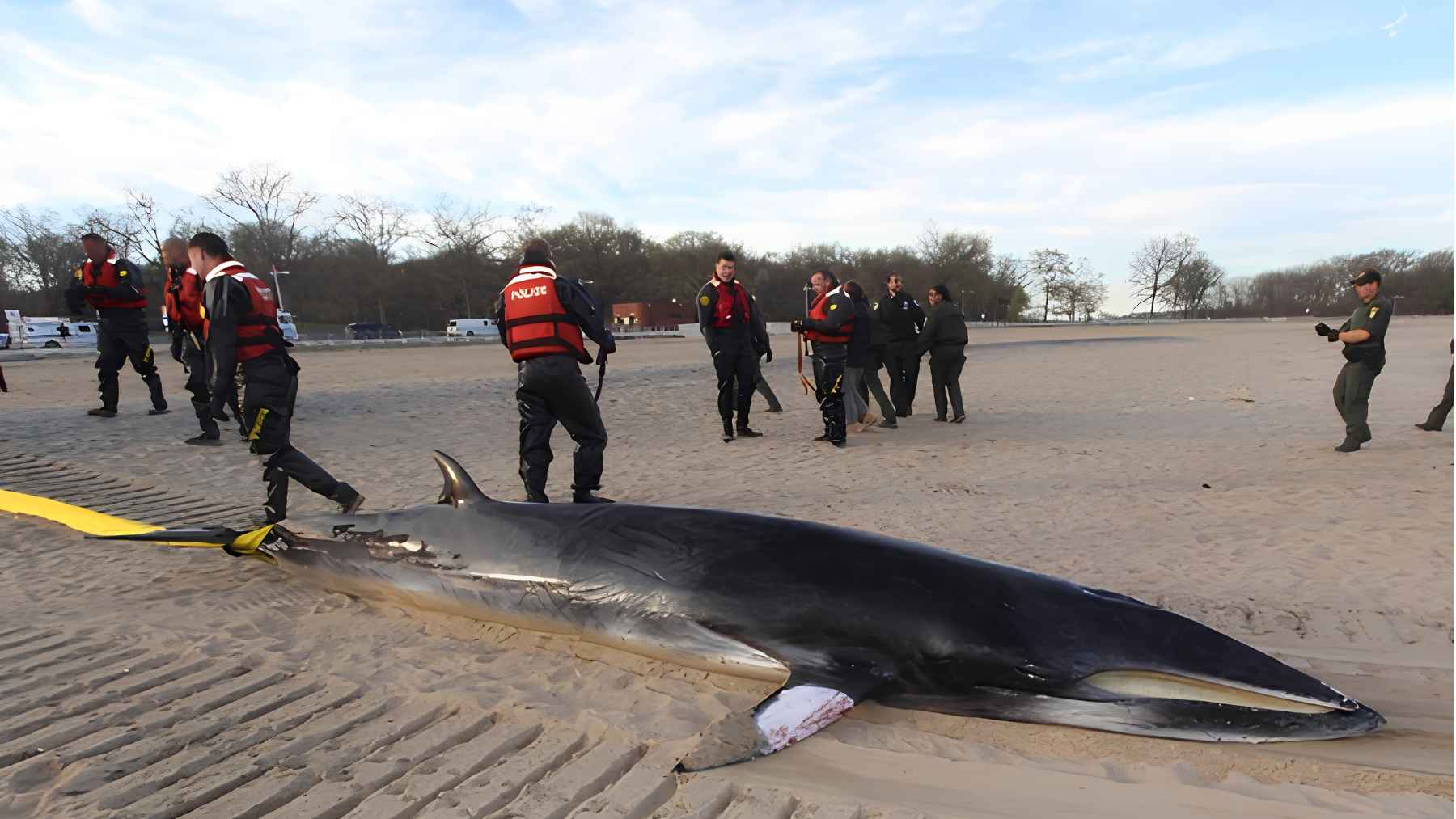
Imagine a whale more like a torpedo than a huge floating creature. The fact that the minke can grow as big as a city bus and weigh nearly 20,000 pounds does not mean it slows it down, as it can still move at speeds of around 22 mph. But the most important aspect is not its speed or size, it is where it chooses to live.
Minke whales choose to feed and travel close to shore. The problem here is that they share the water with fishing lines, ships, and constant noise from engines. Although the common minke is currently classified as Least Concern, between January 2017 and August 5, 2026, NOAA recorded 212 strandings in the Atlantic coast. Researchers still have not found a single cause behind this concerning amount of cases. This shows that even a fast swimmer faces important risks.
What is a minke whale?
There are two recognized species: one is the common minke (Balaenoptera acutorostrata) and the other one is the Antarctic minke (Balaenoptera bonaerensis). They are both rorquals, a group of baleen whales which have distinctive grooves on their throats. In general, the smaller dwarf minke is considered as a subspecies of the common minke.
The size of a common adult minke whale can be around 35 feet long and they can weigh as much as 20,000 pounds. Females tend to be a bit larger than males. Their backs are dark gray or brownish black, their undersides are pale, and in many Northern Hemisphere populations, you can observe a noticeable white band on each flipper. Since 1990, researchers in the Hebrides have used references such as marks and notches on their dorsal fins to recognize more than 300 individuals.
Minke whales usually break the surface with their snout, and then they release a short, faint blow that can be difficult to spot in rough waters. When they dive, they usually disappear beneath the surface without lifting their tail, and may stay underwater for around 6 to 12 minutes.
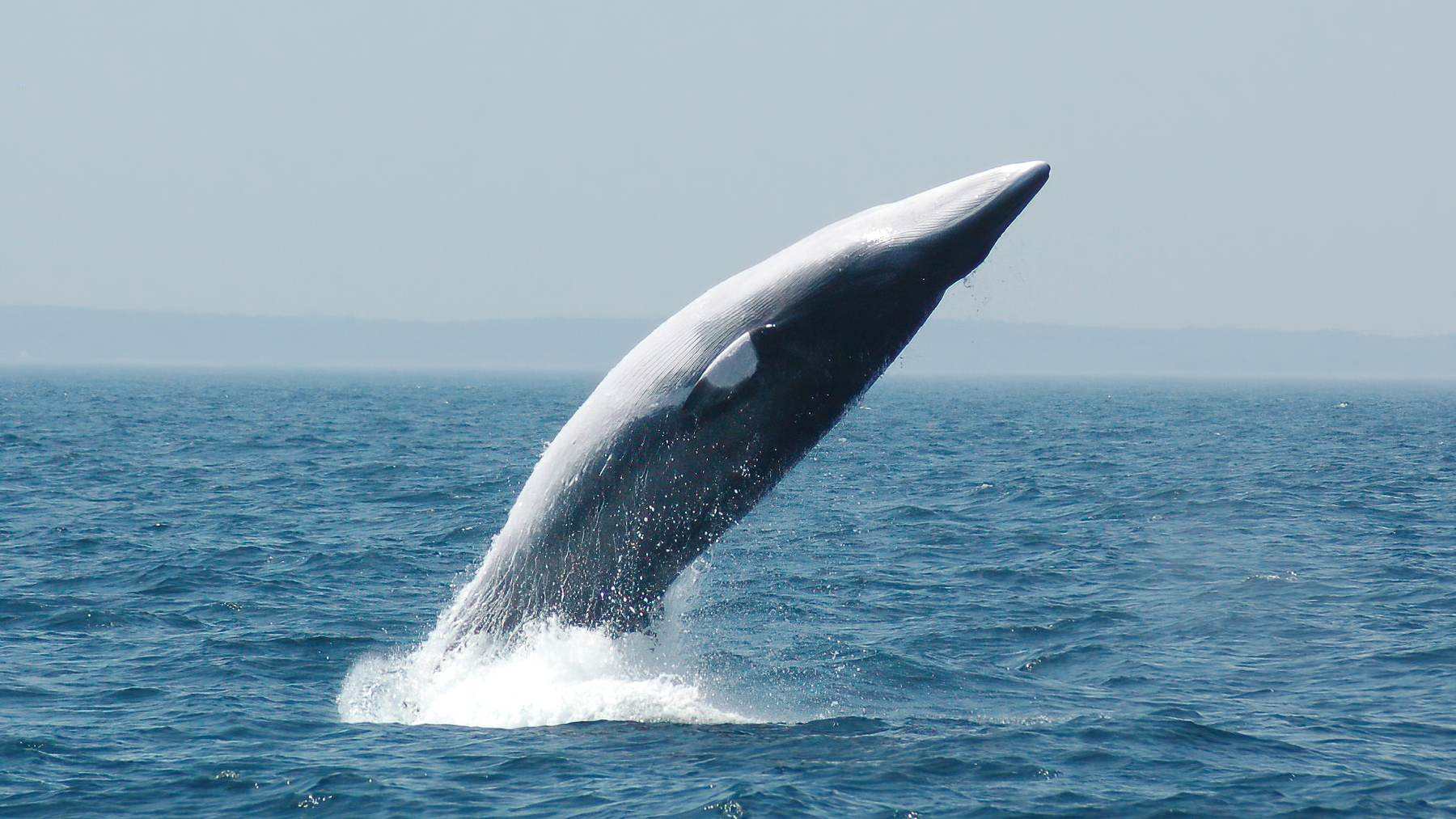
Toothless hunters with expandable throat
These whale species do not have teeth. Instead, they have rows of coarse keratin plates called baleen, which hang from their upper jaw to filter food from the water.
While feeding, a minke can turn onto its side and move through a school of fish with its mouth wide open. The grooves present in its throat expand like an accordion, which allows it to take in a huge amount of water. It then pushes the water back out through the baleen, keeping the prey inside.
They feed on schools of herring, capelin, mackerel, and cod, although they also eat plankton and krill in some regions. In the Antarctic region, minkes mainly depend on krill, and although they usually travel on their own, they can also gather in places where food is more abundant.
Almost electronic sound
Minke whales are not silent. Their sounds may vary between populations, but they produce grunts, thumps, pulse trains, the North Pacific “boing,” the dwarf minke “Star Wars” call, and the Antarctic “bio-duck”. Scientists spent decades trying to figure out the source of that strange sound.
There was one dwarf minke call recorded at 150 to 165 decibels, measured at a distance of one meter. This number cannot be compared directly with the sound of an airplane taking off. Decibels in air and underwater are calculated using different reference pressures, so the numbers are not equivalent.
Researcher Jason Gedamke described the call as synthetic and said, “When I first heard it, I couldn’t believe it came from a whale.” Scientists still debate its full purpose, although mating displays and spacing between animals are among the leading ideas.
Researcher Jason Gedamke compared this call to a synthetic sound. He said, “When I first heard it, I couldn’t believe it was coming from a whale.” Its exact purpose remains unclear, but according to scientists, this sound may be used to attract mates or to help keep distance between them.
From warm waters to the icy coasts
Minkes inhabit tropical waters, to temperate ones, and reach polar waters, but, unlike the classic migration patterns of a humpback, their seasonal migration is more erratic. A large number of them travel to cooler feeding areas in the summer, and heading towards more temperate breeding during the winter, but acoustic research evidences that a portion of Antarctic minkes stay close to the ice packs instead of migrating away.
Usually, females are around 7 or 8 years old when they reach their reproductive age, having a 10 month long gestation period, and nursing the calf for between 5 and 6 months. The short nursing stage for the calf means that the feeding habitat productivity is of the utmost importance.
While being around moving ice, minkes may breach the surface or ascend vertically to “spyhop”. Curiosity even makes some of them draw near halted boats, but this must not be interpreted as a sign to approach or pursue them.
“Low risk” is not risk-free
While nature’s only known predator for the minks are killer whales, people can pose a far bigger threat. Entanglement can lead to exhaustion or even drowning, a direct collision with a vessel strikes can prove to be fatal, and a constant noise pollution can pose a direct interference with these animals which depend on auditory means to navigate unlit waters.
Depending on the type of minke, the conservation picture varies. Whereas the common minke is listed in the Least Concern category, the Antarctic minke’s situation is labeled as Near Threatened, and, despite a moratorium from the International Whaling Commission, there are still parts of the world in which commercial hunting remains an issue.
The public’s course of action is clear and simple: sailors should lower their navigation speeds, and maintain at least 100 yards of distance while in U.S. waters. Every registered detection adds valuable information, meaning boaters must report any stranded or injured whale rather than approaching it.
The official mortality update was published on NOAA Fisheries.