In 1998, Barry Clay was pushing dirt with a bulldozer on a placer claim along Swift Creek, near the Yukon River village of Ruby in interior Alaska, when he noticed something in the gravel that turned out to be the largest gold nugget ever found in the state.
According to Heritage Auctions’ catalog entry, Clay “had identified something ‘unusual’ and immediately collected the object,” and he “knew he had excavated a massive Gold nugget” before taking it into town to have it examined. The version told in Heritage’s presale announcement adds that Clay “is said to have buried the nugget near a tree, buying time until he decided what to do with his remarkable find.”
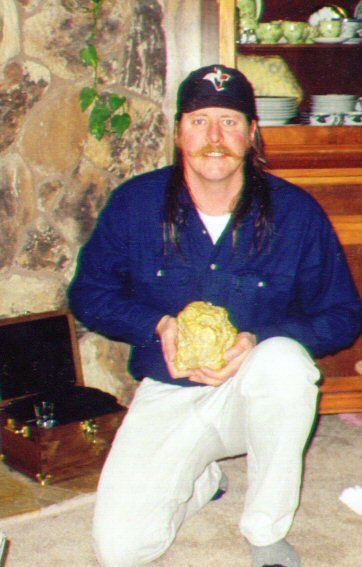
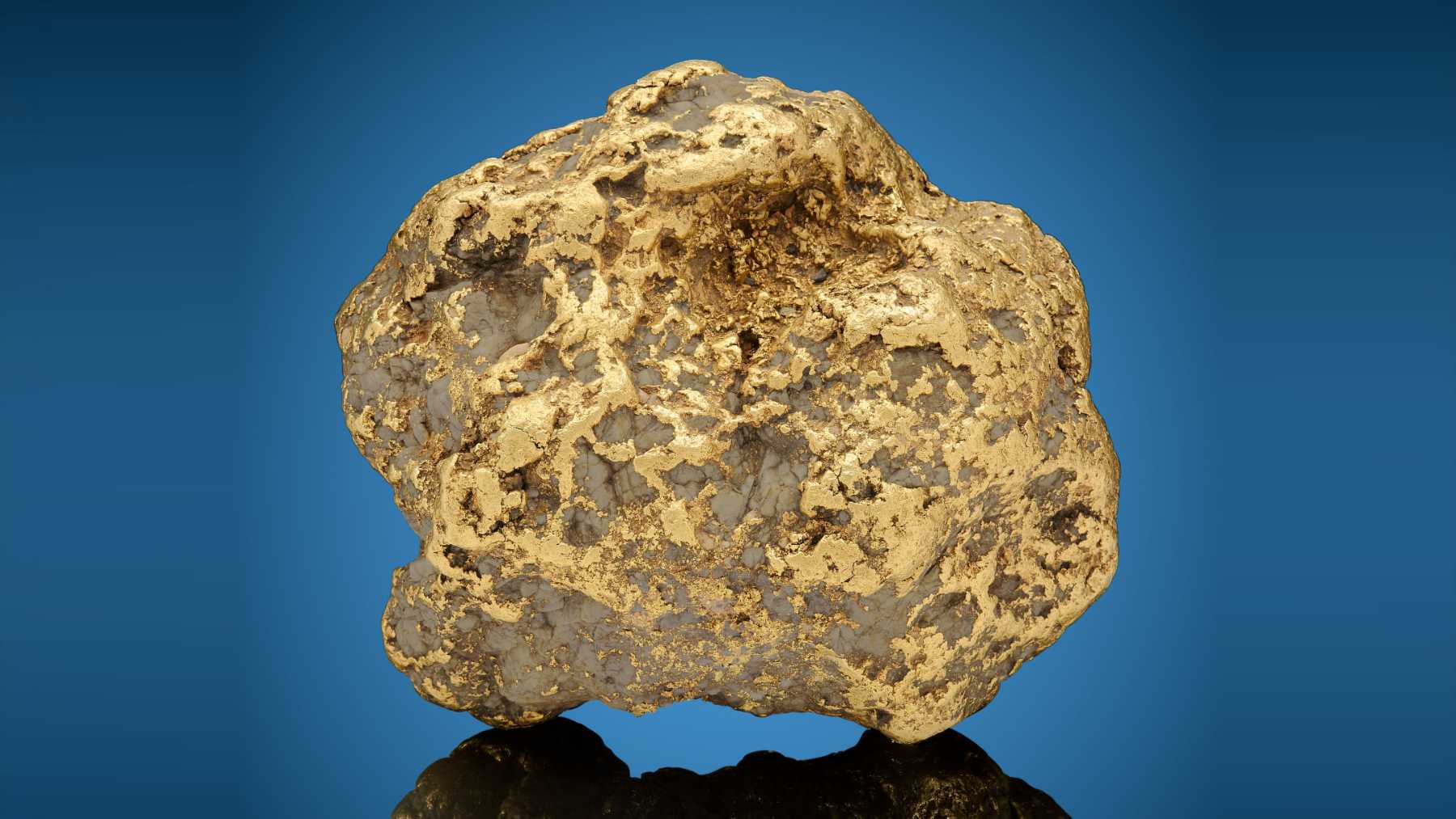
The examination confirmed what he suspected. The specimen weighs 294.1 troy ounces, which is just over 20 pounds (9.14 kilograms), and it became known as the Alaska Centennial Nugget because, in the catalog’s words, it “was found on the 100th anniversary of the Klondike Gold Rush.”
Sold for $750,000 at a Dallas auction
The nugget then stayed out of public view for more than two decades. Heritage said the consignor “purchased the rock directly from gold miner Clay, and it has been in the same family for more than two decades,” which made the Dec. 8, 2021, Nature & Science auction, held in Dallas and online, its first public offering.
It sold for $750,000, against a presale estimate of $700,000 to $1 million, and led a sale that brought in $2,356,714 in total, according to the results announcement Heritage released the following day.
“It is difficult to come up with the superlatives to fully explain the significance of this nugget,” said Craig Kissick, Nature & Science director at Heritage Auctions. “The winning bidder got a prize that can be the centerpiece of any collection, the focus in any room.”
Kissick added that it is “not only the largest ever found in the 49th state, but also one of the largest ever discovered in the Western Hemisphere.” Before the sale, he said that fewer than 50 gold nuggets weighing more than 250 ounces exist, which puts it in rare company, although it weighs a fraction of the man-sized nugget that made two miners rich in 1869.
A little larger than a softball
The catalog gives its measurements as 6.69 by 5.70 by 4.33 inches (17 by 14.5 by 11 centimeters), and the Swift Creek Mine website, which collects stories about gold from the Ruby area, describes it as “a little larger than a softball.” Measured in the ordinary ounces used for groceries rather than troy ounces, it comes to over 322 ounces, as Heritage noted in its results announcement.
Much of its appeal comes from the rock as well as the metal. The catalog describes “vibrant yellowish Gold all over the surface of the giant rock anchored by a ‘muddy’ white Quartz matrix.” In mineral collecting, the matrix is the host rock that a specimen formed in or is still attached to.
How much of it is actually gold
That quartz means not all of the 294.1 troy ounces are gold. An X-ray fluorescence (XRF) analysis was performed on it, a test that hits a surface with X-rays and reads the energy the atoms give back to identify the elements present, and “the Gold on the exterior surface of the rock tested to an average purity of 87.59 percent, which is equivalent to a rating of 21 Karat, with 24 Karat being pure Gold.”
The catalog adds that the nugget was “rather large for an evaluation with Specific Gravity testing,” the density method that can estimate how much gold sits inside a gold and quartz specimen. Its owner also “never felt it necessary to perform an assay on the nugget, citing that the actual Gold content was not correlated to the value of a piece as important, historical, and singular as the Alaska Centennial.”
Gold and quartz often turn up together in this way, and some geologists have proposed that earthquakes may play a part in forming gold nuggets inside quartz.
Why collectors pay more than the melt value
The owner’s choice reflects how the nugget trade works. “The majority of gold mined is refined,” Kissick said in the presale announcement. “A one-ounce gold nugget is even more rare than a five-carat diamond.”
People in Alaska’s gold trade were making the same point years earlier. In a May 30, 2006, Anchorage Daily News story by Peter Porco about a 3-pound nugget from Long Creek, also near Ruby, which is reproduced on the Swift Creek Mine website, Steve Herschbach, co-founder of Alaska Mining and Diving Supply in Anchorage, said, “Gold nuggets are gemstones.” He went on to say, “If you smelt it, you literally destroy the value.”
Kim Tanner of Oxford Assaying and Refining Corp. in Anchorage told the paper that “a nugget is more rare than diamonds, so it doesn’t really follow the gold price.” The same article noted that Herschbach’s website ranked the Centennial first among Alaska’s 20 largest nuggets and listed its location at the time as “unknown.”
Herschbach also described the problem with selling big nuggets, speaking of a 42-ounce Alaska nugget that had sold for $50,000. “The larger the nugget, the harder it is to sell,” he said, “because who’s got the money for a $50,000 paperweight?” He told the paper that most nuggets through history had been melted down, and that it was roughly in the 1960s that intact nuggets first came to be valued for themselves.
How gold ends up in a creek bed
The gold in Swift Creek got there through slow geology. A 1989 U.S. Geological Survey publication by Warren Yeend, Daniel Shawe and Kenneth Wier describes how weathering frees gold from lode deposits in bedrock and how water then carries it and concentrates it in stream gravel. “Placers account for more than two-thirds of the total world gold supply, and roughly half of that mined in the States of California, Alaska, Montana, and Idaho,” the authors write.
Alaska’s Department of Natural Resources defines placer deposits as “loose accumulations of valuable heavy minerals that have been naturally concentrated in streambeds, floodplains, beach sands, or other unconsolidated sediments by the action of water and gravity.” The agency lists conventional surface mining of stream and bench gravels among Alaska’s methods, using mechanical excavation and water-based gravity separation such as sluices, which is the kind of work Clay was doing.
The catalog notes that the Ruby Mining District “is known for producing large nuggets,” and Heritage sold another Ruby nugget, weighing 24.5 troy ounces, for $68,750 in the same auction. Large finds also turn up far from Alaska, including a record nugget found in England’s Shropshire Hills by someone using a faulty metal detector.
The muddy water behind placer gold
Washing that much gravel also produces muddy wastewater. The DNR page says placer mining “generally does not generate Acid Rock Drainage and typically does not require chemical treatment to recover the valuable minerals,” because the sediments have already been weathered, but the sediment in the water is a separate problem.
A January 1983 handbook prepared for Alaska’s Department of Environmental Conservation by R & M Consultants of Fairbanks, still hosted on the state’s website, explains that properly designed and operated settling ponds can remove the coarser soil particles in placer mining wastewater and reduce turbidity, the cloudiness caused by fine particles suspended in water. It also warns that in most cases ponds alone do not ensure compliance with the state’s water quality standards for turbidity, and says they “may be an important unit process used in conjunction with additional treatment processes, such as recycling or filtration.”
What the records leave out
The public record on the Centennial Nugget has gaps. Neither Heritage nor the Swift Creek Mine website says what Clay was paid for it, the mine’s site says only that it “is currently in a private collection,” and the results announcement did not name the buyer. The lot page lists a buyer’s premium of 25 percent on the first $300,000, but the announcement does not say whether the $750,000 figure includes it.
Without an assay, the amount of gold inside the rock is unknown, because the 87.59 percent reading applies only to the surface. Its ranking as the second-largest nugget in the Western Hemisphere, behind the Mexican specimen known as the Boot of Cortez, is something the catalog says the nugget “is often said to be,” and Kissick himself chose the more careful phrase “one of the largest.”
The main sources for this story are Heritage Auctions’ catalog entry for lot 72018 and its results announcement of Dec. 9, 2021.