What if the heaviest “nugget” you have ever picked up was not gold at all, but a piece of the early solar system? That is the twist behind the Maryborough meteorite, a space rock found in Victoria, Australia, that sat in a shed for years before scientists confirmed what it really was.
Research shows the rock is an ordinary chondrite, a common type of meteorite that can still carry rare clues about how planets formed. It likely formed in the asteroid belt between Mars and Jupiter and may have landed on Earth within the last 1,000 years.
Not gold after all
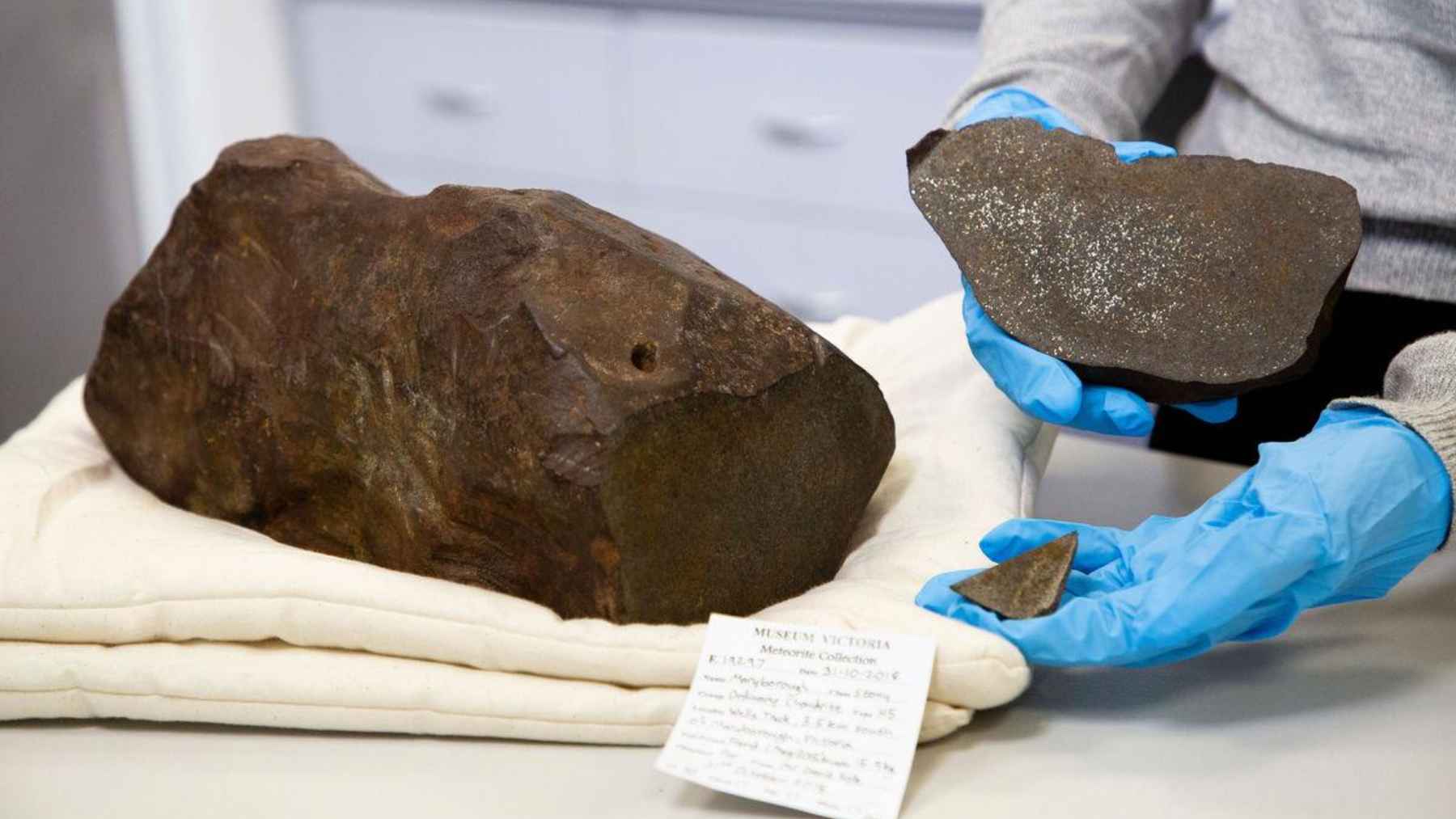
In May 2015, David Hole was using a metal detector in Maryborough Regional Park when he dug up a reddish, unusually heavy stone about 1.2 miles south of the town. At about 37.5 pounds and 15 inches long, it felt more like lifting a small sack of concrete, which is why he suspected a hidden nugget inside.
Back home, the stone earned new drill holes and grinder marks as he tried to learn what he had found. The outer surface was also exposed to acid, according to the later lab description, which may have changed some of its original features.
Three years later, still unsure, he brought the rock into Melbourne Museum for identification. The museum’s own storytelling notes that staff see plenty of “meteor-wrongs,” objects that look promising but turn out to be ordinary Earth rocks.
A hard test in the lab
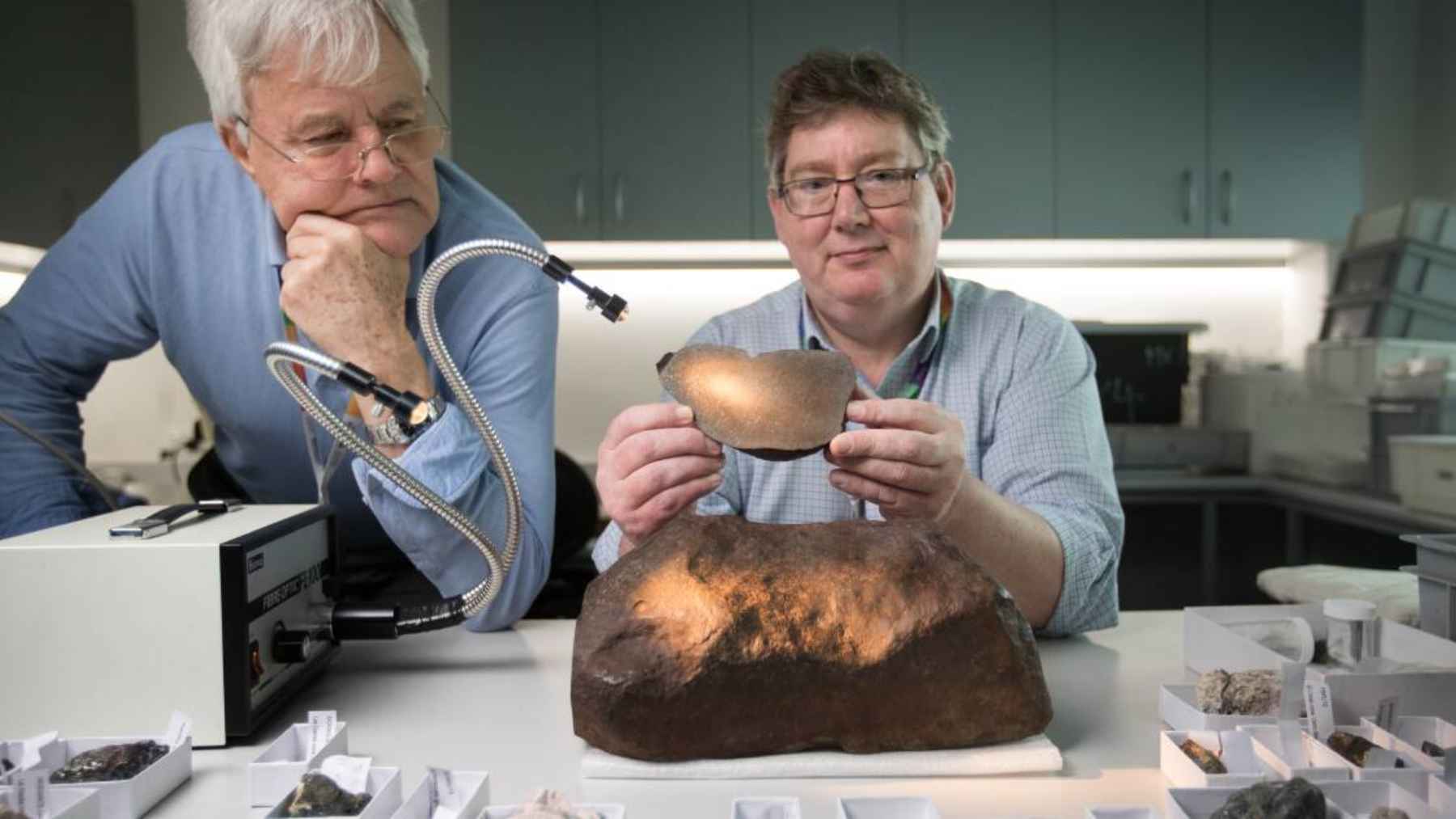
Geologists Bill Birch and Dermot Henry at Museums Victoria, joined by Andrew G. Tomkins of Monash University, tested the stone and confirmed it was a meteorite. Birch later called it “mind-boggling” that we can hold and study a rock formed billions of years ago.
To do the checks, the team cut off a small slab and examined thin slices under microscopes, looking for textures that do not form on Earth. They also documented the outside, including shallow “thumbprint” dents known as regmaglypts and a missing or worn “fusion crust,” the thin shell that often forms when a meteorite’s surface briefly melts in the atmosphere.
The meteorite’s name and classification were approved in December 2018 and listed in the Meteoritical Bulletin Database, which tracks confirmed meteorites worldwide. That step matters because it turns a good story into an official scientific reference other researchers can build on.
What is inside?
The Maryborough meteorite belongs to a group called chondrites, which are built from tiny, once-molten droplets called chondrules. The paper reports some chondrules up to about 0.04 inches across.
Its subtype, called H5, is jargon that carries two simple ideas. The “H” points to a high amount of iron and nickel, while the “5” suggests the rock was warmed and reworked inside its parent asteroid before it broke apart.
In practical terms, that means the meteorite has a noticeable amount of metal spread through a stony matrix, including iron and nickel minerals with names like kamacite and taenite. Researchers also reported that it shows only light weathering and no signs of a major shock event, which helps preserve its internal record.
When it landed
Scientists often talk about two different “ages” for a meteorite, and this one is a good example. Its birth age is about 4.6 billion years, dating back to the earliest chapter of the solar system when the planets were still assembling.
Its Earth age is much younger and, for the most part, harder to pin down. Carbon-14 testing carried out at the University of Arizona’s Accelerator Mass Spectrometry Laboratory suggests it fell sometime within the last 1,000 years, and the authors say it may have landed toward the more recent end of that range.
No obvious impact crater has been linked to the find, which is not unusual for a single rock that may have slowed down in the atmosphere and dropped at the end of a fireball. Newspapers in the region reported bright meteor events between 1889 and 1951, but the study cautions that none can be tied to this specific stone.
Rarer than gold
For locals, Maryborough sits in the wider Goldfields region, so it makes sense that a heavy rock sets off “gold” alarms. But in the state of Victoria, only 17 meteorites have been recorded, a tiny number compared with the thousands of gold nuggets found over time.
The paper also places the find in a narrower category that matters to researchers. Maryborough is the third H5 meteorite identified in Victoria and the second-largest single chondritic mass in the state, behind the Kulnine meteorite, which weighs about 121 pounds.
Meteorites earn this attention because they are physical samples from places we cannot easily visit. Some, like the well-known Murchison meteorite, have been studied for organic compounds that help scientists think about the chemistry that existed before Earth was fully formed.
If you ever find a “space rock”
Most meteorites do not look like movie props, and some can blend into local soils until someone notices the weight. Clues can include an unusually dense feel, a magnetic pull from iron, and a surface that looks melted or dimpled from atmospheric entry.
On the other hand, lots of Earth rocks can mimic one or two of those signs, which is why museums get swamped with false alarms. The Maryborough case is a reminder that careful lab work, not just a quick glance, is what separates a real meteorite from a convincing “meteor-wrong.”
So yes, the odds are slim, and nobody should expect to strike cosmic treasure on a weekend hike. Still, the next time a rock feels strangely heavy in your hand, it might be worth asking a simple question: where did this really come from?
The main study has been published in Proceedings of the Royal Society of Victoria.