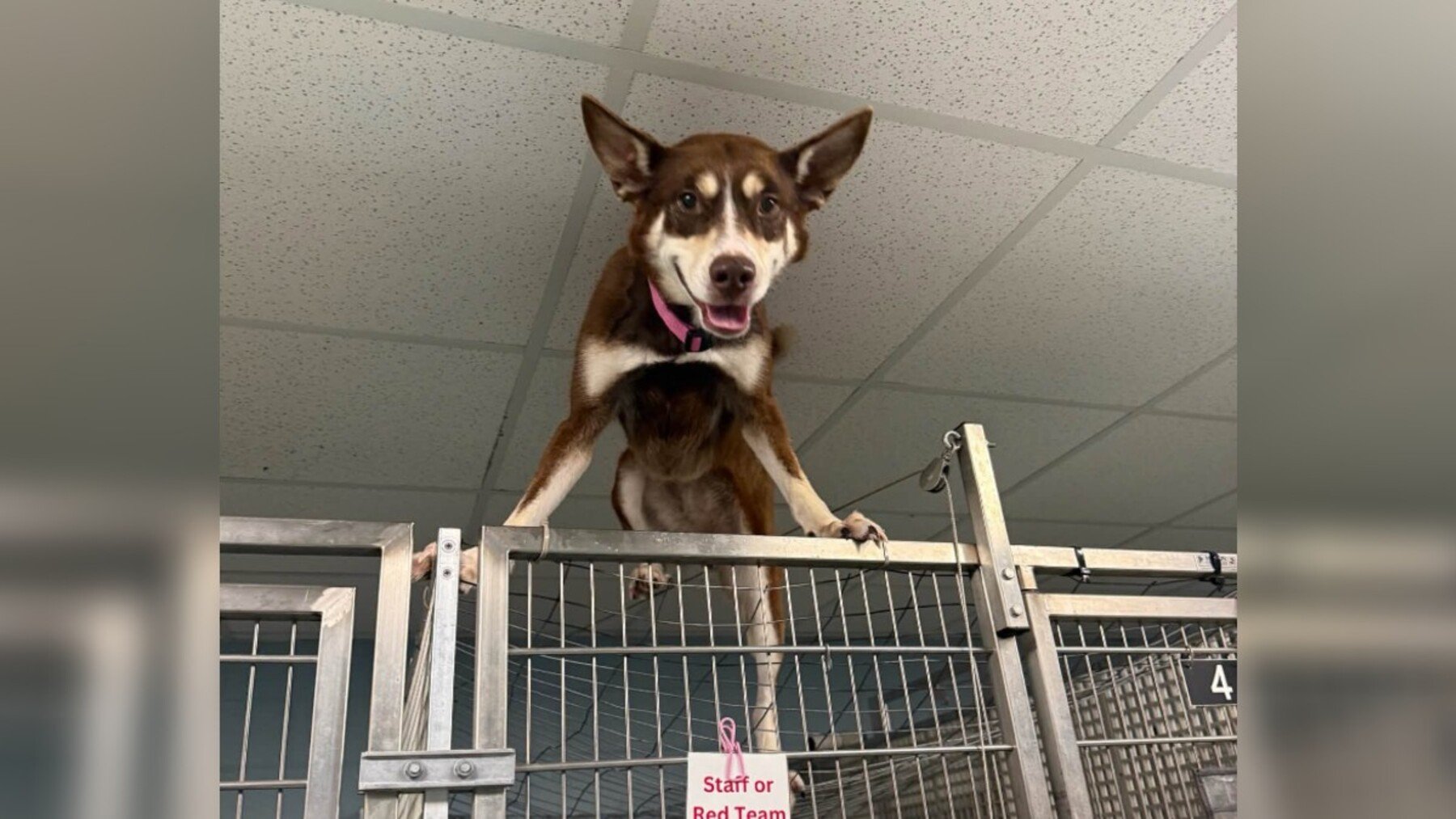
When workers at Richmond Animal Care & Control entered the kennel area, they expected to find Maya waiting behind the gate. Instead, the 5-year-old husky was standing on top of her covered enclosure, calm, balanced, and looking as though the highest seat in the shelter had always belonged to her.
The photograph is funny, but Maya’s story carries a heavier message. Only a few months earlier, officers had rescued her with a chain embedded in her neck, and her unlikely climb now offers a striking picture of resilience, intelligence, and the kind of careful home she still needs. For anyone considering adoption, the important question is not whether Maya is entertaining, but whether a household can safely channel all that energy.
Maya turned a kennel into a climbing puzzle
Staff eventually worked out that Maya had scaled the walls, squeezed through an opening near the wall, and settled onto the wire cover above the kennel. There was no smashed gate or frantic destruction. Just one very agile dog enjoying a better view.
“We were dying laughing and then really wondered how she managed it,” shelter director Christie Peters told The Dodo. In its own Facebook post, RACC joked that Maya was behaving as if she had paid rent and described the locks as little more than puzzles to solve. For a moment, the kennel block had its own four-legged magician.
The viral moment began with a painful rescue
The scene felt especially powerful to the people who knew what Maya had survived. Animal control officers rescued her from a Richmond yard in May with a chain wrapped twice around her neck, and Peters said the metal had become embedded, causing significant pain and discomfort. That detail turns a comic photograph into something far more sobering.
Even with that history, staff did not describe a withdrawn dog. Peters called her “very exuberant” and “happy-go-lucky,” saying she loves life and the people around her. That contrast is what gives the rooftop image its real weight.
Why the shelter changed Maya’s enclosure
A successful escape may look like comedy on social media, but shelters also have to treat it as a safety warning. A dog above a kennel could fall or move into another animal’s space, so staff retrofitted the back of Maya’s covered enclosure and clipped it flush against the wall.
That response matters because cleverness and risk can arrive in the same package. RACC’s current adoption profile describes Maya as energetic, outgoing, and determined, while noting that she needs an adopter with husky experience who understands secure containment and “creative exits.” In practical terms, her future home cannot depend on an ordinary latch and good luck.
Foster care appears to have brought a calmer chapter
After the kennel-hopping episode, Maya moved into a foster home. Staff said she appeared more comfortable there and no longer seemed to feel the need to escape, although one dog’s behavior cannot tell us exactly what she was experiencing. A home can also give caregivers a fuller picture of how she handles ordinary household life.
Still, the broader evidence makes the change worth noticing. A review of shelter-dog enrichment research reported that foster placement was associated with lower cortisol, a hormone linked with stress, while even one or two nights in a volunteer home produced lower cortisol and longer uninterrupted rest. This does not prove why Maya climbed, but it helps explain why a quieter and more predictable setting can matter.
The right adopter will need more than a sense of humor
Maya is not being presented as a low-maintenance pet. At the time of publication, her written shelter profile says she weighs about 44 pounds, is spayed and vaccinated, and is seeking a home without other dogs and with children age 10 or older. Prospective adopters should confirm the latest household requirements directly with RACC.
What does that look like in everyday life? It means checking gates before stepping into the yard, offering regular exercise and problem-solving activities, and understanding that a quiet dog behind a door may already be studying the latch. Maya’s intelligence is part of her appeal, but it cannot be treated as a party trick.
One funny photograph can help a shelter dog be seen
RACC is Richmond’s only open-admission public shelter, and its supporting foundation says the organization cares for more than 3,000 stray, sick, injured, and surrendered animals each year. In that busy setting, a viral moment can do something practical. It can turn an anonymous kennel number into a dog people remember.
For Maya, the hope is that the next move will not be upward or outward, but home. Peters called her “clearly a problem solver,” and the best match will be someone who sees both sides of that description, the joy and the responsibility.
The official shelter update was published on Richmond Animal Care & Control’s Facebook page.