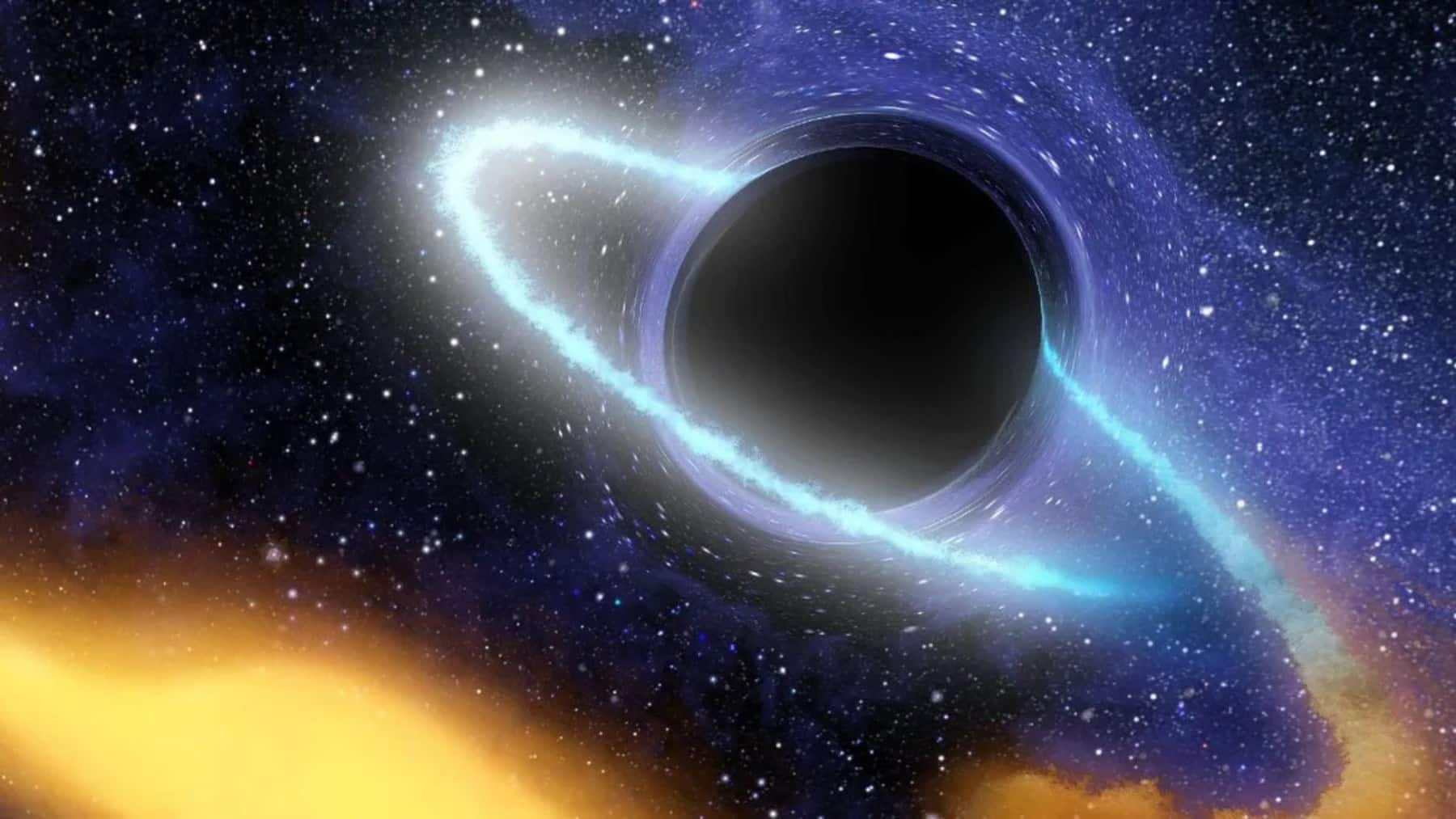
Ever since we first pointed our telescopes at the sky, we’ve noticed that the universe is vast, ancient, and very, very mysterious. Boson spheres are among the phenomena discovered. Throughout the 20th century, we’ve been able to detect stars, black holes, distant galaxies, and even planets orbiting other stars, all based on light, whether visible, infrared, or X-rays. But what if there are objects out there that simply don’t emit any light? We’re talking about celestial bodies so discreet that they traverse the universe without leaving a trace… that’s where invisible boson spheres come into play.
Before invisible boson spheres, we need to talk about dark matter
Before we talk about the invisible boson spheres themselves, we need to address one of the biggest enigmas in science today: dark matter. It is a type of matter that, although invisible, appears to make up about 25% of the mass and energy of the universe. We have even detected its gravitational effects in galaxies and clusters, but we have never been able to observe it directly. At the beginning of our research, we believed that particles known as WIMPs (weakly interacting massive particles) could be the key to this mystery. However, even after decades of experiments, WIMPs have not been found. So scientists turned to other, bolder alternatives, such as axions.
And what are axions? To put it bluntly, they are hypothetical particles proposed to solve a symmetry problem in the strong nuclear force. Not stopping there, they have characteristics that make them perfect candidates for dark matter. How so? Well, they are extremely light, they barely interact with ordinary matter, and, most intriguingly, they are bosons. That is, they can accumulate in large quantities in the same quantum state, collapsing under their own gravity. Okay, so what does this have to do with NASA’s search?
Why do boson spheres matter?
Well, in addition to the stars we can see, which number trillions, spread across billions of galaxies, there is a possibility that there are also completely invisible cosmic structures, called boson stars. These objects would be formed by dense clusters of axions, collapsed by their gravity, without emitting any type of radiation. And why does this matter?
Unlike traditional stars, which shine due to nuclear fusion (and which generate stellar explosions), these boson spheres would be silent and static, although massive. Some could even have a mass comparable to that of a common star, while others could be immense, the size of galactic nuclei. In other words, our universe could be filled not only with light, but with condensed darkness.
That’s where NASA and other agencies have begun investigating the indirect effects of these objects, whether through gravitational distortions, anomalies in stellar mergers, or mysterious explosions known as bosenovas. And, well, if they’re real, these spheres could change our understanding of what makes up the cosmos.
And now, how to detect boson spheres?
Finding a boson star? Mission almost impossible. They don’t shine, they don’t interact with almost anything, and they go unnoticed by our telescopes. They can cross an entire solar system without leaving a trace, and we only notice something if they cause a huge gravitational distortion or collide with something. That’s why, like dark matter, they have become one of the greatest mysteries in the universe.
However, all is not lost… scientists have already been developing extremely sensitive sensors to capture indirect effects. Apart from that, we have to see the positive side of this search, which, in addition to expanding our knowledge, only reinforces a thought that we should already be much more accustomed to: the absence of light does not mean the absence of existence. It is no wonder that only 5% of the universe is visible matter, and we cannot ignore the other 95%, right?