Picture this: a relic born billions of years ago — long before Earth spun into being, long before the first cell flickered into life — and yet, it’s still here, unchanged, almost taunting the passage of time. Not some passing comet or ancient spacecraft, but a stubborn witness from an age we can’t even imagine. And now, thanks to more than a decade of tireless Mars exploration, NASA has shown it to us. What they’ve captured blends raw science with the quiet poetry of deep time — a reminder that the universe keeps its own archives, far from human hands.
Mars carves a stone “flower” that outlived rivers, lakes, and eons of change
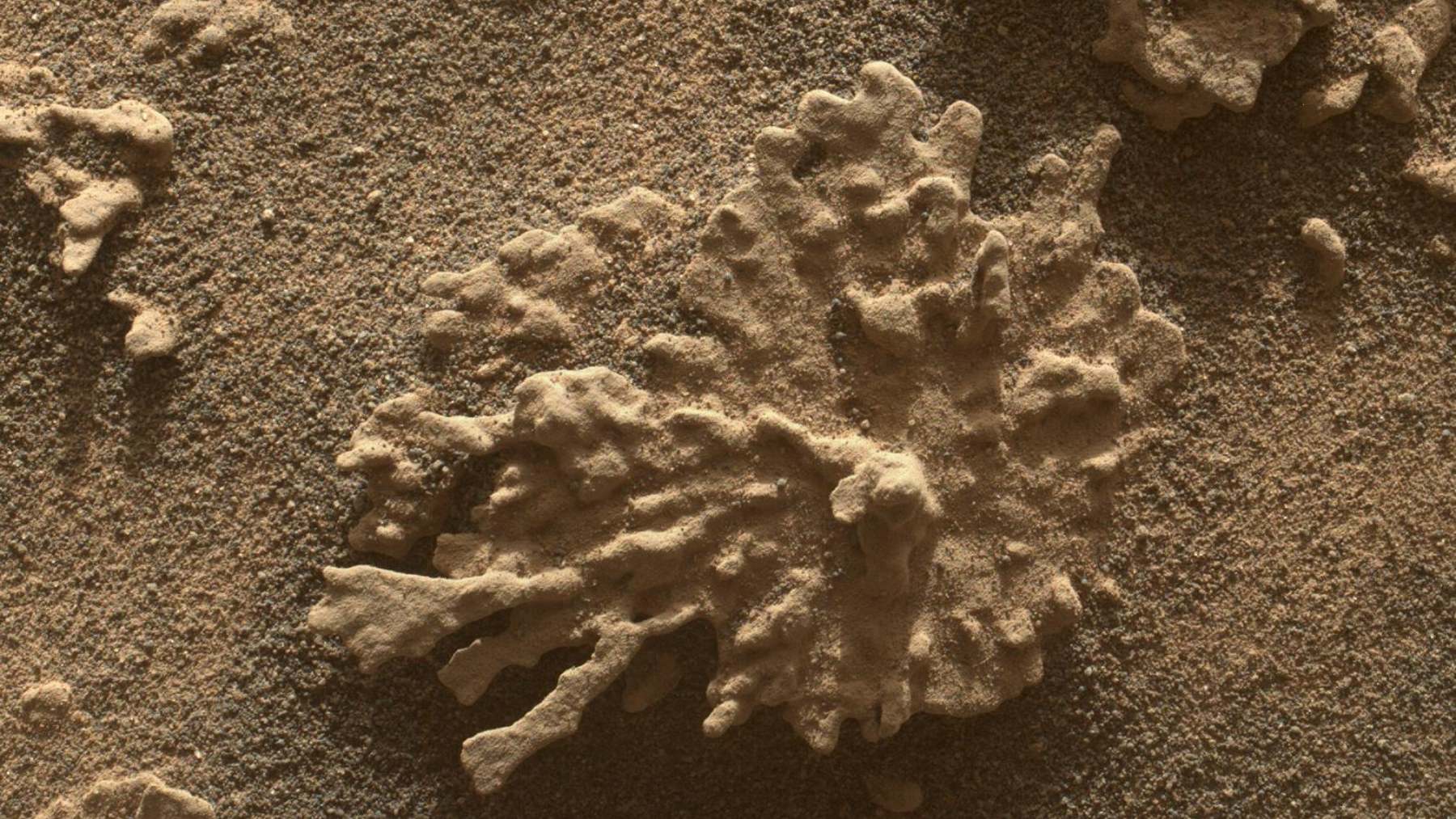
The setting: Gale Crater. The Curiosity rover has been crawling over its rugged floor since 2012, clocking more than 35 km in the kind of terrain that would shred a mountain bike in a day. On July 24, 2025, the rover’s cameras found something that stopped the team in their tracks: a delicate, branching rock, shaped so precisely it looked like nature’s own jewellery.
No, it’s not a coral fossil — science is clear that complex life never thrived here. But the beauty lies in its backstory: this stone “flower” was sculpted billions of years ago, back when Mars still had rivers, lakes, and the kind of wet landscapes we’d recognize on Earth. “Water carried dissolved minerals into rock cracks and later dried, leaving the hardened minerals behind. Eons of sandblasting by the wind wore away the surrounding rock, producing unique shapes,” the Curiosity team explained.
This is the “ancient object” of the title — not a drifting asteroid, not some long-lost probe, but a survivor etched in stone, holding the memory of a Mars that pre-dates Earth itself.
The real puzzle: relics of water or whispers of Martian life?
How does something so fragile-looking endure for billions of years? It comes down to three slow-motion acts:
- Act I — The birth: Liquid water slips into tiny fractures. Over time, minerals — sulfates, silica, and more — crystallize, locking in a skeleton-like structure.
- Act II — The shield: These hardened veins form a kind of armor, resisting the quick work of erosion that grinds everything else away.
- Act III — The reveal: Centuries of windstorms sweep the softer rock into dust, leaving only the mineral lace behind.
On Earth, the same process creates the alien beauty of the Atacama Desert and the glittering crystal caves of Mexico. On Mars, it produces time capsules. And each one forces scientists to ask the same twin questions: how long did Mars keep its water… and did anything alive make use of it? Curiosity has already catalogued other specimens — including a“flower” rock that went viral in 2022 (and NASA found this shiny white skull in this desert). Every one of them is another piece in the slow puzzle of Mars’ habitability.
How to keep a 13-year-old Mars rover alive and kicking
Curiosity is no fresh-out-of-the-lab machine. Thirteen years on a hostile planet ages hardware fast. Its heart — a radioisotope thermoelectric generator — turns plutonium heat into electricity, but the output fades year by year. That means the team has to get crafty. They’ve taught the rover to multitask: drive while beaming data to orbiters, or snap photos during other operations.
They’ve given it energy instincts: finish a job early, and it powers down on its own. And they’ve built workarounds for aging parts — from camera tweaks to drilling hacks to a new driving algorithm that spares the wheels. Even if those wheels lose their outer treads entirely, the rover can limp along on the inner rims. It’s no wonder we also just spotted a ‘Serpentine Dust Devil’ moving on Mars.