A bear shoulder blade discovered in 1864 is helping researchers reconstruct a disturbing chapter of England’s relationship with wildlife. A new study finds that bear-baiting was established by the 12th century, roughly 400 years before the spectacles familiar from Shakespeare’s London. The evidence suggests that imports of living bears increased after the Norman Conquest of 1066.
Researchers at Cardiff University and the University of Nottingham combined animal bones, historical records, literature, and images to investigate the practice. Their findings reveal how imported bears became part of medieval entertainment across social groups, despite the expense of transporting and feeding them. The museum specimen offers a particularly revealing clue.
Bear-baiting had deep medieval roots
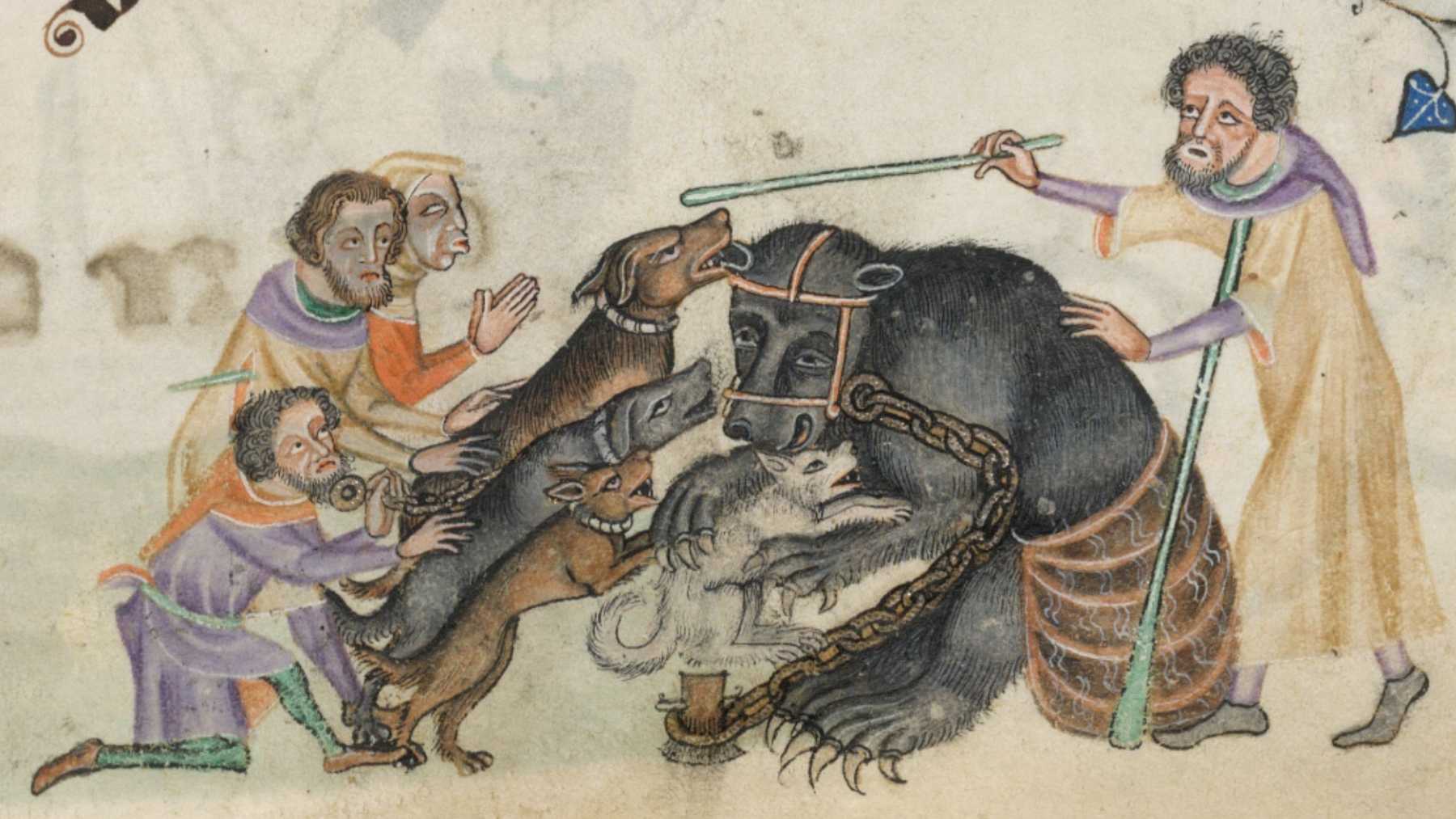
Bear-baiting involved setting dogs against a tethered bear. It is well documented in Elizabethan England, including performances for Queen Elizabeth I and events in London’s Bankside district. The new research brings its medieval history into sharper focus.
The team examined evidence from England and northern France, including bear remains identified at 10 archaeological sites across the two countries. Documents such as the Domesday Book, medieval manuscripts, and other historical records helped place those physical discoveries in a wider social setting.
Liam Lewis, a medieval literature scholar at Cardiff, said the combined evidence showed that “bear baiting was an established activity in England by the twelfth century.” That conclusion rests on several kinds of evidence, rather than a single bone or an illustrated scene.
Why England’s bears had to travel
Wild brown bears had disappeared from Britain by the period examined in the study, making imported animals central to this story. Their exact extinction date remains uncertain, with earlier research by Hannah O’Regan outlining more than one possible timeline. The medieval remains therefore need to be understood in the context of human trade and captivity.
But how can bones show whether people brought in a living bear or just its fur? Paw bones can remain attached to traded skins, while other skeletal parts provide stronger evidence that whole animals were present. That distinction helps researchers avoid treating every bear fragment as evidence of a captive performer.
The researchers combine remains from towns such as Colchester and Carlisle with written records to reconstruct the movement of captive bears. Lewis links the wider pattern after 1066 to increased imports from continental Europe. Moving these animals also meant paying for their travel and upkeep, expenses that continued long after their arrival.
A museum bone helps narrow the timeline
The Richmond shoulder blade, held by the Yorkshire Museum, was sampled for radiocarbon dating in collaboration with the researchers. Thibaut Devièse at the University of Oxford carried out the dating work. The result placed the animal in the 11th or 12th century.
The published study’s dating results favor the period between 1078 and 1155, but also allow an earlier interval between 1024 and 1053. In other words, the bone most likely dates after the Norman Conquest, although a date before 1066 cannot be ruled out. That uncertainty matters when describing how quickly bear imports expanded.
Richmond also appears in an early reference to a named “bearward,” or bear keeper. Known as Spenellus, he lived there in the early 1200s, according to the researchers. The record adds a human figure to the history, without establishing that he handled the animal represented by the museum bone.
Entertainment reached beyond the aristocracy
Medieval stories and sermons connect bear-baiting with weddings, aristocratic recreation, and noisy celebrations. But the presence of bears in several English towns suggests that ordinary townspeople encountered these animals too. The researchers argue that the practice reached beyond elite households.
Images offer another part of the picture. The team points to a bear-baiting scene in the lower border of the Bayeux Tapestry, while medieval manuscripts depict performing and dancing bears. Read alongside bones and written accounts, these pictures help explain how familiar such animals may have been.
Still, a bear’s presence does not establish everything about its life. A recovered bone alone cannot show whether the animal fought dogs, danced, or was displayed in some other way. The broader interpretation depends on bringing those different sources together.
Old collections still hold new evidence
The Richmond find shows why museum collections remain valuable long after an excavation ends. A specimen recovered more than 160 years ago can still help answer questions that its original discoverers could not resolve. Preserving the material makes that later investigation possible.
For environmental history, the study also highlights the difference between a species surviving in the wild and people keeping imported individuals in captivity. Bears could disappear from Britain’s natural landscape yet remain visible in its towns and entertainment culture. Their bones preserve traces of that complicated relationship.
The research appears in Society & Animals. The official announcement was published on Cardiff University’s website.
Image: British Library / Wikimedia Commons (CC BY 4.0)