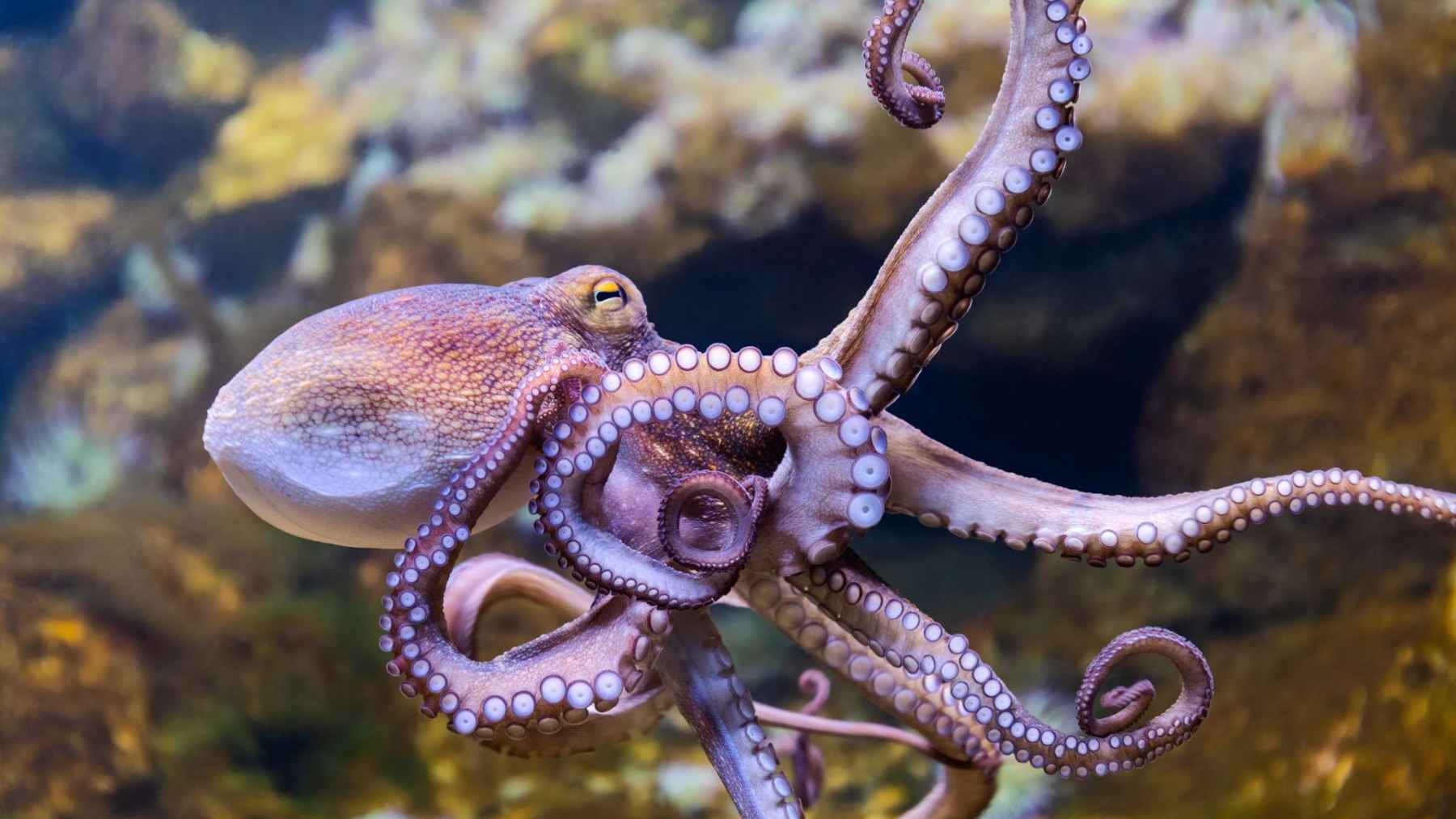
An octopus already looks like something nature dreamed up after midnight. It has three hearts, blue blood, a donut-shaped central brain, and eight arms that do much more than grab. The common octopus has about 500 million neurons, and roughly two thirds of them are found in its arms, not in the central brain.
That is why the famous “nine brains” line is both catchy and a little too simple. A living octopus is not eight separate minds arguing with one central boss. It is something stranger and more interesting, a body where control is shared, sensation is spread out, and intelligence begins at the very place the animal touches the world.
Not quite nine minds
The phrase “nine brains” usually refers to one central brain plus major nerve centers running through each of the eight arms. The central brain still matters. It helps with vision, learning, memory, overall direction, and decisions such as whether to hunt, hide, squeeze through a gap, or investigate something new.
But the arms are not passive cables waiting for orders. The Natural History Museum notes that each arm can taste, touch, and move without direct instruction, while the central brain can still exert top-down control when needed. In practical terms, the octopus seems to get the best of both worlds.
Arms that taste
Have you ever reached into a bag without looking and figured out what you touched by feel alone? An octopus does something far more advanced when it slips an arm into a dark crevice. Its suckers can detect texture and chemistry, helping the animal “taste by touch” as it searches for prey or danger.
Harvard researchers reported that octopus suckers contain chemotactile receptors that help the animal identify what it is touching and whether it may be prey. That makes the arm less like a simple limb and more like a moving sensory lab, sampling the seafloor one sucker at a time.
Fast signals, quick moves
A 2025 study in Bioelectronic Medicine pushed the question further by recording electrical activity from the octopus anterior nerve cord. Researchers found that spikes within the first 0.1 seconds after stimulation could predict whether an arm movement would happen with 88.64 percent confidence.
That does not mean a severed arm “thinks” like an animal. It means the local circuitry is powerful enough to turn sensation into action very quickly. The central brain guides the mission, but the arm handles many of the small adjustments that make hunting, crawling, gripping, and exploring possible.
Built in segments
The arm’s nervous system is not just a messy bundle of wires. A 2025 Nature Communications study found that the axial nerve cord running through cephalopod arms is segmented, with modular organization linked to the suckers.
The authors described a spatial map of the suckers, sometimes called “suckerotopy,” inside the arm’s neural layout.
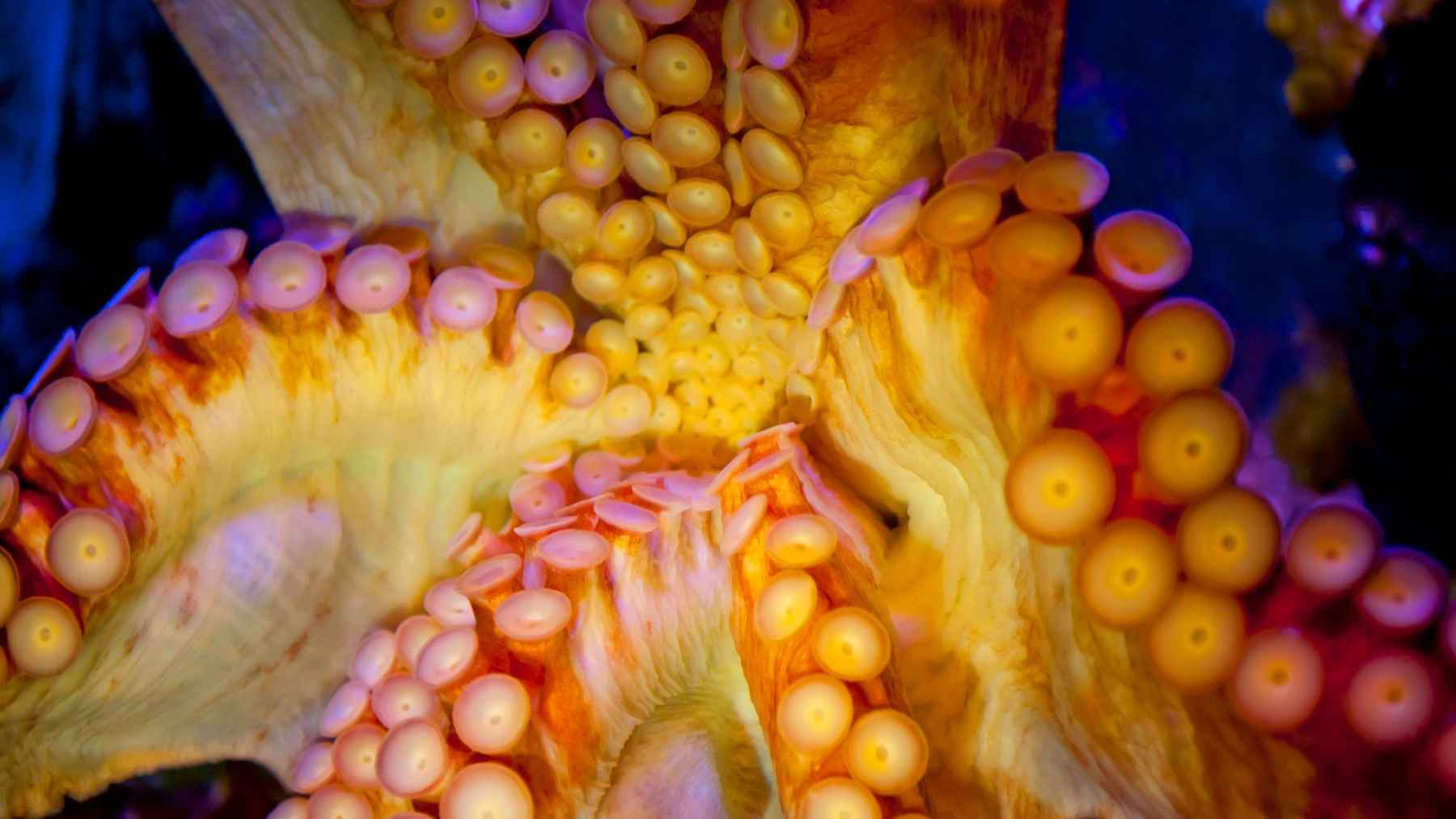
That matters because an octopus arm bends, twists, shortens, stretches, grips, releases, and explores without bones. One part of the same arm may anchor to a rock while another part probes a hole.
No wonder University of Chicago researcher Clifton Ragsdale called this arrangement “a good way to set it up.”
Three hearts, blue blood
Then there is the circulatory system. Octopuses have three hearts, with one circulating blood around the body and the other two pumping it past the gills to pick up oxygen. That setup supports an animal that crawls, hunts, hides, changes color, and powers eight demanding arms.
Their blood is blue because it uses hemocyanin, a copper-based oxygen carrier, rather than the iron-based hemoglobin that makes human blood red. The Natural History Museum explains that this copper-based protein is more efficient in cold, low-oxygen ocean conditions. It sounds like a fantasy detail, but it is chemistry doing its job.
Why robots care
This is not just a fun biology fact for ocean lovers. Engineers working on soft robots pay attention to octopuses because controlling a flexible arm with no rigid skeleton is a huge problem. Every point along that arm can bend, twist, press, curl, and react to the environment.
A 2022 paper in Frontiers in Robotics and AI argued that conventional centralized planning for an octopus-like arm would be computationally intractable. The octopus offers a different lesson. Do not send every tiny decision to headquarters. Build smarter local control into the arm itself.
A different kind of mind
The bigger question is not simply whether octopuses are intelligent. They solve problems, learn from experience, use their arms with remarkable precision, and explore the world with a kind of tactile curiosity that feels almost alien to us. The real question is where that intelligence lives.
For humans, it is tempting to imagine the brain as the command center and the body as the machinery. The octopus complicates that tidy picture. Its intelligence is centralized and distributed, visual and chemical, soft-bodied and touch-driven, all at once.
The strange lesson
So, no, an octopus does not have nine little personalities inside one body. That would be exaggerating. But it also is not a single brain dragging eight obedient tentacles through the water.
The truth is better. An octopus is a living network, with a central brain, eight richly wired arms, hundreds of suckers, three hearts, and blue blood adapted for ocean life. The next time one slips through a hole barely larger than its eye, you are not just seeing flexibility. You are seeing a different blueprint for being smart.
The study was published on Springer Nature Link.