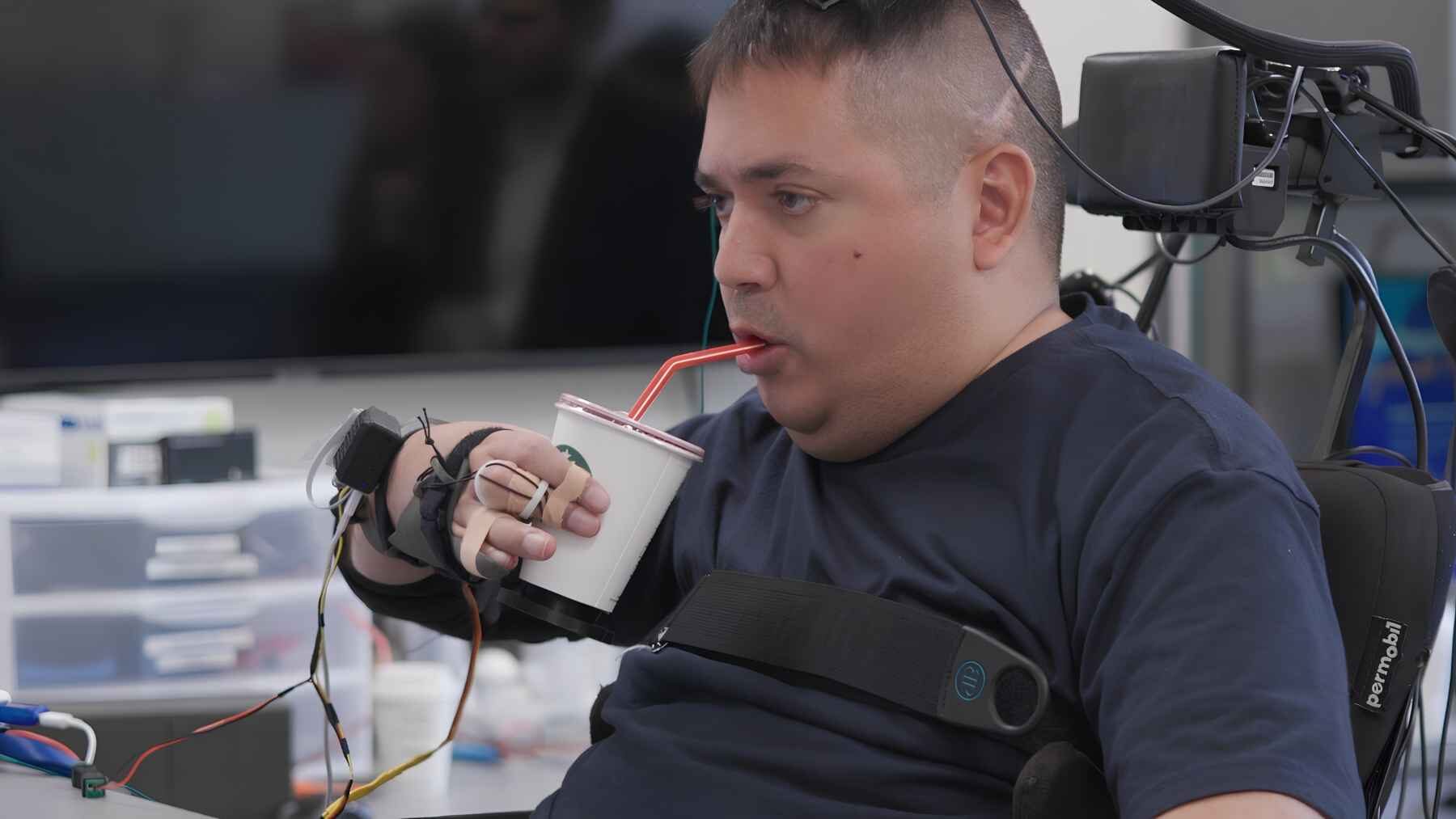
Keith Thomas had resigned himself to a life of limited or no movement after suffering severe spinal cord damage, but experimental brain implants have given him hope. After months of training, he regained the ability to pick up a cup and drink from it, and recovered some sensation in part of his right wrist.
It took almost six years after his diving accident to do what most of us take for granted, but the surprising part is what doctors observed after the system was turned off: some movement and feeling remained. They are now considering whether the experiment helped surviving nerve pathways adapt to the training once it had stopped.
The study published July 16, 2026 only documents Mr. Thomas’ case, which is a promising step forward, but far from a ready cure with widespread application.
A bridge around the spinal injury
The spinal cord acts like a fiber-optic messenger system between the brain and body. Injuries to the system can block the two-way communication, preventing brain commands sent to the muscles from arriving or feelings such as pressure returning to the brain. Researchers created the “double neural bypass” to get around that damage by implanting five small electrode arrays in brain regions controlling touch and movement.
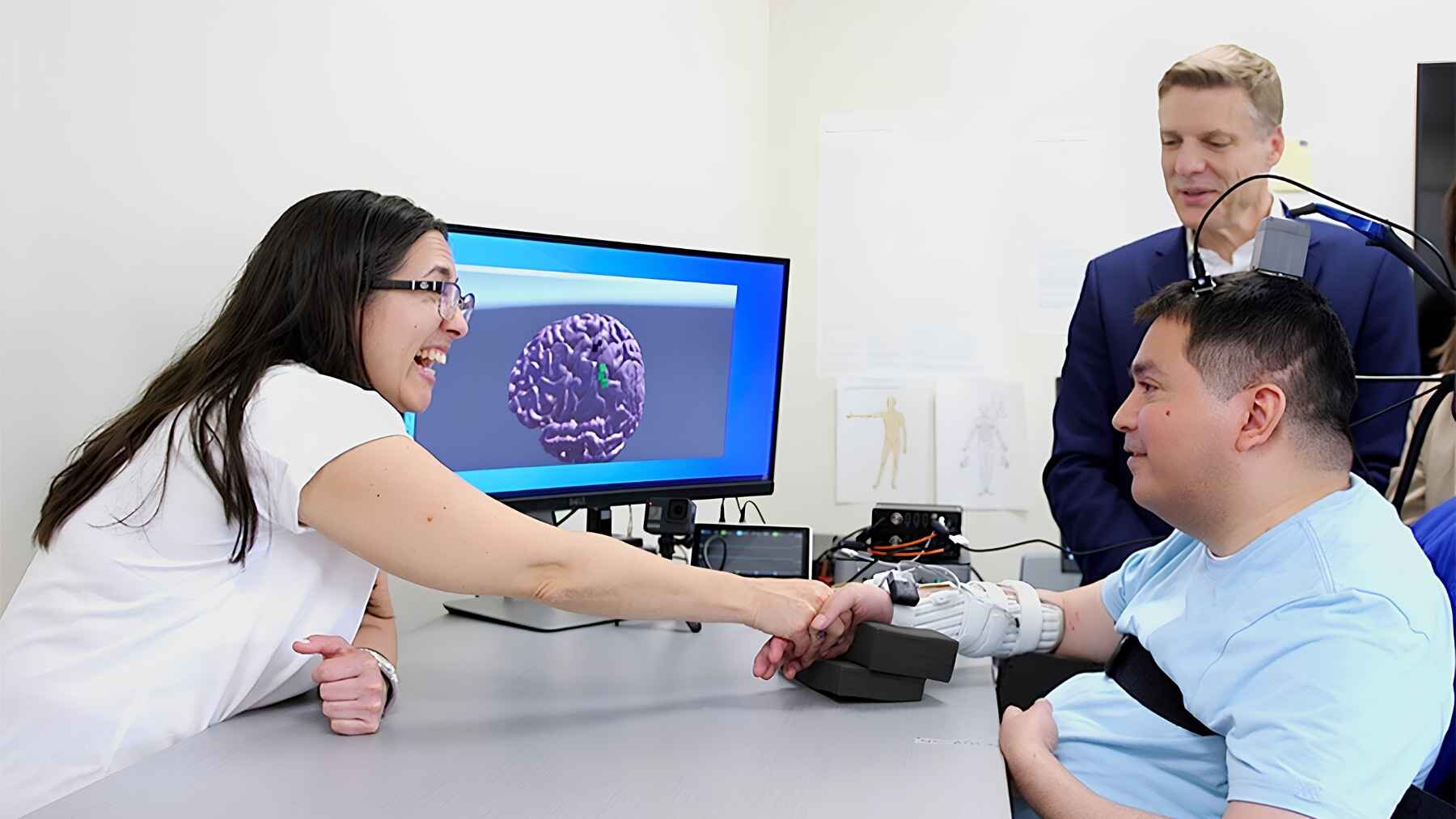
Simply put, the team engineered a system that could read his brain’s intentions, like reaching, grasping, or opening, and send those signals to muscle stimulators. A 3D-printed hand support used pressure sensors to measure grip force and send the sensation back to the brain, simulating the feeling of touch. In this process called “cortical mirroring,” they were able to stimulate the brain, spinal cord, and skin together in real time.
From a drinking cup to a fragile eggshell
Researchers measured an 86% strength increase in his right elbow and up to 62% in his left after about nine months on the program. Previously unable to feed himself or drink from a cup unassisted, he could now control his hands enough to touch his face and hold small objects.
Using force-control software, Thomas learned to carefully handle an empty egg shell without breaking it in 87% of trials, compared to only 27% with the system switched off. Regaining hand strength is one thing, but control is quite another.
These advancements have “changed my life dramatically,” Thomas said. Even away from the lab, he often managed to eat and wipe his face without assistance, pet his dog, and regain some of the freedom that his accident took away.
Why the lasting gains matter
The most remarkable accomplishments of this work are seen after the machines are turned off. Santosh Chandrasekaran and corresponding author Chad Bouton of the Feinstein Institutes for Medical Research at Northwell Health led the study, in which Thomas’ ongoing gains in wrist sensitivity and arm strength two years after the program were “incredibly encouraging,” in the words of Dr. Bouton.
They attribute these gains to the possibility of neuroplasticity, the way in which the nervous system reorganizes itself through repeated practice. More study is needed to fully explain the case results.
There is a distinct difference between assistive technologies and therapeutic systems. The double neural bypass system was designed to be the latter, leaving a patient better off long after therapy ends.
A promising result with serious limits
This study required brain surgery, months of therapy, custom machinery and software, and a highly specialized team. One successful in-human trial cannot necessarily become a standard treatment, and every patient is different.
John Downey of the University of Chicago points out the complexities of individual cases, where attributing the program’s success to the correct components is difficult at best. David McGonigle of Cardiff University characterized the research as “a step towards future work, rather than an end in itself.” Even with this cautious questioning, both remain impressed by the outcomes.
Brain implants are moving beyond simple control
Another 2026 study documented two patients with paralysis who learned to type on a QWERTY keyboard, where one of them reached 22 words per minute with reasonable accuracy. The implanted interfaces did not move their fingers, however, as the keyboard was virtual, not physical.
One could infer that brain implant technology is advancing from moving cursors to much more complex interaction between the brain and body. Thomas’ case along with this study are fairly clear evidence of that direction, but the science is still burgeoning.
What happens next
Thomas’ case is remarkable and an important proof of concept, but the road from experimental study to standard clinical practice is long. The future must include larger trials with different injuries, simplified equipment, correct attribution of effects, evaluation of risks, and suitability assessment for use outside of the laboratory.
Keith Thomas will probably never regain his prior physical capabilities, but his renewed independence is a motivating development for researchers. More importantly, his case offers much-needed, new hope to patients suffering with paralysis.
The official study has been published in Nature Medicine.