What is a rolling blackout? Texas and California grid operators order planned power cuts, area by area, as a last resort, and California's August 2020 cuts lasted 8 to 150 minutes per customer
Rolling blackouts: ERCOT orders controlled outages by area when reserves run low, and has done so four times, up to 20,000 MW in February 2021

· 6 min read
A rolling blackout is a planned, temporary power cut ordered area by area when there isn't enough electricity to go around, and the Electric Reliability Council of Texas (ERCOT) says in its 2026 Energy Emergency Alert Overview that these cuts are used "as a last resort to bring operating reserves back to a safe level and maintain system frequency."
ERCOT calls them controlled outages, or load shed. According to the overview, they're "ordered by ERCOT but implemented by transmission and distribution service providers, to quickly reduce electric demand, balance the grid, and prevent an uncontrolled system-wide outage."
That last clause is the difference between a rolling blackout and an ordinary one: the rolling kind is controlled, with someone deciding which customers lose power, and a system-wide blackout isn't.
That someone isn't the grid operator, however. ERCOT hands each utility an amount, in megawatts (MW), that it has to cut, based on the utility's percentage of historic peak demand. Each utility then decides how to trim demand in its own service area and runs the outages on its local system, and "ERCOT does not have oversight into these outage plans," the overview says.

For scale, ERCOT figures 1 MW is enough to serve about 250 residential customers during its peak hours. The operator has ordered controlled outages four times since it was established, the January 2026 overview says: 500 MW on December 22, 1989; 1,000 MW on April 17, 2006; 4,000 MW on February 2, 2011; and 20,000 MW on February 15-18, 2021.
Why grid operators cut power on purpose
Rolling blackouts happen when a grid's operating reserves, the spare power it keeps on hand, run too low to cover demand. ERCOT works through three levels of Energy Emergency Alerts (EEAs) before it gets there.
Level 1 starts when reserves drop below 2,500 MW and aren't expected to recover within 30 minutes. ERCOT then brings extra generation online and imports up to 1,220 MW from neighboring grids.
Level 2 comes when reserves drop below 2,000 MW on the same terms, or when the grid's frequency (the steady rhythm its alternating current has to hold) sags below 59.91 hertz for 15 minutes. At that stage ERCOT asks the public to conserve and taps large industrial customers who are paid to reduce their power, worth up to 1,000 MW.
Level 3 is the one households feel. If reserves fall below 1,500 MW, or frequency drops below 59.8 Hz for any length of time, ERCOT tells utilities to start controlled outages, and those hit every customer class: residential, commercial and industrial. By ERCOT's own yardstick, 1,500 MW is enough for roughly 375,000 residential customers at peak.
Out West, the steps aren't a strict staircase. The RC0410 procedure from RC West, the reliability coordinator run by the California Independent System Operator (CAISO), lists three alert levels plus a termination level (in effect since July 1, 2026). It says "it is not necessary to progress through the levels sequentially." Its Level 3 means firm load (regular customers, not ones paid to switch off) is about to be cut or already is. Before asking for that, an operator that's short on power has to bring every available generator online and use its demand-management programs.
Two cases from the 2020s came from opposite ends of the thermometer. In California in August 2020, a heat wave kept demand high into the evening. In Texas in February 2021, freezing weather knocked power plants offline.
Grid work brings its own fights, too: in Oregon, a Portland power project could remove 376 trees from Forest Park, and the deal meant to save the grid has split conservation groups.
How long rolling blackouts last
There's no single number, because it depends on the emergency and on how each utility rotates its cuts. The clearest figures come from California, in a preliminary root cause analysis by CAISO and two state agencies.
CAISO issued a Flex Alert on August 13, 2020, asking for voluntary conservation from 3:00 p.m. to 10:00 p.m. the next day. At 6:38 p.m. on August 14, it declared a Stage 3 Emergency, its top level, "because reserves had fallen below the minimum requirements," which the North American Electric Reliability Corporation (NERC) and the Western Electricity Coordinating Council set at roughly 6 percent of load.
The rotating outages that followed lasted about an hour and hit approximately 492,000 customers, each for 15 to 150 minutes. The next evening, a second Stage 3 at 6:28 p.m. ran for 20 minutes and reached 321,000 customers for 8 to 90 minutes apiece. Both lined up with the net demand peak (total demand minus solar and wind), which came in the early evening, when solar output was dropping fast.
Texas in 2021 wasn't measured in minutes. During the week of February 14, ERCOT averaged 34,000 MW of generation outages for more than two days in a row, nearly half of its 69,871 MW all-time winter peak at the time, according to a joint staff report from the Federal Energy Regulatory Commission (FERC), NERC and regional entities. Its firm load shed lasted nearly three consecutive days and hit 20,000 MW at its worst.
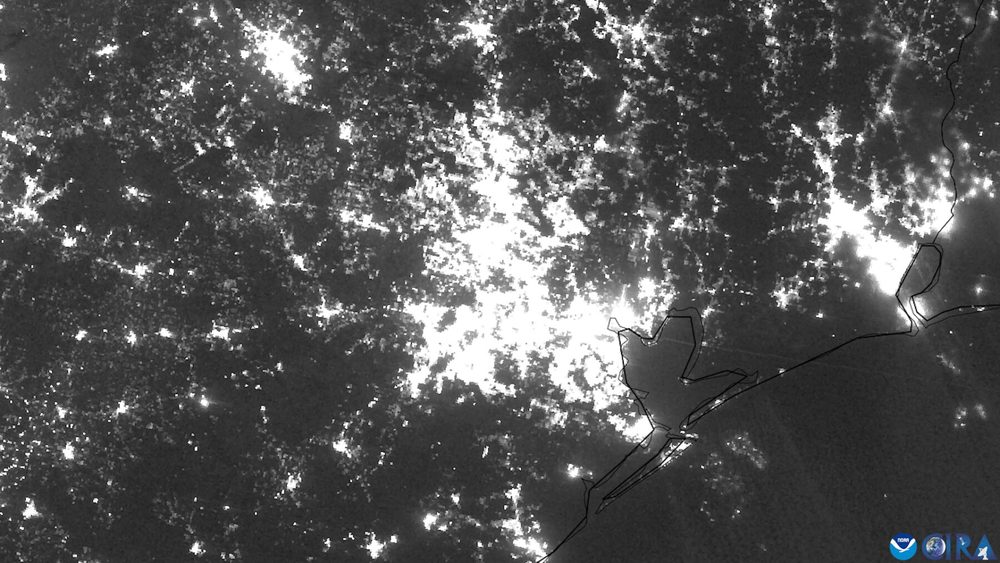
Cuts elsewhere didn't run nearly as long: the Southwest Power Pool shed load for more than four hours in total, and MISO South for more than two. With ERCOT, that came to 23,418 MW, the "largest firm load shed event in U.S. history," the report says.
For a wider yardstick, the U.S. Energy Information Administration (EIA) counts every kind of interruption, not just rolling blackouts. The average U.S. customer had about 11 hours of them in 2024, the agency reported, and nearly 9 came from major events such as Hurricanes Beryl, Helene and Milton. Without major events, it's usually about 2 hours a year. Storm damage counts toward those totals, the kind ECONEWS covered when a winter storm warning forecast up to 60 inches (152 centimeters) of snow and widespread power outages.
In Puerto Rico, customers averaged about 27 hours of interruptions a year without major events from 2021 through 2024, against about 2 hours on the mainland, and went more than 73 hours without power in 2024 with all events counted, EIA found. Meanwhile, much of a $1 billion federal fund for solar panels and batteries in vulnerable Puerto Rico households is being diverted to the old power grid.
How you'll know one is coming
The alert ladder doubles as the warning system. In California, the public signal is a Flex Alert, a request for voluntary conservation; in 2020, CAISO issued one the day before the rotating outages began. In Texas, an EEA 2 includes asking the public to conserve.
Not every step shows up, though. The Western procedure lets operators skip levels, and a call to save power isn't an emergency alert by itself.
ERCOT's advice for people with critical medical needs is to call their utility before trouble starts. "If you have critical medical needs, it's important to contact your local electric utility ahead of a need, that way you are registered in the utility's system," the overview says. It also tells everyone to keep a backup plan "for any emergency situation, not just energy-related scenarios."
Glossary for this story
- Megawatt
- One million watts. Used to measure the output of power plants and wind or solar farms.
- Heat wave
- Several days in a row with temperatures far above normal for the time of year and place.
Javier Niño
Writer at ECOnewsJavier Niño has been a Spanish National Police officer since 2017 and a journalist specialising in employment, labour law and Social Security, with more than seven years of writing experience. At ECOnews he covers environment, energy and sustainability news, focusing on how new regulations and court rulings affect people in their everyday lives.
More from Javier NiñoComments · 0
Rules ›No comments yet. Be the first to share your view.