
Scotland may see the world’s first floating wind farm rise on its waters after Alex Salmond, the country’s first minister, began negotiations on Monday with Norwegian energy giant Statoil A.S. for the offshore wind project.
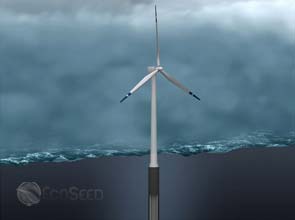
A floating wind turbine generates electricity in water depths where ground-mounted towers cannot be used. Current offshore turbines can only be installed in waters around 30 meters to 50 meters deep.
Statoil (OSL:STL, NYSE:STO) already constructed a 2.3-megawatt prototype version of its Hywind floating turbine, anchored 10 kilometers offshore at Karmøy in Norway. The prototype uses a turbine from Siemens A.G. (FWB:SIE, NYSE:SI) and floating technology from France’s Technip S.A.
The turbine costs about 400 million Norwegian kroner ($64.9 million) to build and deploy, and is expected to generate about 9 gigawatt-hours of electricity annually. Statoil claimed the turbine can be used in waters as deep as 700 meters.
One advantage of having offshore wind farms in deeper waters is that winds can be stronger and steadier due to the absence of mountains that may disrupt wind flow. Also, people on land would hear little or no noise at all because the turbines are located miles away.
Offshore wind farms will also decrease bird deaths that plague onshore wind farms since fewer birds fly out to sea.
After a successful wave of tests since September 2009, Statoil is currently assessing sites worldwide to host a full-scale floating wind farm.
Statoil identified waters off Lewis and Aberdeenshire as suitable areas for the floating wind farm. The sites could house three to five Hywind units, and will also allow tests to determine the commercial potential of the technology.
The Scottish Development International and Marine Scotland have been collaborating with Statoil on feasibility studies. Statoil will visit Scotland again next month to look more deeply into the potential of possible sites.
«The Hywind II wind farm project would see a Scotland-Norway collaboration push the boundaries of deepwater offshore wind beyond the 100 meter mark and open up vast areas of the world’s oceans to the development of wind energy for the first time,” Mr. Salmond said.
Scotland has huge potential for offshore wind power development, which the government aims to harness. The industry can bring in £30 billion ($46.64 billion) worth of investments and create up to 20,000 jobs, Mr. Salmond pointed out.
The government believes that offshore wind energy can account for a larger share of the country’s energy mix. A recent study suggests that harnessing a third of Scotland’s practical resources off its coast by 2050 would generate enough electricity to power the country seven times over.
Scotland set a goal to get 50 percent of its total electricity consumption from renewable energy sources by 2020. The country intends to achieve 31 percent by 2011. Scotland already sources 22 percent of its electricity from renewables as of 2008.