
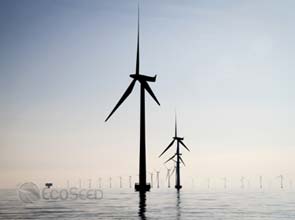
The Scottish government identified six areas off the Scottish coast as ideal locations for offshore wind farms which could deliver as much as 5 gigawatts by 2020, enough to power three million homes. However, the government also knocked back three proposed development sites, which could be potential setback for some major wind energy developers that have been investing in the region.
The Crown Estate, which oversees Britain’s seabed, listed 10 short-term Scottish water location options for wind farm construction in 2009. The tenth site in the original list, near the Bell Rock lighthouse, was withdrawn by developers before ministers reached their decision.
Six sites won approval under the government’s Blue Seas, Green Energy plan published last March 18. Three of the sites are in the Eastern Region off the Firth of Forth and the Firth of Tay. One site is located in Moray Firth, while the rest of the feasible offshore wind sites are in Islay and Tiree.
Developers like SeaEnergy Renewables and NPower Renewables can now move forward to the licensing stage to get the turbines up and running in the wind sites approved by the government. The government also identified 25 additional offshore sites that may be suitable for wind projects.
Setback
However, the government said that three sites – Kintyre, Solway Firth and Wigtown Bay – should not be included in the nation’s offshore wind plans, due to environmental and economic issues.
This means that E.ON, Germany’s largest utility, Dong S/A, the largest producer of electricity in Denmark, and Britain’s Airtricity must reconsider their plans in these sites.
E.ON was awarded rights to develop 300 megawatts in the Solway Firth site while Dong was awarded rights to develop up to 280 MW in Wigtown Bay. Airtricity was also given rights to develop 378 MW in Kintyre.
Scottish & Southern Energy Plc, Britain’s second-largest power producer, also shelved this month plans to develop a 378-MW wind farm at the Kintyre site, after surveys raised concerns about adequate winds and the project’s potential impact on air traffic and recreation.
However, the company insisted it will continue with plans for a 690-MW sister project 13 kilometers off the west coast of the Isle of Islay.
Rural Affairs and Environment Secretary Richard Lochhead said Scotland has 206 GW of offshore wind, and wave and tidal capacity – almost 40 percent of Britain’s total capacity. Harnessing just one third, or 68 GW, would result in net value of £14 billion in electricity sales alone by 2050.
These wind power initiatives are part of Scotland’s plan to meet its renewable energy target of 80 percent of gross consumption by 2020.