
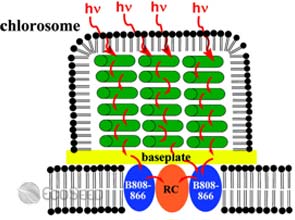
Researchers are studying the light harvesting capabilities of certain strains of bacteria to develop the next generation of efficient solar cells. Scientists from Washington University in St. Louis and the Department of Energy’s Oak Ridge National Laboratory are analyzing the structure of chlorosomes in green photosynthetic bacteria.
Chlorosomes are photosynthetic antenna complexes found in certain forms of bacteria. They allow for the capture of light that is then converted to energy to support the continued growth of the bacteria.
“It is one of the most efficient light harvesting antenna complexes found in nature,” said research scientist Volker Urban of O.R.N.L.’s Center for Structural Molecular Biology.
The researchers used neutron analysis performed at the center’s Bio-SANS instrument at the High Flux Isotope Reactor, allowing the team to examine chlorosome structure under a range of thermal and ionic conditions.
It was found that chlorosomes were not only able to still collect sunlight in low-light conditions but also to maintain structural stability under extreme conditions. This stability could be an invaluable characteristic in future solar cells.
«What’s so amazing about the chlorosome is that this large and complicated assembly is able to capture light effectively across a large area and then funnel the light to the reaction center without losing it along the way,» Mr. Urban said.
The size, shape, and organization of light-harvesting complexes such as chlorosomes are critical factors in electron transfer to semiconductor electrodes in solar devices. Understanding and mimicking chlorosomes’ ability to function could allow scientists to replicate the ability in bio-hybrid or bio-inspired solar cells.
Artificial or man-made photosynthetic systems based on the systems found in nature – green leaves, algae, and bacteria – are of considerable interest to solar energy researchers. The highest efficiency solar cell has yet to be able to match that of natural photosynthesis.
Another group of scientists at the University of Leiden have been working with chlorosomes to attempt to fashion an “artificial leaf” to harvest light for solar energy.
The Leiden researchers modified the chlorophyll found in an algae strain to resemble the hardier bacterial chlorosomes.
The team, led by Robert Blankenship of Washington University, published its findings in the journal Langmuir. The research was supported through the Photosynthetic Antenna Research Center, an energy frontier research center funded by D.O.E.’s Office of Science.