

Researchers at the Department of Energy’s Oak Ridge National Laboratory are looking at thermoelectric materials on the atomic level in the hopes of making waste-heat-to-energy systems commercially viable.
Thermoelectric materials display the thermoelectric effect, the ability to create a voltage in the presence of a temperature difference. Thermoelectrics can convert low-grade waste heat – such as that created in an industrial process or from the exhaust system of a car – into electricity.
Another use for thermoelectric would be the transportation of heat from an external source of power that could then be manipulated to cool a surface.
The researchers believe thermoelectric materials can be used in new, energy-saving technologies, if they were only more efficient.
“Right now the materials may be on the order of 10 percent efficiency,” said Oliver Delaire, a Shull fellow at O.R.N.L. and part of a collaboration between the lab and the Massachusetts Institute of Technology.
“If we can make them two or three times better, if we can get 30 percent efficiency, that would get people very excited, and it would be much more viable economically,” said Mr. Delaire.
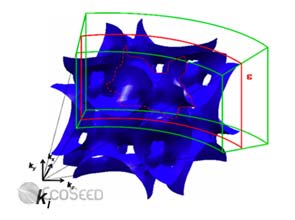
The research collaboration seeks to improve thermoelectric materials by improving understanding of phonons, atomic vibrations that are said to enable the transport of heat through thermoelectric materials.
In order to do this, the researchers are subjecting the materials to neuron scattering via instruments at the Spallation Neutron Source and the High Flux Isotope Reactor facilities of O.R.N.L.
Single crystals of the thermoelectric materials lead telluride, lanthanum telluride and iron silicide were grown at O.R.N.L. for the tests.
“Neutron scattering is unmatched in its ability to probe the atomic vibrations in the crystals,” said Mr. Delaire.
The research is funded by an Energy Frontier Research Center at the M.I.T. and involves a dozen investigators at O.R.N.L.
Scientist from several other D.O.E. labs – Brookhaven National Laboratory, Argonne National Laboratory, Los Alamos National Laboratory as well as Columbia University, Northwestern University, and the Swiss Federal Institute of Technologies are also studying thermoelectric materials.
Their research project involves the observation of nanoscale atomic action in lead chalcogenides, specifically the atomic displacement that occurs when the materials go through temperature changes.
According to the team, as the materials got warmer, structural distortions started to appear and the distances between the materials atoms started growing. This impedes the movement of heat through the material and lowered its thermal conductivity.
The researchers believe their findings could help identify even more materials that display the thermoelectric effect for further development of thermoelectric devices.