

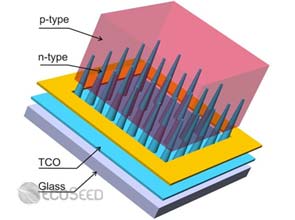
Researchers from the Oak Ridge National Laboratory have developed a nanocone-based solar cell that can increase light-to-power conversion by overcoming the problem of poor transportation of charges.
Charges in a conventional solar cell, specifically negative electrons and positive holes, typically become trapped by defects in bulk materials and their interfaces, and degrade performance which leads to the cell’s lower efficiency.
“To solve the entrapment problems that reduce solar cell efficiency, we created a nanocone-based solar cell, invented methods to synthesize these cells, and demonstrated improved charge collection efficiency,” said Jun Xu, lead researcher and O.R.N.L. member of the chemical sciences division.
The solar structure consists of n-type nanocones that are made of zinc oxide and serve as the junction framework and the electron conductor. These nanocones are surrounded by a p-type semiconductor matrix made of polycrystalline cadmium telluride. The semiconductor serves as the primary photon absorber medium and hole conductor.
Having this solar structure, Mr. Xu and his colleagues were able to achieve an increase of 78 percent in light-to-power conversion efficiency. From 1.8 percent efficiency of conventional planar structure of the same materials, its efficiency increased to 3.2 percent.
“The important concept behind our invention is that the nanocone shape generates a high electric field in the vicinity of the tip junction, effectively separating, injecting, and collecting minority carriers, resulting in a higher efficiency than that of a conventional planar cell made with the same materials,” Mr. Xu said.
In addition to the increased efficiency, the solar material has two other features. The material’s synthesis is inexpensive and has a lower risk of defects and voids in semiconductors which lead to enhanced electric and optical conversion of solar photons to electricity.
The research was supported by the Department of Energy’s Office of Nonproliferation and Research and Engineering, and the Laboratory Directed Research and Development program, which accepts proposals of projects that they will fund.
However, when it comes to the conversion efficiency of concentrated solar photovoltaic cells, California-based Solar Junction achieved 43.5 percent efficiency through the company’s multijunction cells that are more complex but expensive to make.