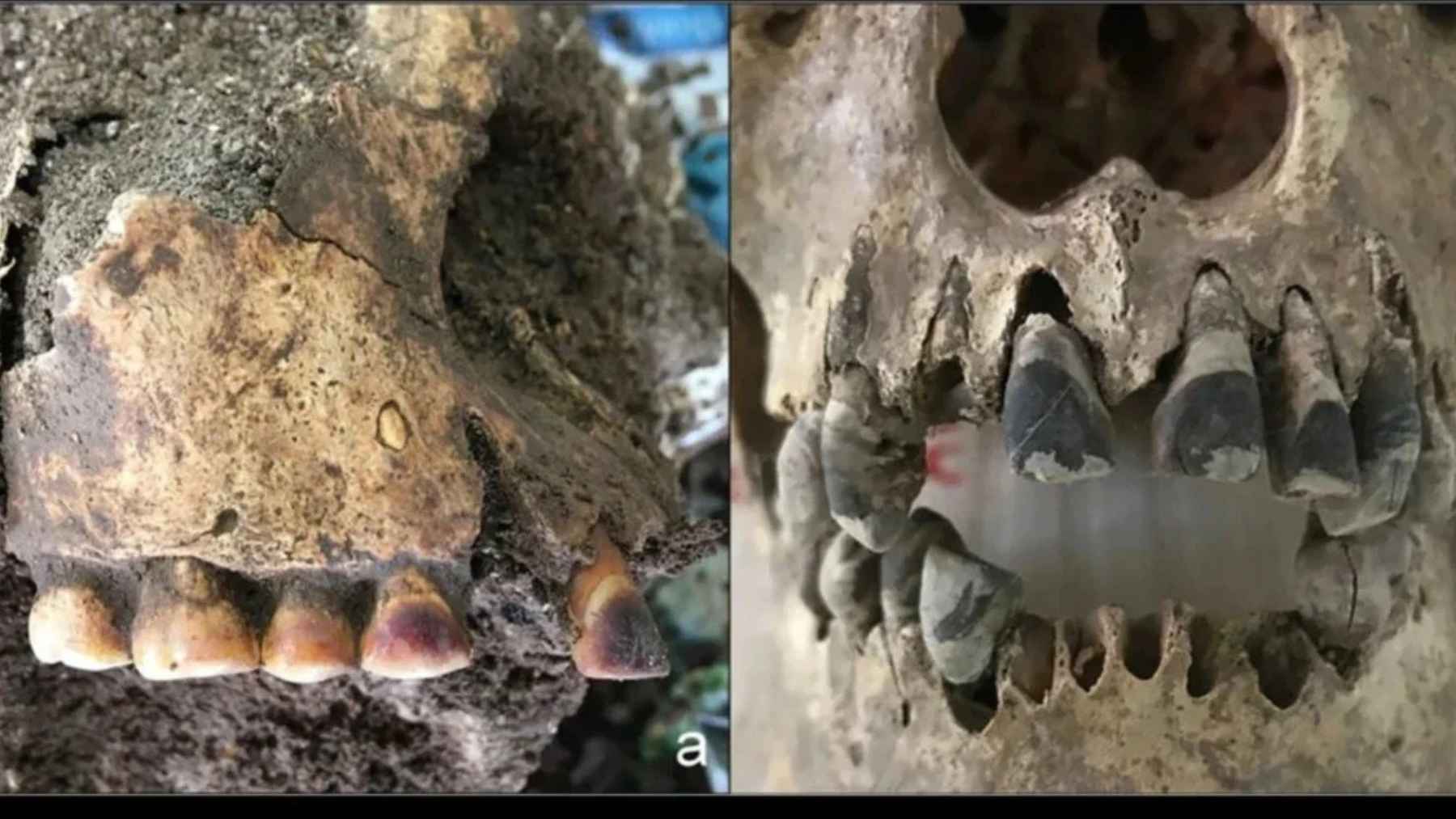
If you think a “perfect smile” has to be bright white, a set of Iron Age teeth from northern Vietnam tells a different story. Researchers have confirmed that people living around 2,000 years ago deliberately dyed their teeth a glossy black, and the chemistry is still readable today.
The team found iron-based compounds locked into ancient enamel, linking a tradition remembered in parts of Vietnam and Southeast Asia to a much deeper past. Just as important, the work gives archaeologists a clearer test for telling intentional tooth blackening apart from stains caused by food, habits, or burial conditions.
A beauty standard that flips the modern script
In the United States, most dental ads push “whiter” as the goal, and plenty of people chase it with whitening strips or brightening toothpaste. In Vietnam, ethnographic records and historical accounts describe communities where blackened teeth were admired and socially meaningful well into the 19th and 20th centuries.
That creates a tricky problem for archaeology. When dark teeth show up in old burials, are we looking at a beauty practice, a common stimulant like betel nut, or just chemistry from the ground? Until recently, the answer was often guesswork.
Dong Xa and a clue that survived two millennia
The new evidence comes from Dong Xa, a site in the Red River delta region of northern Vietnam associated with the Dong Son cultural period. The settlement and cemetery date to Vietnam’s Iron Age, roughly 550 B.C. to A.D. 50, and some of the burials include teeth with a striking black coating.
Instead of damaging the remains, the researchers used non-destructive tools to read what was on and in the enamel. They analyzed teeth from three individuals using portable X-ray fluorescence and scanning electron microscopy with energy-dispersive spectroscopy, which can identify elements by the signals they emit.
The chemical fingerprint points to iron salts
When the team targeted the darkest enamel areas, they found a high concentration of iron oxide and clear signals for iron and sulfur. In the best-preserved sample, the study reports iron averaging roughly 2.4 to 4.0 percent of the elemental readings and sulfur around 1.1 to 1.8 percent, which stands out against normal enamel chemistry.
That iron plus sulfur pairing matters because it is consistent with iron salts used to create deep black pigments. Lead author Yue Zhang told Live Science that “the combined presence of Fe and S signals” strongly indicates iron salts were part of the process.
How plants and iron make a lasting black
So how do you turn that chemistry into a glossy, durable finish? In Vietnam and nearby regions, documented methods often combine an iron-based ingredient with tannin-rich plant materials, and when tannic acids bind to iron ions they form stable dark complexes, similar to the chemistry behind long-lasting iron-gall inks.
The specific ingredients likely shifted by era and community, but reporting linked to the study mentions botanicals such as betel nut, pomegranate rind, or aromatic woods as plausible sources of tannins. Ethnographic records also describe both quick approaches and refined multi-stage recipes, including a two-stage version that can take about 20 days to fully darken enamel.
Separating fashion from food stains
Betel nut chewing has been widespread for thousands of years across parts of Southeast Asia and the Pacific, and it can stain teeth and gums a reddish-brown color over time. But betel staining is not the same as intentional tooth blackening, and the Dong Xa teeth needed more than a visual call.
To test the idea, the researchers recreated a blackening mixture and applied it to a modern animal tooth as an experimental control. The modern tooth showed a matching elemental pattern with elevated iron and sulfur, strengthening the argument that the Dong Xa discoloration came from a deliberate recipe rather than an accidental stain.
What it says about Iron Age identity
The Dong Son period is famous for bronze drums, weapons, and far-reaching exchange networks, but those objects do not always tell us how people presented themselves day to day. The study argues that tooth blackening should be read as a culturally embedded form of identity expression within those connected communities.
It also appears to have been common in some places. The paper notes that altered dental color affects at least one-fifth of observed individuals in the broader Dong Son assemblage complex, and other researchers have reported rates around 40 percent, suggesting the practice could have been widespread depending on the community.
The big unanswered questions
Even with the chemical fingerprint, the original reason people chose black teeth is still debated. The researchers discuss possibilities such as a less harmful substitute for tooth ablation, or a way to enhance tooth coloration associated with betel use, especially once iron tools became easier to access during the Iron Age.
There is also a subtle environmental note hiding in plain sight, because the recipe relied on local minerals and plant chemistry rather than manufactured pigments.
The study was published in Archaeological and Anthropological Sciences.