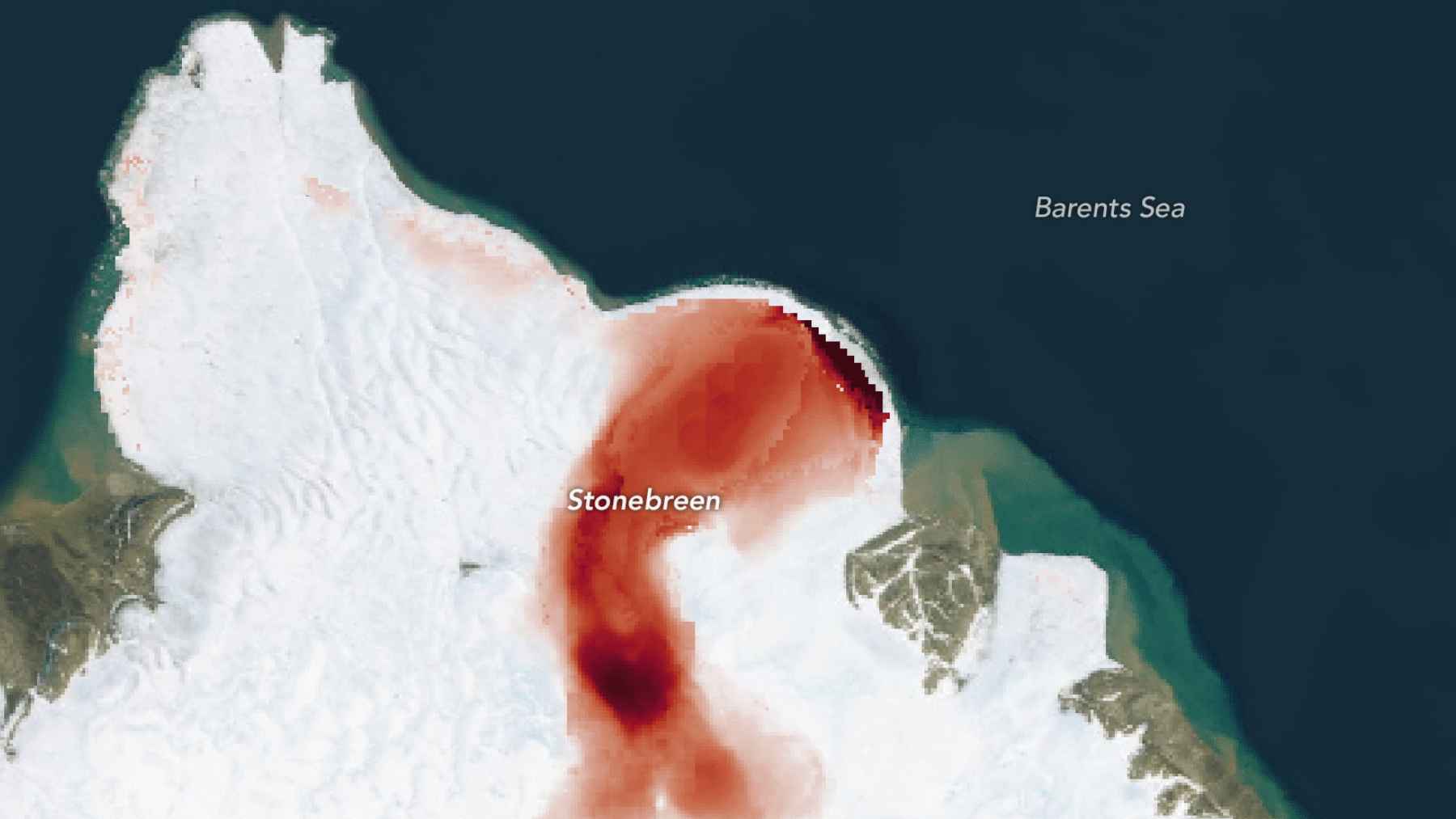
Can a glacier have a heartbeat? Not literally. But NASA says Stonebreen, a glacier on Edgeøya in Norway’s Svalbard archipelago, comes surprisingly close.
New imagery from the agency shows the glacier pulsing in shades of red through the year, not because the ice changes color, but because the animation tracks how fast the surface is moving. Darker reds mean faster flow.
The image is striking partly because the place itself feels so remote. Edgeøya sits in southeastern Svalbard, roughly halfway between mainland Norway and the North Pole, and the animation turns a quiet Arctic landscape into something that almost feels alive.
That is what catches the eye. The science underneath it matters more.
Why Stonebreen seems to “pulse”
Between 2014 and 2022, Stonebreen moved relatively slowly through winter and spring, then sped up by late summer to more than 1,200 meters (about 3,940 feet) per year in some areas. In summer 2020, parts of the glacier reached 2,590 meters (roughly 8,500 feet) per year.
NASA says those summer bursts happen when meltwater slips from the surface to the base of the glacier, raising pressure and helping the ice slide more easily over rock.
The animation comes from NASA’s ITS_LIVE project, which measures glacier speed by tracking crevasses and other surface patterns in optical and radar satellite images. In simple terms, researchers are following the glacier’s fingerprints from one month to the next. As glaciologist Chad Greene put it, “We wanted to check the health of Earth’s glaciers, so we measured their pulse.”
A rare glacier with an even stranger cycle
Stonebreen is unusual for another reason. It is a surge-type glacier, a rare class that can sit in a slower phase for years and then suddenly lurch forward much faster for months or even years. NASA says only about 1% of glaciers worldwide behave this way, although they are more common in Svalbard.
Before 2023, Stonebreen had been in a fast-moving phase after melting at its front likely destabilized it. Since 2023, it has mostly shifted into “quiescence,” with just a brief summer glide when meltwater returns.
Why this matters beyond one Arctic island
Why should anyone care about a glacier so far from daily life? Because Stonebreen’s “heartbeat” fits into a much larger pattern. Using millions of satellite images collected from 2014 to 2022, NASA scientists mapped seasonal glacier motion around the world and reported that Earth has more than 200,000 glaciers.
Their 2025 study in Science found that seasonal velocity changes are strongest where annual maximum surface temperatures rise above 0 degrees Celsius, and that future warming could amplify and shift those patterns worldwide.
That makes Stonebreen more than an Arctic curiosity. Its seasonal pulse acts, to a large extent, like a vital sign. It will not tell the whole story on its own, but it can help researchers see which glaciers may be more vulnerable as warming changes the timing and intensity of meltwater flow. And that is the part worth watching.
The official statement was published on NASA Earth Observatory.