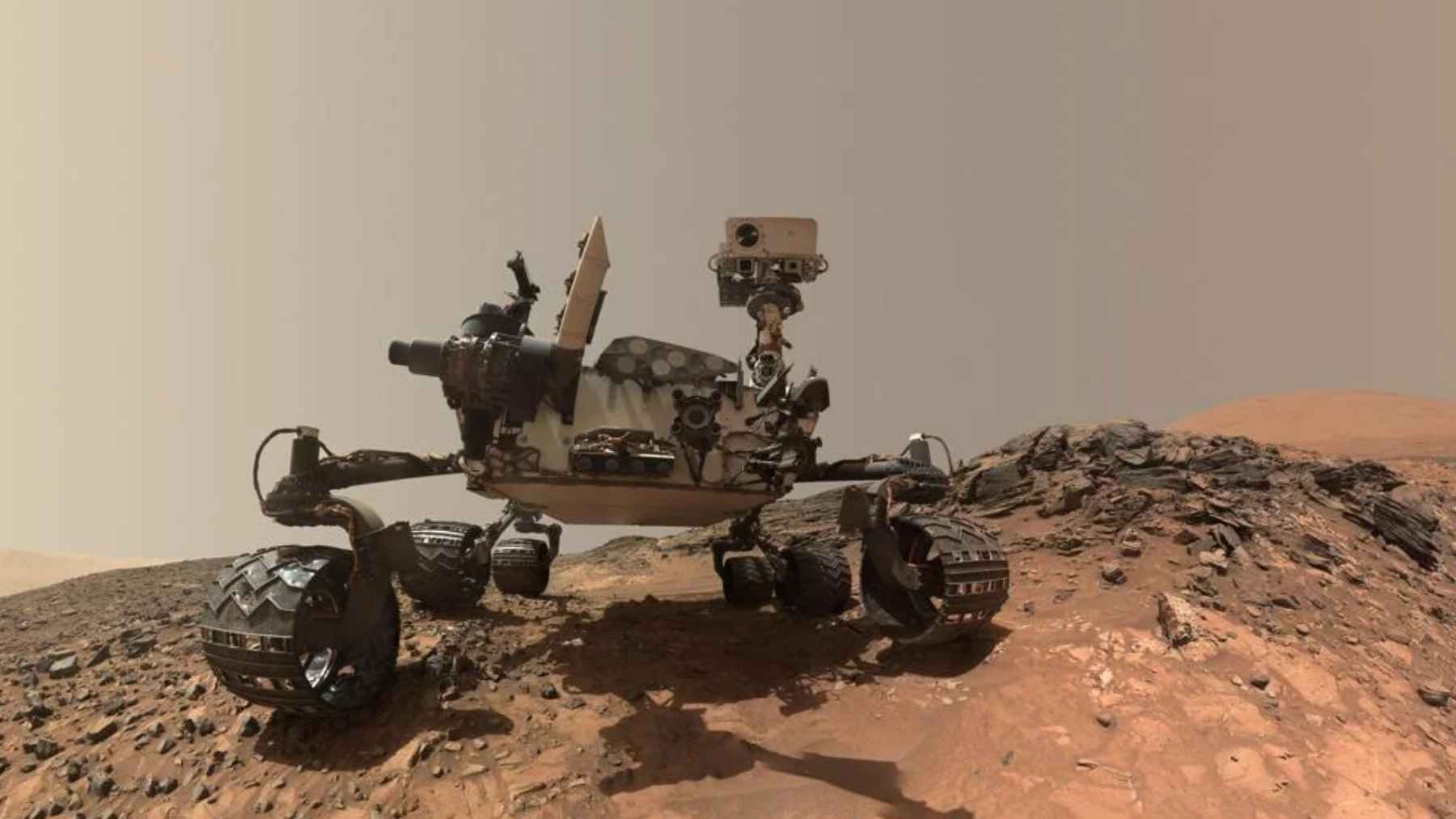
Could a rock sample drilled more than a decade ago hold one of the clearest clues yet to ancient life on Mars? In March 2025, NASA’s Curiosity rover revealed the largest organic molecules yet detected on the planet, and a follow-up paper published on February 4, 2026, says the nonbiological sources tested do not fully explain how much organic material may once have been in that rock.
No one is calling this proof of life. Not yet. But researchers say the result matters because the molecules came from an ancient lakebed and because Mars’ surface radiation likely erased part of the original chemical record over millions of years, making today’s signal only a leftover trace.
Why this old Curiosity sample matters
Here is the twist. These molecules were not found in a brand-new drill hole but in Cumberland, a sample Curiosity collected in 2013 and later analyzed inside its Sample Analysis at Mars lab. The team identified decane, undecane, and dodecane carbon-rich compounds that may be broken pieces of fatty acids, which help build cell membranes on Earth.
That does not automatically point to life, since geology can make some fatty-acid-like compounds too. Still, the sample came from Yellowknife Bay in Gale Crater, an ancient lake environment where clay minerals, sulfur, and fine mudstone make it easier for fragile chemical clues to survive for immense spans of time.
What the new study actually did
So what changed in the new paper? A team led by Alexander Pavlov at NASA Goddard Space Flight Center combined laboratory radiation experiments, mathematical models, and Curiosity data to estimate how much organic material the rock may have held before about 80 million years of surface exposure gradually broke much of it down.
In practical terms, the researchers tried to rewind Mars’ chemical clock. Their analysis said meteorites, carbon-rich dust, and a haze from ancient Mars do not readily account for the estimated original abundance, leaving two broad ideas under discussion: organics made by hot water-rock reactions, or chemistry linked to a past Martian biosphere.
Why scientists are still being careful
The earlier March 2025 paper in Proceedings of the National Academy of Sciences, led by Caroline Freissinet of the French National Centre for Scientific Research, made the first detection but also stressed a hard limit. Curiosity can spot these compounds, yet it cannot determine whether they were made by living things or by nonliving chemistry.
That caution is why scientists are still speaking carefully. Curiosity had already found preserved organic material in Gale Crater in earlier work, including a 2018 report on ancient organics, and the new studies fit that longer story. Mars has not yielded proof of past life, but this old bit of lake mud keeps the question very much alive.
The main study has been published in Astrobiology.