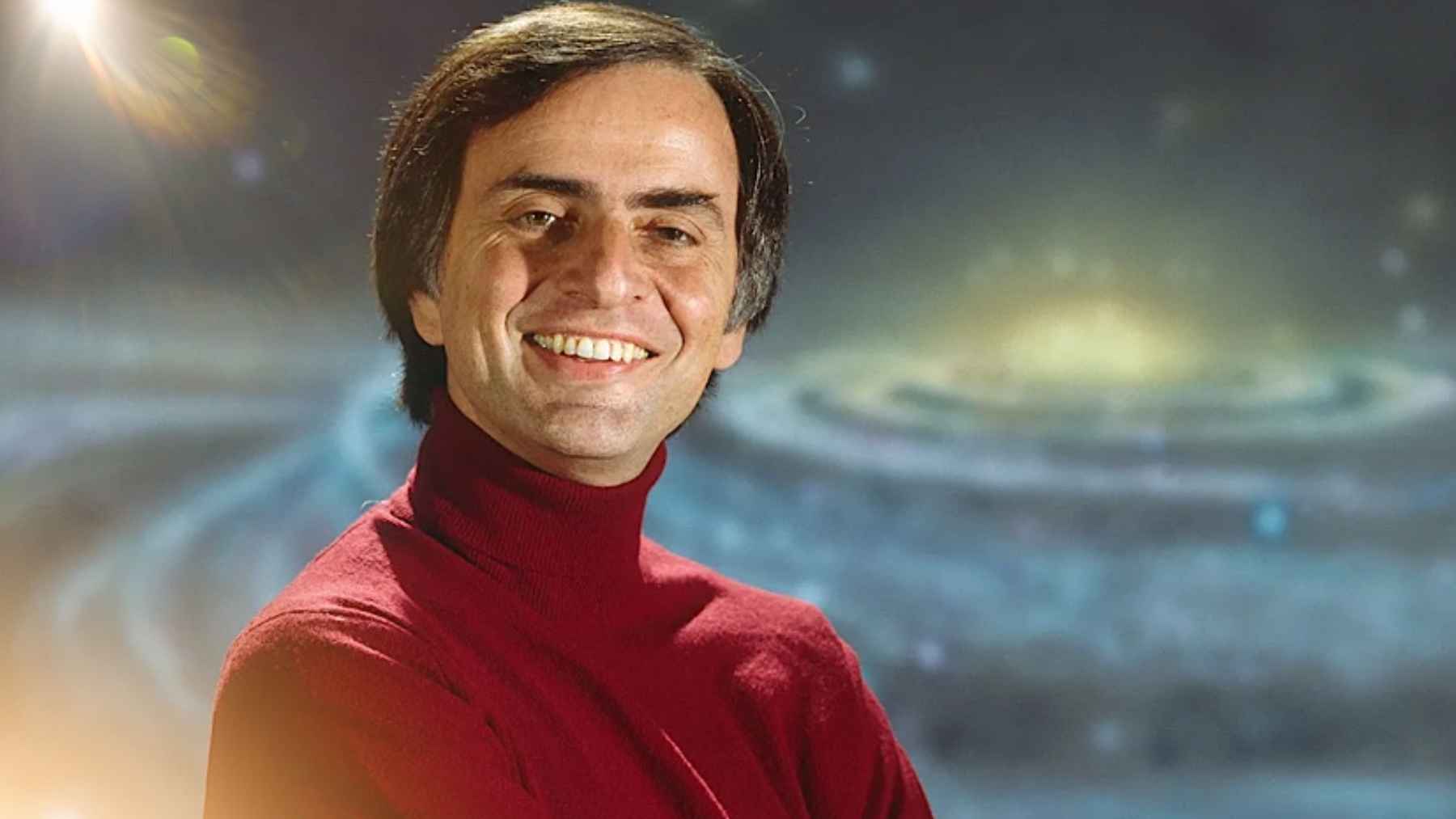
Most people have looked up at the night sky and felt, for a second, that it must somehow revolve around us. Carl Sagan spent much of his life explaining why the answer is no. The astronomer argued that the universe is not tailored to human beings, and that blunt idea also summed up his wider defense of evidence over rumor, superstition, and wishful thinking.
That message reached a huge audience through the 1980 TV series Cosmos, which became the most-watched show in public television history and was seen by more than 500 million people in 60 countries. It was not science fiction, and it was not mysticism. It was science, translated into plain language for millions of people watching from their living rooms.
What Sagan meant by an indifferent universe
The core idea was simple. The universe follows natural laws, not human wishes, which means stars are born, planets cool, and worlds are destroyed whether anyone is watching or not. It pushed back against the old human-centered view that everything in the sky was somehow arranged for our comfort.
A manuscript of his essay “A Universe Not Made for Us,” now preserved by the Library of Congress, shows how seriously he took that point. He argued that science has to stand on evidence people can test, not on comforting stories or vague beliefs that happen to feel good. In practical terms, that means the truth matters more than human pride.
How he brought the stars down to Earth
Sagan was far more than a television host. He earned degrees in physics, astronomy, and astrophysics at the University of Chicago, spent years on the Harvard faculty, later taught at Cornell University, and advised NASA during the early decades of planetary exploration. His research helped shape modern thinking about places like Venus and Mars, along with the search for life beyond Earth.
But his rare skill was translation. He could take giant distances, strange planets, and hard scientific ideas and explain them in words a teenager could follow after dinner or before bed, even if the night sky outside was washed out by city lights. That helps explain why so many people saw him as the scientist who made the universe feel understandable.
Why the backlash never erased the legacy
Fame did not shield him from academic resistance. An official memoir from the National Academy of Sciences says his nomination for membership was unsuccessful in 1992, even though the academy awarded him its Public Welfare Medal two years later. For the most part, that tension reflected a suspicion that public communication was somehow less serious than research.
But the public heard something else. They heard a scientist saying that human beings are small in the cosmic picture, yet lucky enough to understand a piece of it and responsible for protecting the fragile world beneath their feet. Maybe that is why his words still resonate now, when rumor moves fast and evidence often has to fight for attention.
The main archival material behind this story is preserved in the Library of Congress’s Carl Sagan archive.