California’s farmers are being asked to do something that sounds almost impossible. Grow the same food with less water, even as drought and rising heat make every drop more precious. And in many orchards, one of the biggest quiet problems is not drought stress. It’s overwatering in the wrong places at the wrong time.
Researchers at the University of California, Riverside say they have a better way. Their new system uses a small ground robot to map soil moisture across an orchard, tree by tree, so irrigation can be targeted instead of averaged across the whole field.
Why overwatering happens even when farmers are careful
Walk through an orchard and it might look uniform, but the soil underneath is not. Fine, tightly packed soils can hold water longer, while sandy soils let it drain fast, so two neighboring trees can end up living in totally different root zone conditions even when sprinklers apply the same amount of water.
That mismatch pushes growers toward guesswork, especially when they rely on a handful of buried moisture sensors for hundreds or thousands of trees. As Elia Scudiero, a UC Riverside associate professor who led the project, put it, “The information those sensors provide is very limited,” because it “really only tells you what’s happening in the immediate areas where they’re placed.”
The stakes are rising. Pumping and delivering irrigation water costs money, and it can add up in a way that feels a lot like watching an electric bill climb during that sticky summer heat we all know.
A “modern-day divining rod” that runs on data
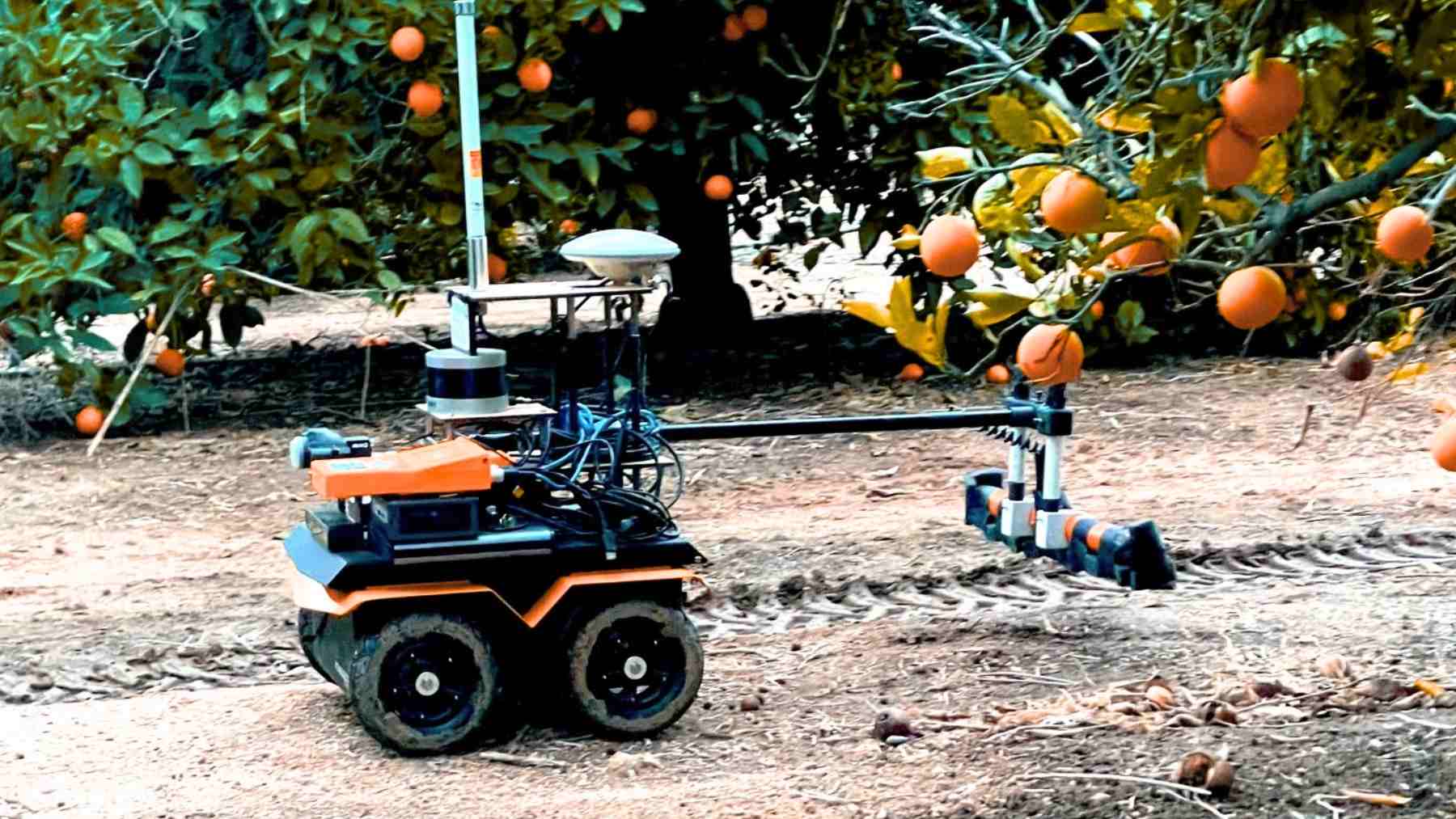
For generations, some people have walked fields with a forked stick, hoping it would point to hidden water. UC Riverside’s version is less mystical and a lot more measurable. A compact robot drives through orchard rows and measures soil apparent electrical conductivity, a property influenced by moisture as well as salt and clay content.
In the study, the team mounted a lightweight electromagnetic induction sensor that weighs about 0.9 pounds (425 grams) on a small unmanned ground vehicle about 20 inches long, 17 inches wide, and 10 inches tall (0.51 by 0.43 by 0.25 meters). The sensor collected about one reading per second, and a GNSS receiver tracked positions with better than about 12 inches (30 centimeters) of horizontal accuracy under typical field conditions.
Here’s the key twist. The robot’s conductivity readings were paired with direct soil moisture measurements from time domain reflectometry tools at a limited set of spots, then fed into a statistical model that translated conductivity into estimated volumetric water content across the orchard. In practical terms, that means a grower can stop watering by averages and start watering by need.
The “sweet spot” matters for roots and yields
Water stress is not a simple “more is better” story. Too little water can weaken trees and leave them more vulnerable to pests and disease, but too much water can also backfire by pushing oxygen out of soil pores and essentially suffocating roots. Scudiero summed it up bluntly with, “There’s a sweet spot.”
The research also highlights why orchard irrigation can be so tricky. In the two citrus orchards studied at UC Riverside’s Citrus Research Center and Agricultural Experiment Station in Riverside, California, the trees were micro irrigated with two micro sprinklers per tree averaging about 14 gallons per tree per hour (53 liters per tree per hour), scheduled two to three times a week for run times up to eight hours.
So when watering is even slightly off, the consequences can ripple. A long irrigation run can mean a lot of water moving through soil, and if the soil structure varies across the field, some areas may be left dry while others become saturated.
What the results say about accuracy and real-world effort
The team’s fieldwork ran from October 2024 to March 2025, surveying two citrus orchards four times each. The robot’s sensor measured conductivity down to roughly 2.3 feet (0.7 meters), while the direct moisture checks used for calibration captured the top roughly 4.7 inches of soil (0.12 meters), which the researchers note is a limitation because the sensing depths do not perfectly match.
Even so, the modeling performed well. Using their best approaches, the median evaluation error was about 0.039 m³/m³ in independent testing, which the authors categorized as “good” accuracy for this kind of field mapping.
One of the most practical findings is how few calibration spots may be needed. The study reports that accuracy improved as more calibration footprints were used, but gains became marginal beyond roughly four to six footprints per field, suggesting farms might not need a dense and expensive sensor network to get useful orchard wide moisture maps.
Cleaner groundwater is part of the story too
Precision irrigation is often pitched as a way to save water, but it can also reduce pollution. When fields are overwatered, nutrients applied as fertilizer can be washed below the root zone and into groundwater, which is a problem in many farming regions.
Scudiero pointed to that risk directly, saying that if you apply “only the amount of water the plants actually need,” you reduce the chance of washing nutrients “away from the roots of the crops and into the environment.” It’s a reminder that irrigation decisions do not stay inside the orchard fence line.
There’s also a plant health angle that farmers know well. The study notes that high soil moisture can worsen certain soilborne disease risks when pathogens are present, which makes better moisture control more than just a conservation move.
What comes next for orchard robots
Right now, moving from university research orchards to commercial farms is the hard part. The researchers say real world systems will need rugged machines that can handle different weather conditions and crop systems, plus partnerships with private industry to turn prototypes into products.
In the study setup, the robot was teleoperated to stay close to irrigation lines where moisture patterns can change quickly, and the team filed a patent related to how the robot interacts with sensors without disturbing measurements.
Other work cited in the paper suggests semi autonomous navigation is getting closer, and a similar platform has been tested for longer missions with a maximum battery life around four hours.
If you’re wondering where this could lead, imagine a future where orchards are quietly surveyed the way a warehouse gets scanned for inventory. Not to replace farmers, but to give them better maps so fewer decisions are made in the dark.
The study was published on Computers and Electronics in Agriculture.