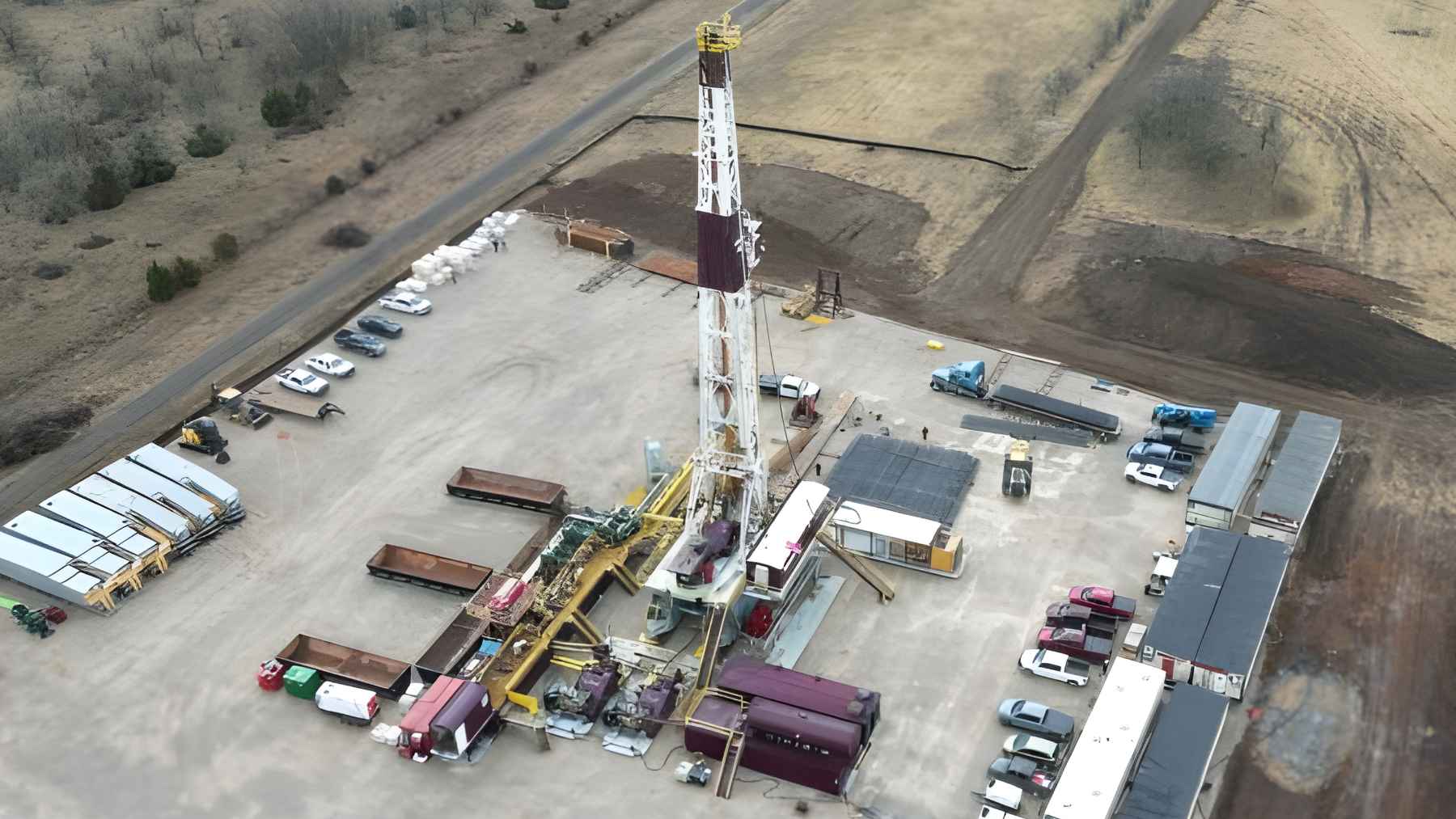
A California startup called Deep Fission has started drilling in Parsons, Kansas, for something the U.S. nuclear industry has never built before: a small reactor designed to sit nearly 6,000 feet underground, using the surrounding rock as a major part of its safety and containment strategy.
The company says this first round of boreholes is the opening move toward a pilot reactor that aims to reach “criticality” in July 2026.
If it works, the pitch is simple and disruptive. Instead of pouring massive surface foundations and building thick concrete-and-steel containment domes, Deep Fission wants to lower a pressurized water reactor into a narrow shaft like a giant piece of industrial equipment, then let geology do much of the heavy lifting.
That could matter for the climate and the grid, especially as data centers and industrial sites demand around-the-clock power that wind and solar cannot always provide on their own.
A nuclear “well” takes shape in the Midwest
Deep Fission says it began drilling its first of three planned exploratory wells on March 11 in Parsons, Kansas. Each test well is expected to reach about 6,000 feet deep and roughly 8 inches wide, using drilling techniques borrowed from the oil and gas sector.
Why Kansas? The company and industry coverage point to stable, well characterized geology as the key selling point, since the entire concept depends on predictable rock layers and low permeability.
These early wells are meant to validate site models and prove the drilling and measurement tools can deliver the precision needed before anything nuclear is lowered underground.
What goes underground and what it is designed to power
Deep Fission’s proposed pilot is a small modular pressurized water reactor design, scaled down to fit inside a borehole. The company describes it as a 15 megawatt thermal unit, which would translate to roughly 5 megawatts of electricity after conversion, enough to support a remote industrial facility or a portion of a data center load.
That focus is not accidental. Data centers are growing fast, and they need steady electricity even when the sun is down and the wind is calm. In practical terms, that means grid planners are hunting for firm low carbon power that can keep servers humming through heat waves, cold snaps, and the kind of sticky summer nights that send the electric bill climbing.
Using pressure and rock instead of massive surface structures
At roughly 6,000 feet down, the water column pressure can reach on the order of 160 atmospheres, which is about 2,350 pounds per square inch. Deep Fission argues that this natural pressure can reduce how much heavy steel pressure boundary hardware is needed compared with conventional aboveground reactors.
The rock matters even more. On the surface, reactors rely on engineered containment and thick biological shielding, built with huge amounts of concrete and steel. Underground, the company’s idea is that the surrounding formations provide an additional barrier that helps isolate radiation and fission products in the event of an accident, largely by distance, density, and geology rather than just manmade walls.
Still, “letting geology do it” raises the obvious question. How do you prove the rock will behave the way the models predict for decades? That is exactly why the company is drilling these characterization wells first, and why the permitting and safety case will be watched closely by regulators and skeptics alike.
The cost and speed claims that are turning heads
Deep Fission says going underground could cut construction complexity and shrink timelines, because the project avoids building large surface containment structures and instead leans on standardized drilling equipment.
Company statements and industry reporting also highlight a claim that cost per installed megawatt could be reduced dramatically compared with traditional nuclear builds.
Investors appear to be buying the story, at least so far. In February 2026, Deep Fission announced it raised $80 million in new financing to accelerate commercialization.
There is also a bigger policy tailwind. The U.S. Department of Energy announced a “Reactor Pilot Program” intended to move multiple advanced reactor projects toward construction and operation on an accelerated timeline, with a goal of achieving criticality for at least three test reactors by July 4, 2026.
Deep Fission is listed among the initially selected projects.
Fuel is secured, but the supply chain is still a pressure point
A reactor concept is one thing, fueling it is another. On February 25, 2026, Deep Fission announced it signed an agreement to purchase low enriched uranium from Urenco USA, aimed at supporting its testing and demonstration work and early operations.
This lands in a moment when nuclear fuel supply is getting more strategic and more complicated. Reuters has reported that the DOE is backing efforts to expand U.S. enrichment capacity, partly driven by future demand and changing import rules, while Urenco is expanding capacity at its New Mexico enrichment facility.
For most readers, the takeaway is not the acronym soup. It is that advanced nuclear timelines increasingly hinge on fuel contracts and enrichment capacity, not just engineering diagrams. And that clock is moving faster than politics.
What happens next and why it matters for the climate
Deep Fission’s near-term milestone is finishing the three exploratory wells, then moving toward a fourth borehole intended to host the pilot reactor.
If the company can demonstrate safe drilling, reliable geology, and a credible regulatory path, it could offer a new template for firm low carbon power that avoids some of the slowest and most expensive parts of conventional nuclear construction.
On the other hand, underground siting does not erase the hard questions about oversight, emergency planning, long-term monitoring, and public trust. Those debates will likely intensify as soon as “nuclear reactor” and “Kansas drilling site” start appearing in the same local headlines. That is when theory meets real life.
The official statement was published on Deep Fission.