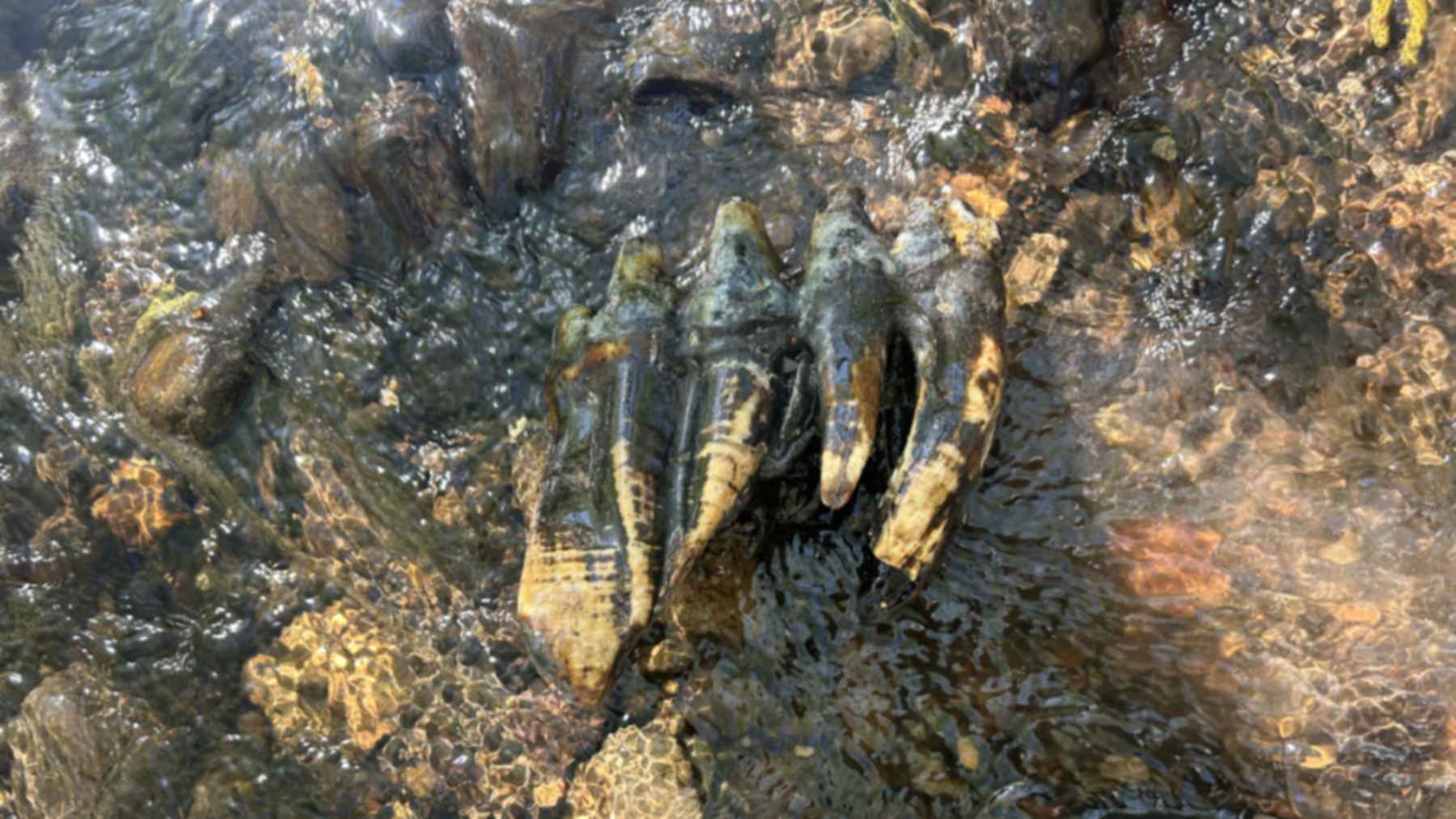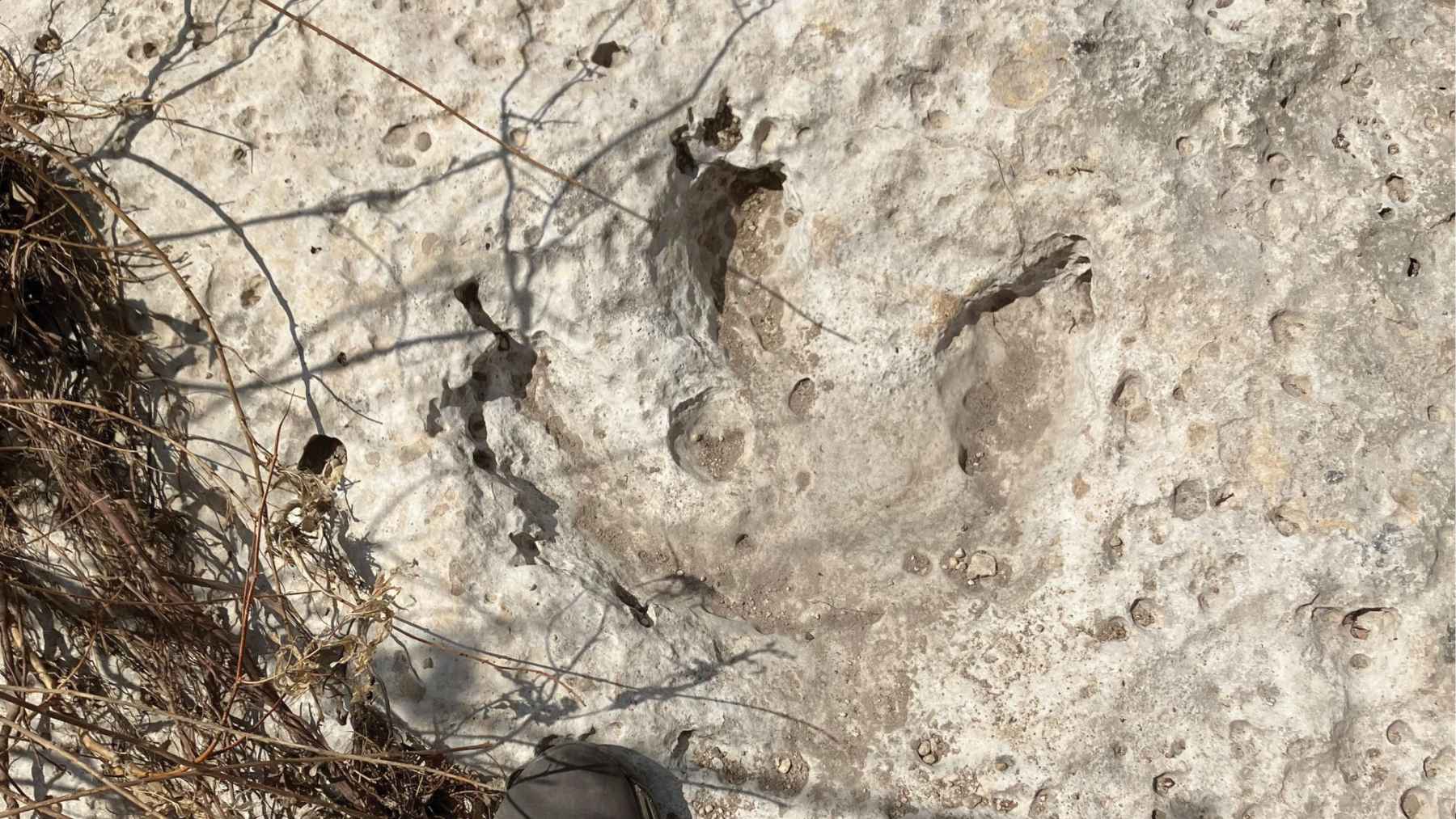
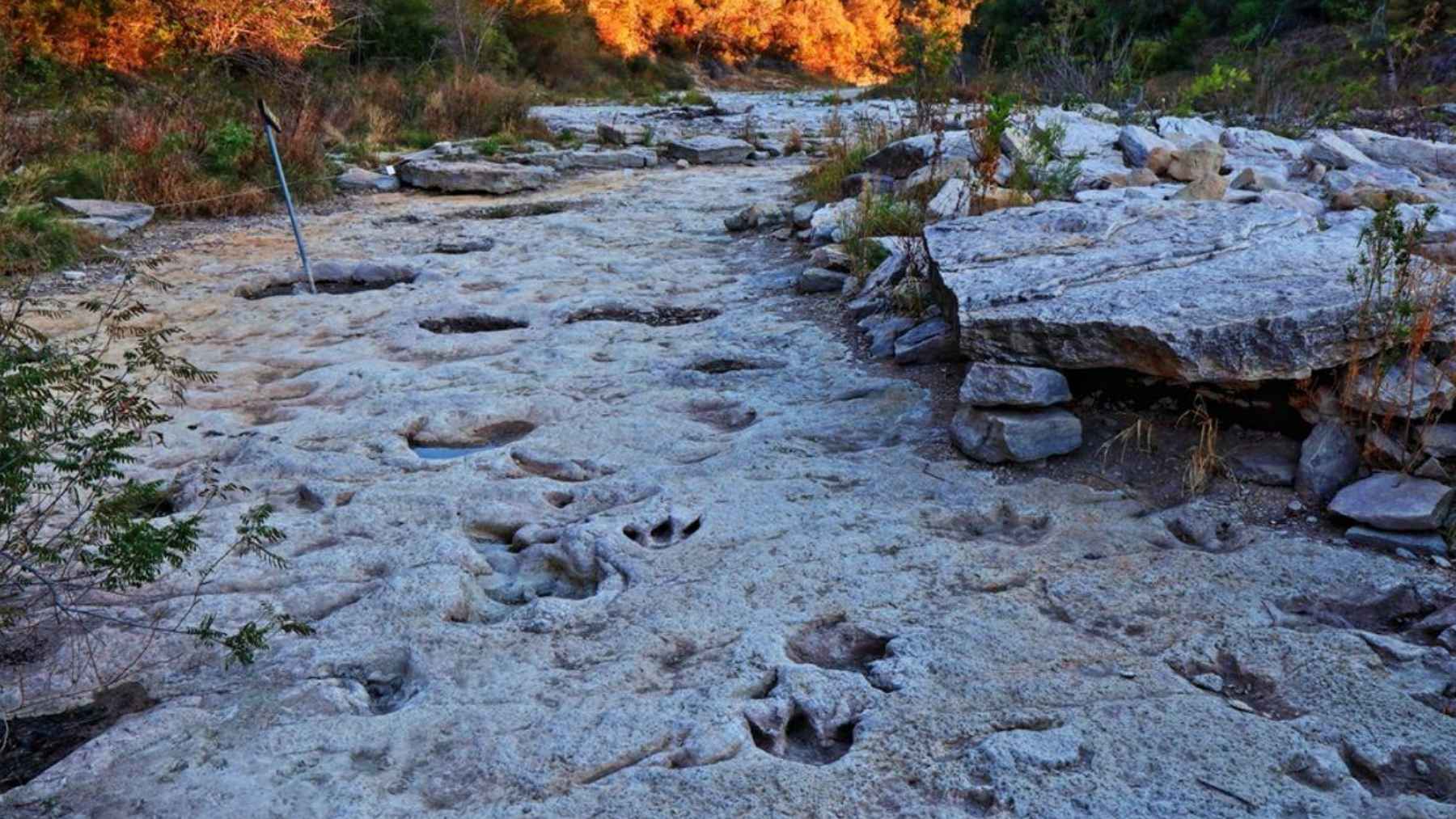
When floodwaters ripped through parts of Central Texas in the summer of 2025, the aftermath looked like you would expect, with mud, debris, and a lot of hard cleanup work. Then a volunteer spotted giant, three-toed impressions in newly exposed limestone that turned out to be dinosaur footprints.
Officials say at least 15 prints have been confirmed so far, each roughly 18 to 20 inches long and preserved in rock that dates back roughly 110 to 115 million years. Researchers want to map and scan the site quickly, because once wind, rain, and heavy equipment move in, fine details can disappear fast. What else might be hiding under creek-bed dirt that seems totally ordinary on a normal day?
Flood cleanup reveals a surprise
The tracks appeared along Sandy Creek after the storms stripped away brush and thin layers of sediment that had covered the rock for decades. It is the same basic process you see when a downpour washes out a patch of soil and exposes roots, except this time the “roots” were marks left by a prehistoric animal.
The discovery also highlights a tricky reality for fossil hunters. Floods and landslides can reveal new sites, but they can also damage them in the same moment, and this site is on private property so details have been kept limited.
How a footprint lasts 110 million years
A fossil footprint is a “trace fossil,” meaning it records an animal’s activity rather than its bones or teeth. In the Early Cretaceous, much of this region sat near the edge of a shallow sea, and dinosaurs walked across soft, lime-rich mud that could hold a clear impression.
If that mud gets buried quickly by more sediment, the imprint can be protected before waves, wind, and other animals destroy it. Over long stretches of time, the layers harden into limestone, turning a temporary footprint into a durable stamp in rock.
Later, waterways carve into those limestone layers and sometimes expose the prints again, including in layers known as the Glen Rose Formation. That exposure can feel sudden after a storm, but it is really geology doing its slow work, then speeding up for a moment when the weather gets extreme.
A likely match for the trackmaker
The newly revealed tracks are the kind usually linked to theropods, the two-legged dinosaurs that walked on three main toes. Based on size and shape, paleontologist Matthew Brown and lab manager Kenneth Bader concluded the prints were probably made by a predator similar to Acrocanthosaurus, which could grow to about 35 feet long.
The same visit also turned up other impressions nearby that may have come from Paluxysaurus, a huge long-necked plant-eater and the official state dinosaur of Texas. If that second ID holds up, it suggests more than one species passed through the area, leaving behind overlapping clues about who shared the landscape.
Still, a footprint rarely comes with a name tag. Scientists often have to match track shapes to the kinds of feet known from skeletons in the same rock layers, and they tend to describe the result in careful terms like “likely” and “possible.”
What scientists want to measure next
The plan now is detailed documentation, not just a quick look. Mapping and 3D imaging can capture the exact layout of the prints, which helps answer practical questions such as whether a single animal crossed the site or several animals moved through at different times.
This kind of digital record has become a safety net for paleontology. A 2014 photogrammetry study in the journal PLOS ONE showed that researchers could rebuild a famous Texas track site from old photographs, creating a 3D model even after parts of the original rock had been removed or damaged.
Why these tracks matter beyond curiosity
Fossil bones tell you what an animal looked like, but footprints can hint at how it behaved. Spacing and direction can suggest how fast something was moving, whether it changed course, and whether different animals might have crossed the same patch of mud within a short window of time.
Ron Tykoski, a curator of vertebrate paleontology at the Perot Museum of Nature and Science, called the Sandy Creek find “another data point” that helps flesh out what these animals were like and how they lived. The irony is hard to miss, because the same flood that exposed the prints also sent the normally dry creek surging to about 20 feet and tearing through whatever stood in its way.
Texas rivers keep revealing dinosaur history
Texas already has famous places where you can stand near fossil tracks, including Dinosaur Valley State Park, where prints can show up in the Paluxy River bed when conditions are right.
The Texas Parks and Wildlife Department warns visitors that the tracks are not always visible, because water levels and weather can cover them again.
Extreme dryness can do the same kind of unveiling. During the summer 2023 drought, low water revealed tracks in the same park that are usually buried under mud and silt, and volunteers counted roughly 75 newly exposed footprints at the time.
Taken together, the drought story and the flood story point to the same lesson. The landscape is constantly reshaped, and sometimes that reshaping briefly opens a window into deep time before it closes again.
The main official press release has been published by the Jackson School of Geosciences at the University of Texas at Austin.