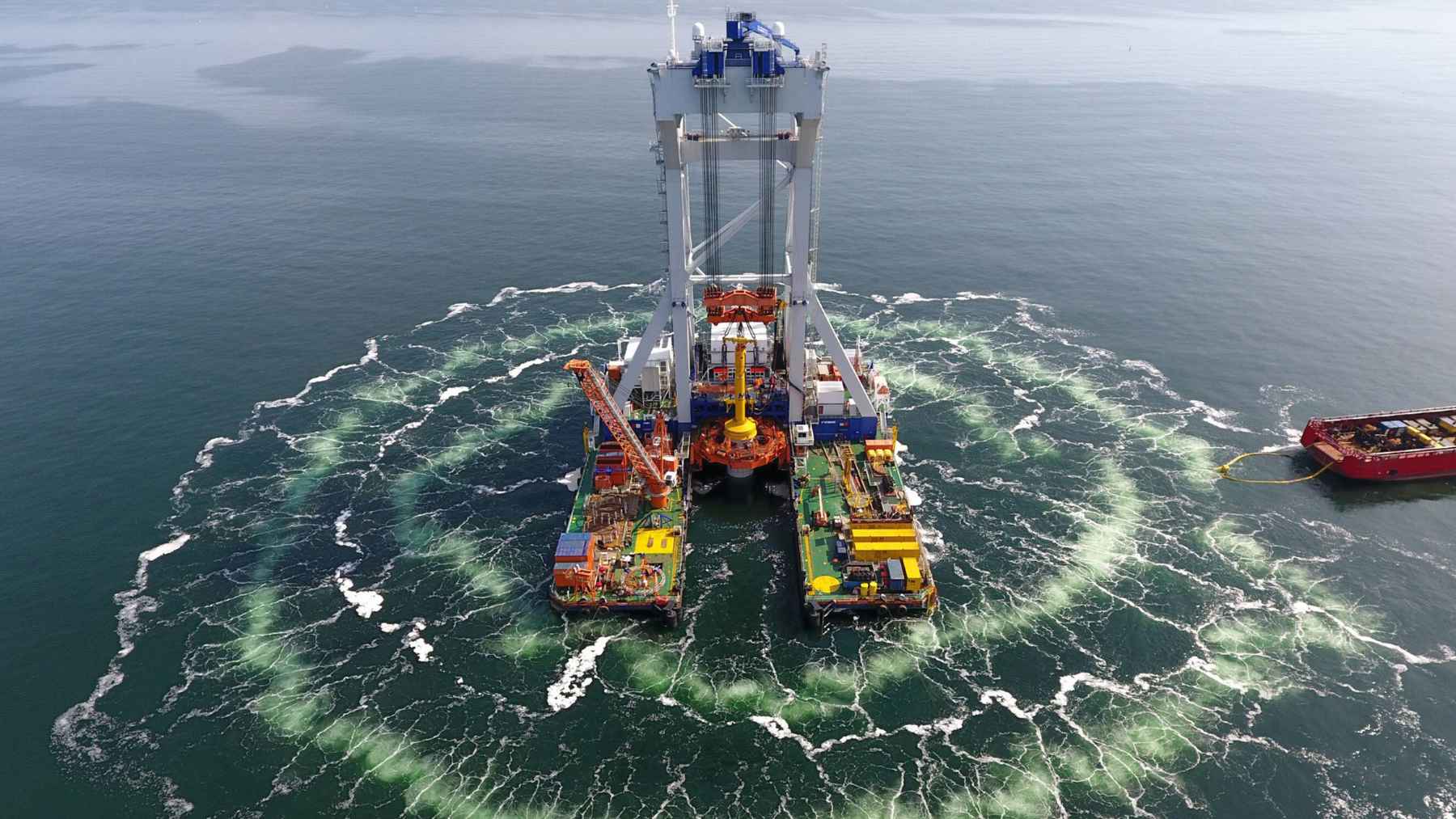
This is a 2.6-gigawatt project that was completed in October 2025 and acoustic measurements show that the idea worked best at longer distances and above 200 hertz.
Why hammering steel into the ocean is so disruptive
Hammering is really dangerous and risky because whales, dolphins, sea turtles and many fish depend a lot on sound to orient themselves. The noise of the hammering can mask the signals they use to communicate with one another, scare them away from their usual routes, or even force them to move from their feeding areas.
It is so severe that if the exposure is that high, it can cause physical injuries or temporary hearing problems. And all this is because, during impact pile driving, the hammers repeatedly hit the steel cylinder until driving it to the needed depth. It is like that sound bounces between the surface and the bottom.
What the hydrophones actually measured
Scientists compared a driven tower with a double bubble curtain against another installed without any kind of protection, using aquatic microphones that were placed about 3 and 7,5 kilometers away.
The study revealed that the curtains were more effective at long distances and in higher frequencies over 200 Hz. However, scientists clarified that there is no magic number of decibels that can be applied to all the installations of the world, since each sea area behaves in a different way.
The seafloor exposed a major blind spot
Bubbles can stop the sound moving through water because they create a sudden change where the pressure wave passes. Part of that same acoustic energy bounces, it scattered, or it is absorbed, weakening the noise on the other side of the curtain. But the bubbles that float to the surface cannot form the same barrier inside the compact sand and sediment at the bottom of the sea.
The revealing measurements done with the soil sensors (known as geophones) confirmed the consequences. The energy that entered the seabed, traveled outside in the form of earth waves and passed without being stopped through the bubbles screens. This allows us to see that there exists a second exposure route for the animals that detect the particle movement near the sea bottom–something that aquatic microphones cannot fully measure.
A useful shield, not a complete solution
Coastal Virginia Offshore Wind is really advanced and was able to deliver its first commercial power to the grid in March 2026, while turbine construction is still happening. The double curtain is still a protective measure very useful because it stops part of the noise inside the water and limits the impact of the strongest hammer strikes. Still, the bubble-ring data has a “message” for offshore wind developers. The results clearly show that the water and the bottom of the sea need to be controlled and monitored with different (and special) instruments –the use of one tool cannot measure or control two totally different paths.
It is clear now that, in order to protect marine life, the acoustic environments should be treated differently,instead of assuming that a simple air wall can stop everything.